City
of hobart
AGENDA
Planning Committee Meeting
 Open Portion
Wednesday, 11 September 2024
at 5.00 pm
Council Chamber, Town Hall
City
of hobart
AGENDA
Planning Committee Meeting
Open Portion
Wednesday, 11 September 2024
at 5.00 pm
Council Chamber, Town Hall
Working together to make Hobart a better place for the community.
THE VALUES
The Council is:
|
People |
We care about people – our community, our customers and colleagues. |
|
Teamwork |
We collaborate both within the organisation and with external stakeholders drawing on skills and expertise for the benefit of our community. |
|
Focus and Direction |
We have clear goals and plans to achieve sustainable social, environmental and economic outcomes for the Hobart community. |
|
Creativity and Innovation |
We embrace new approaches and continuously improve to achieve better outcomes for our community. |
|
Accountability |
We are transparent, work to high ethical and professional standards and are accountable for delivering outcomes for our community. |
|
|
Agenda (Open Portion) Planning Committee Meeting |
Page 3 |
|
|
11/9/2024 |
|
Business listed on the agenda is to be conducted in the order in which it is set out, unless the committee by simple majority determines otherwise.
APOLOGIES AND LEAVE OF ABSENCE
2. Consideration of Supplementary Items
3. Indications of Pecuniary and Conflicts of Interest
5. Planning Authority Items - Consideration of Items With Deputations
6. Committee Acting as Planning Authority
6.1 Applications under the Hobart Interim Planning Scheme 2015
7.2 Delegated Decision Report (Planning)
7.3 Planning - Advertised Applications Report
9. Closed Portion Of The Meeting
|
|
Agenda (Open Portion) Planning Committee Meeting |
Page 5 |
|
|
11/9/2024 |
|
Planning Committee Meeting (Open Portion) held Wednesday, 11 September 2024 at 5.00 pm in the Council Chamber, Town Hall.
The title Chief Executive Officer is a term of reference for the General Manager as appointed by Council pursuant s.61 of the Local Government Act 1993 (Tas).
|
COMMITTEE MEMBERS Councillor M Dutta (Chairperson) Lord Mayor Councillor A M Reynolds Deputy Lord Mayor Cr Dr Z Sherlock Alderman M Zucco Councillor W F Harvey Councillor J Kelly Councillor L Elliot Alderman L Bloomfield Councillor R Posselt Councillor B Lohberger Councillor W Coats Councillor G Kitsos |
Apologies:
Leave of Absence: Nil.
|
|
The minutes of the Open Portion of the Planning Committee meeting held on Wednesday, 28 August 2024, are submitted for confirming as an accurate record.
|
Ref: Part 2, Regulation 8(6) of the Local Government (Meeting Procedures) Regulations 2015.
|
That the Committee resolve to deal with any supplementary items not appearing on the agenda, as reported by the Chief Executive Officer.
|
Ref: Part 2, Regulation 8(7) of the Local Government (Meeting Procedures) Regulations 2015.
Members of the Committee are requested to indicate where they may have any pecuniary or conflict of interest in respect to any matter appearing on the agenda, or any supplementary item to the agenda, which the Committee has resolved to deal with.
Regulation 15 of the Local Government (Meeting Procedures) Regulations 2015.
A Committee may close a part of a meeting to the public where a matter to be discussed falls within 15(2) of the above regulations.
In the event that the Committee transfer an item to the closed portion, the reasons for doing so should be stated.
Are there any items which should be transferred from this agenda to the closed portion of the agenda, or from the closed to the open portion of the agenda?
In accordance with the requirements of Part 2 Regulation 8(3) of the Local Government (Meeting Procedures) Regulations 2015, the Chief Executive Officer is to arrange the agenda so that the planning authority items are sequential.
In accordance with Part 2 Regulation 8(4) of the Local Government (Meeting Procedures) Regulations 2015, the Committee by simple majority may change the order of any of the items listed on the agenda, but in the case of planning items they must still be considered sequentially – in other words they still have to be dealt with as a single group on the agenda.
Where deputations are to be received in respect to planning items, past practice has been to move consideration of these items to the beginning of the meeting.
RECOMMENDATION
That in accordance with Regulation 8(4) of the Local Government (Meeting Procedures) Regulations 2015, the Committee resolve to deal with any items which have deputations by members of the public regarding any planning matter listed on the agenda, to be taken out of sequence in order to deal with deputations at the beginning of the meeting.
In accordance with the provisions of Part 2 Regulation 25 of the Local Government (Meeting Procedures) Regulations 2015, the intention of the Committee to act as a planning authority pursuant to the Land Use Planning and Approvals Act 1993 is to be noted.
In accordance with Regulation 25, the Committee will act as a planning authority in respect to those matters appearing under this heading on the agenda, inclusive of any supplementary items.
The Committee is reminded that in order to comply with Regulation 25(2), the Chief Executive Officer is to ensure that the reasons for a decision by a Council or Council Committee acting as a planning authority are recorded in the minutes.
|
Agenda (Open Portion) Planning Committee Meeting |
Page 7 |
|
|
|
11/9/2024 |
|
6.1 Applications under the Hobart Interim Planning Scheme 2015
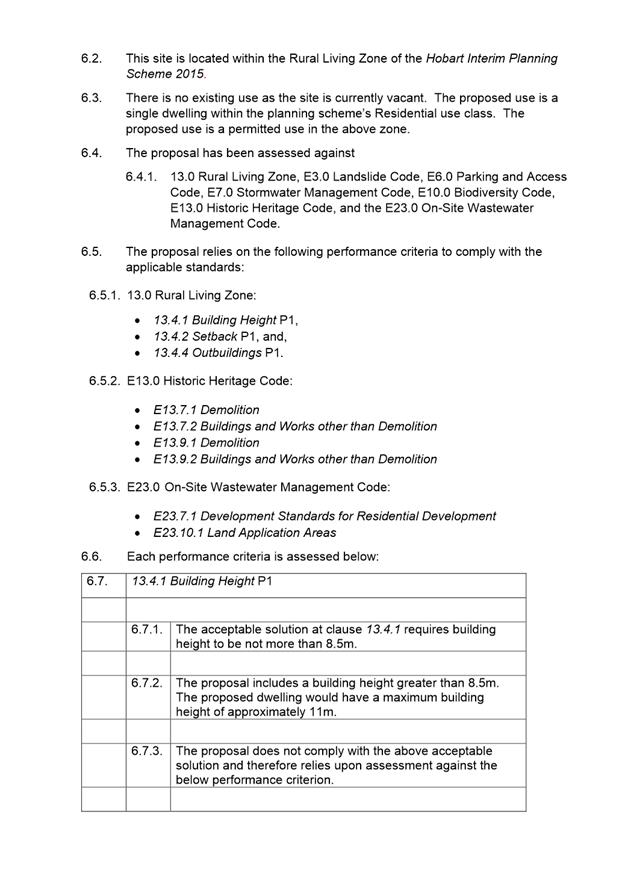
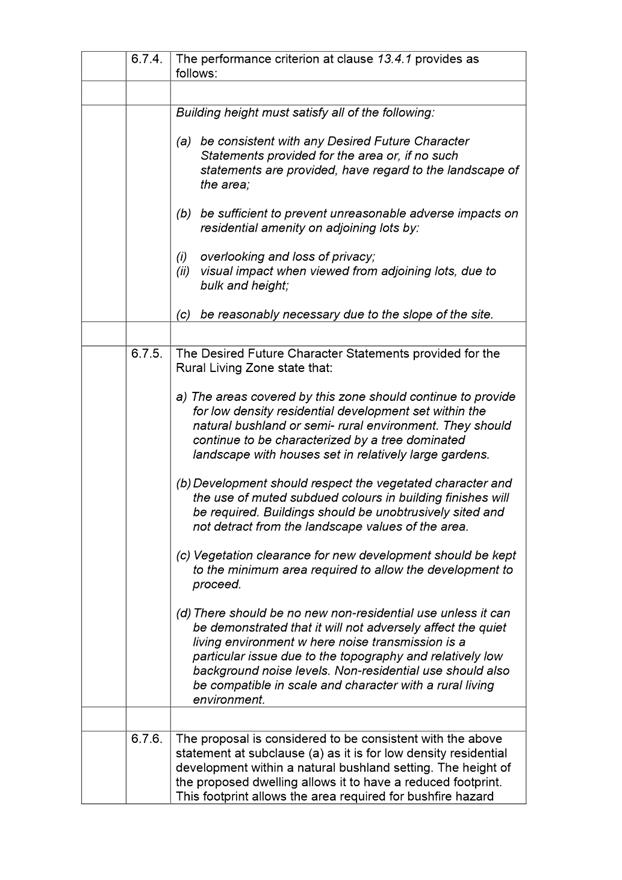
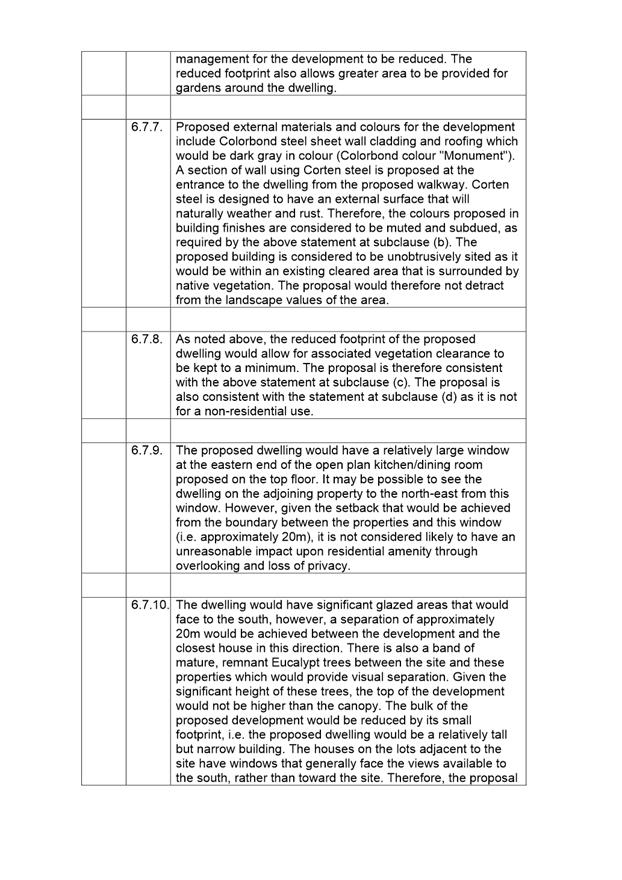
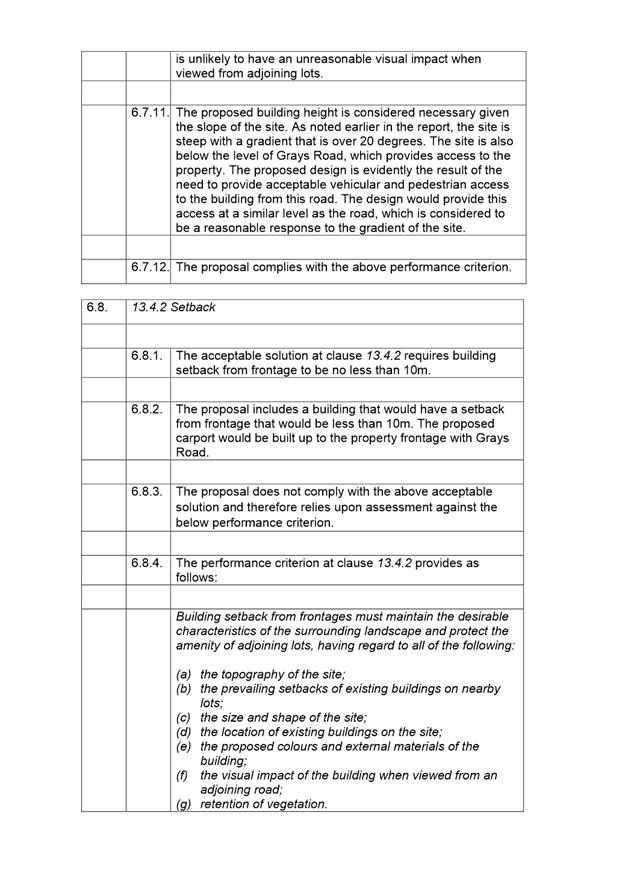
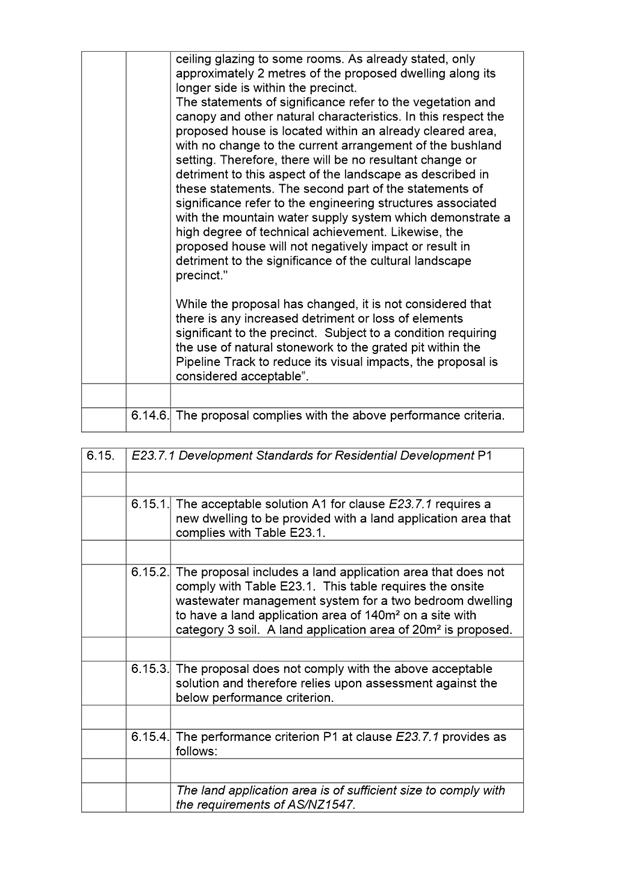
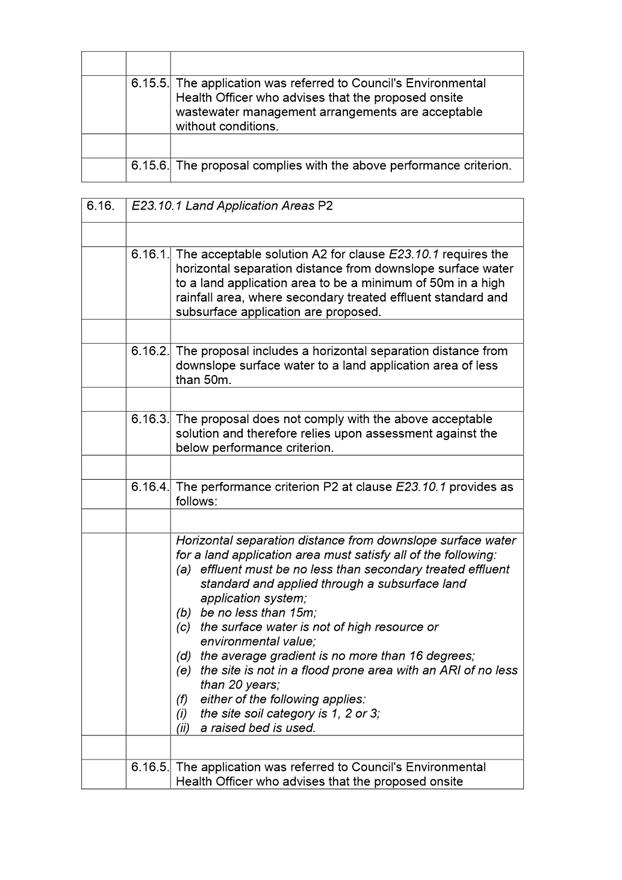
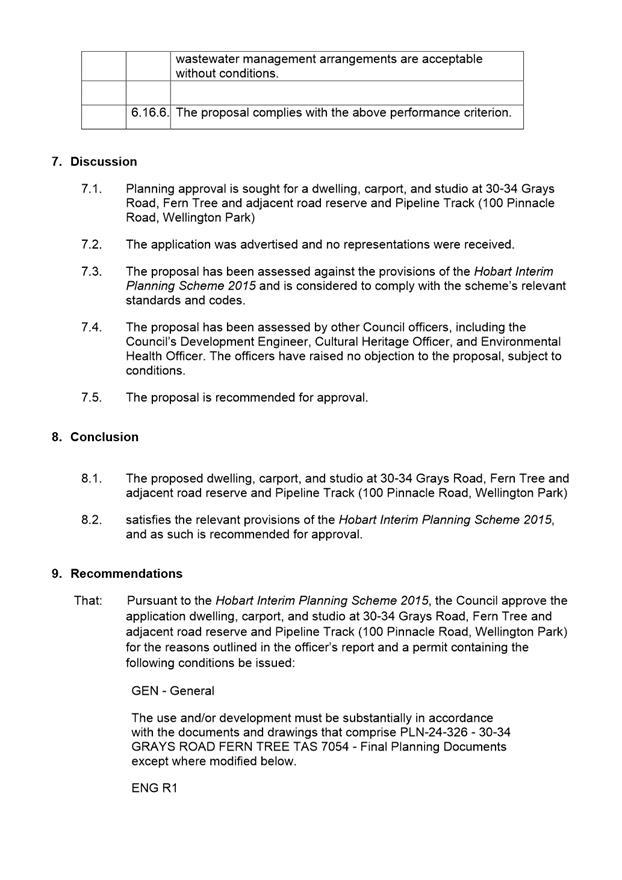
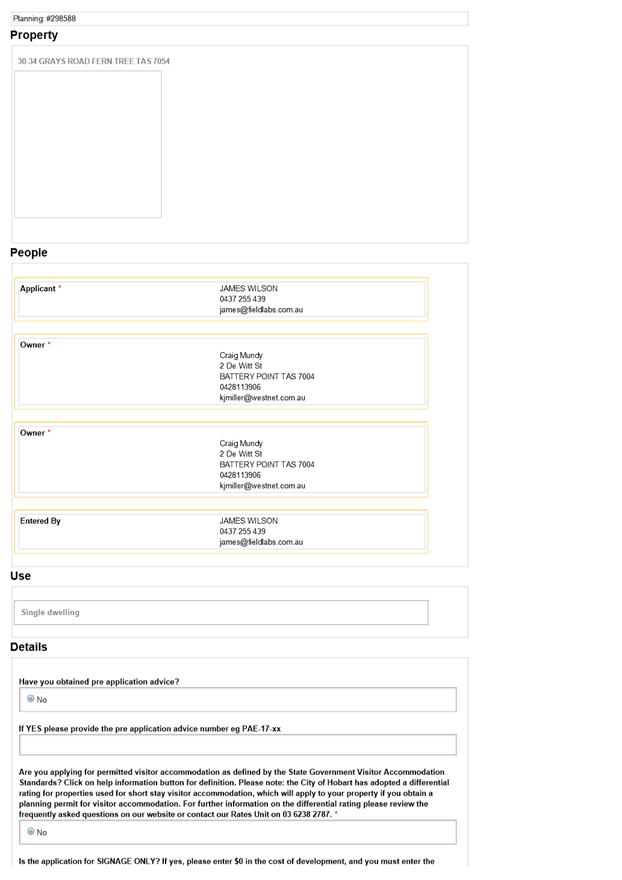
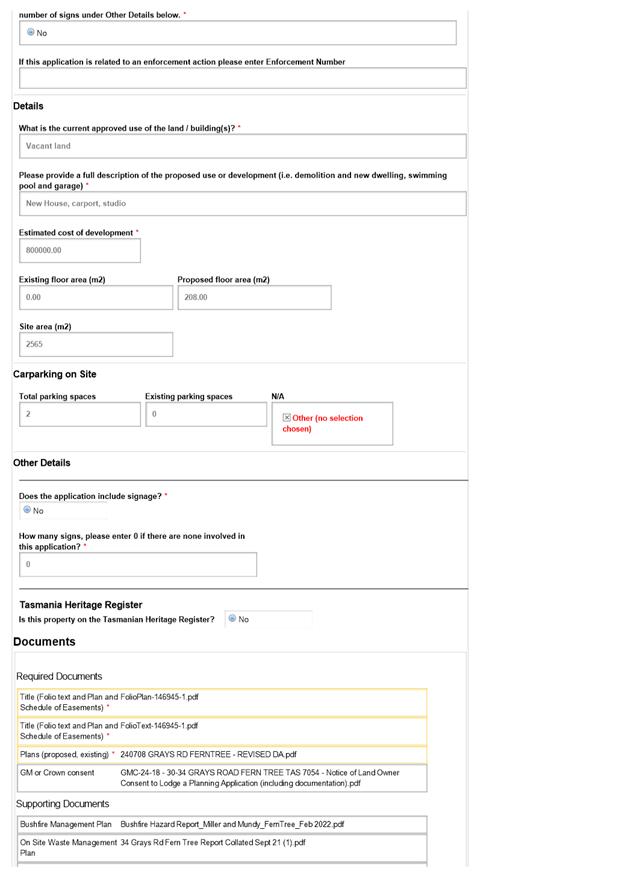
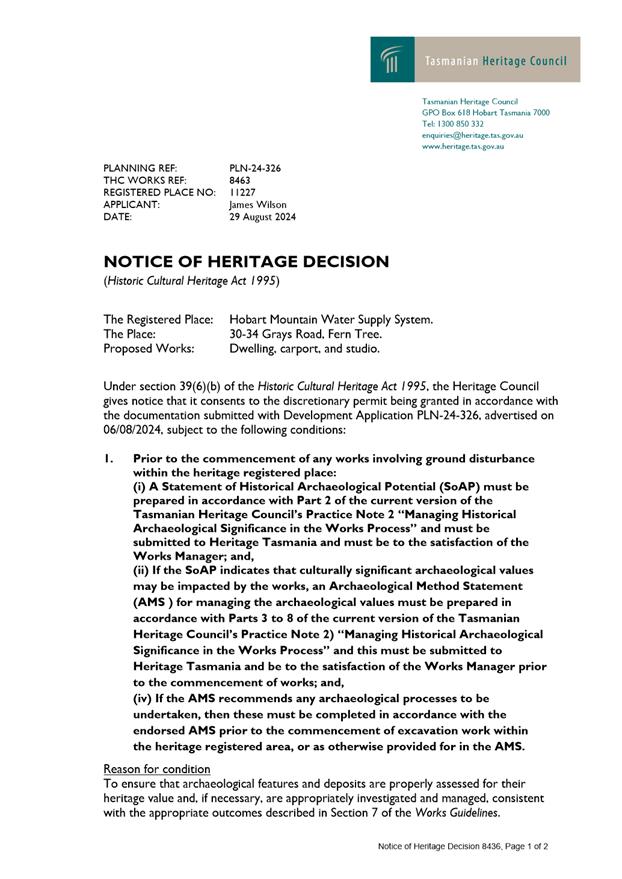
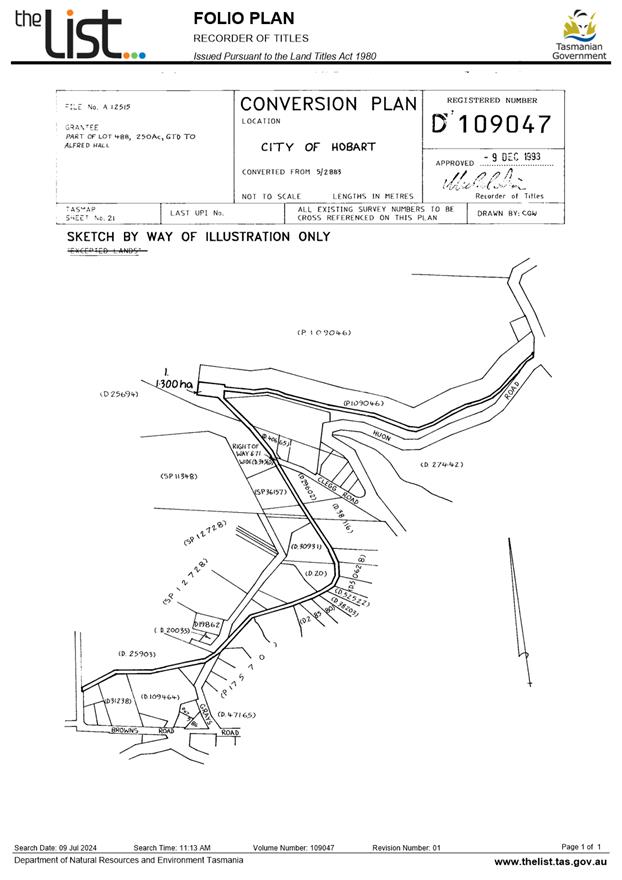
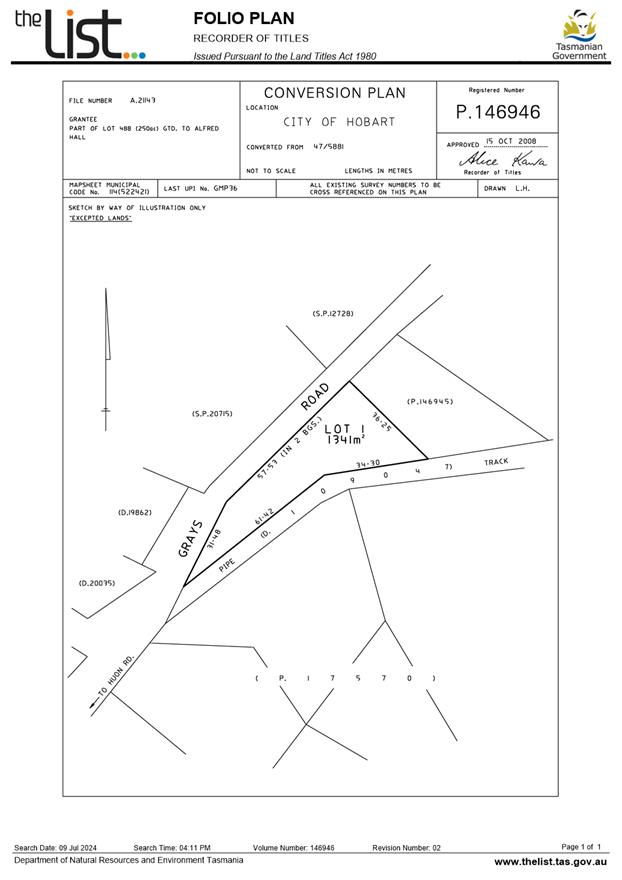
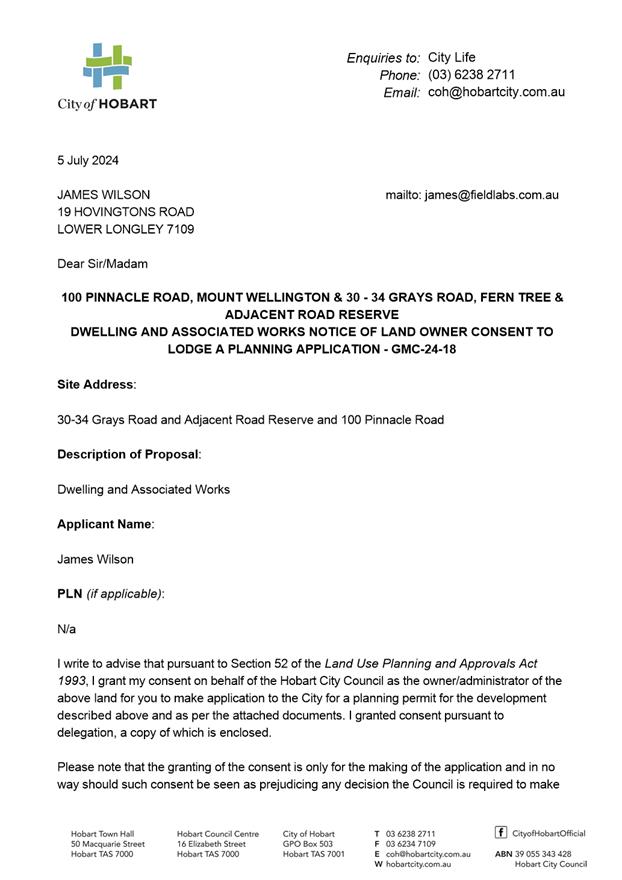
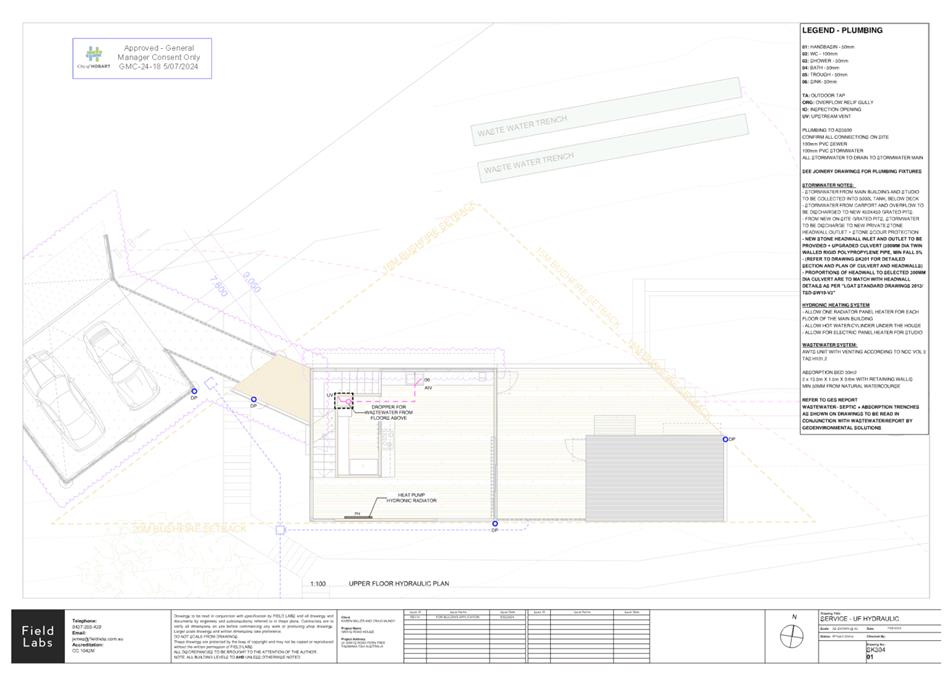
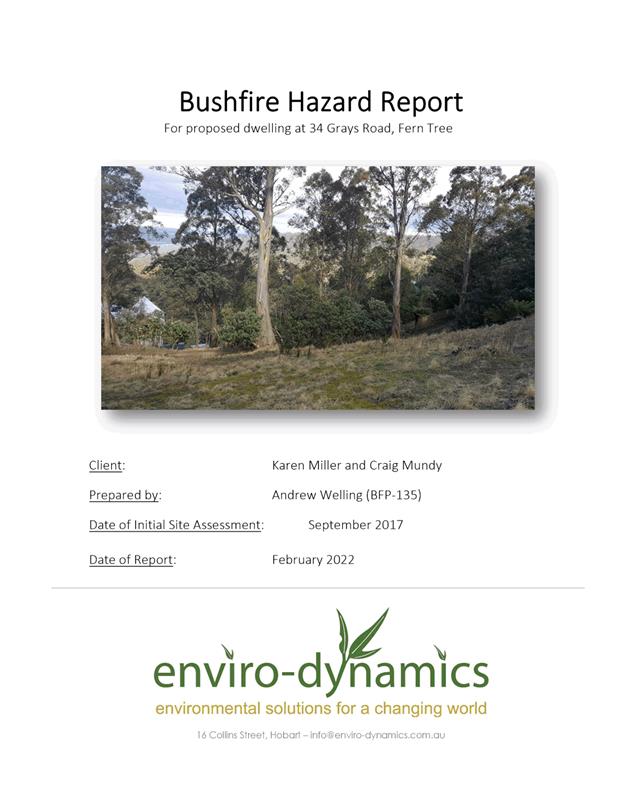
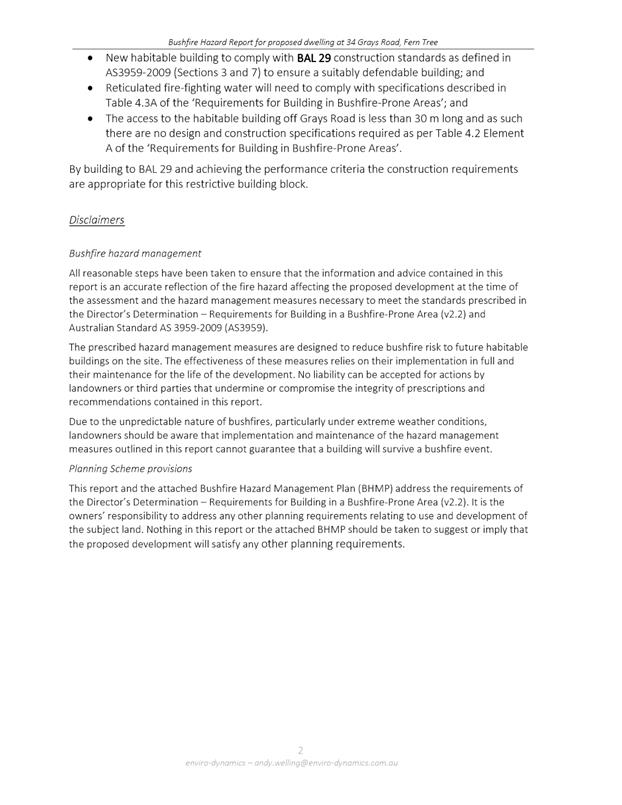
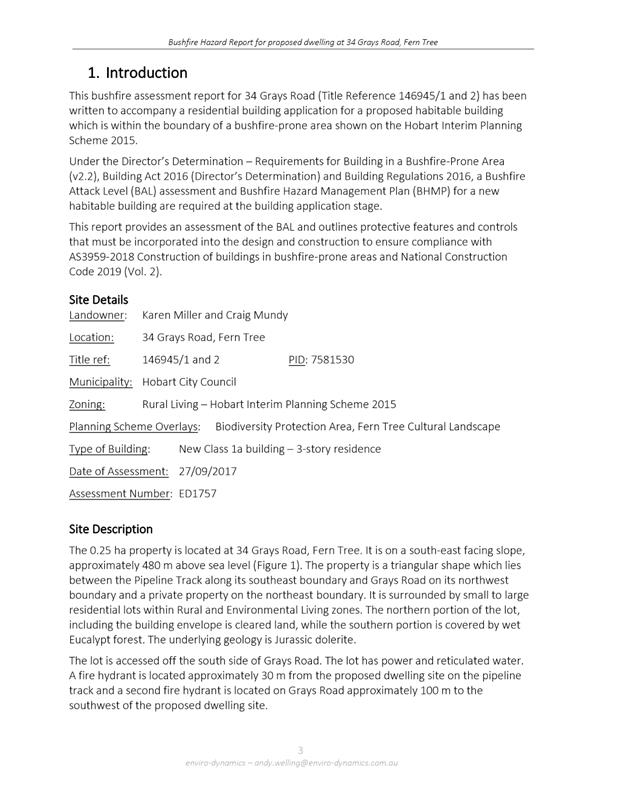
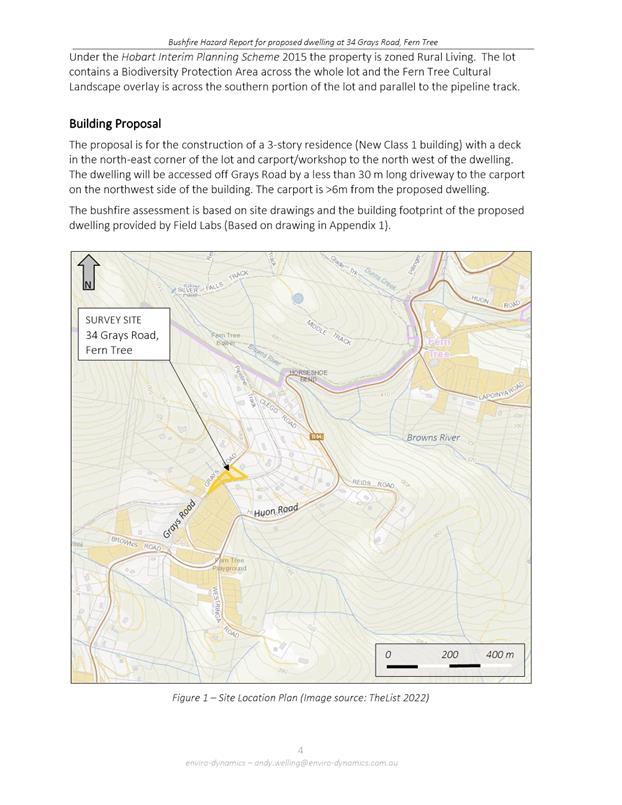
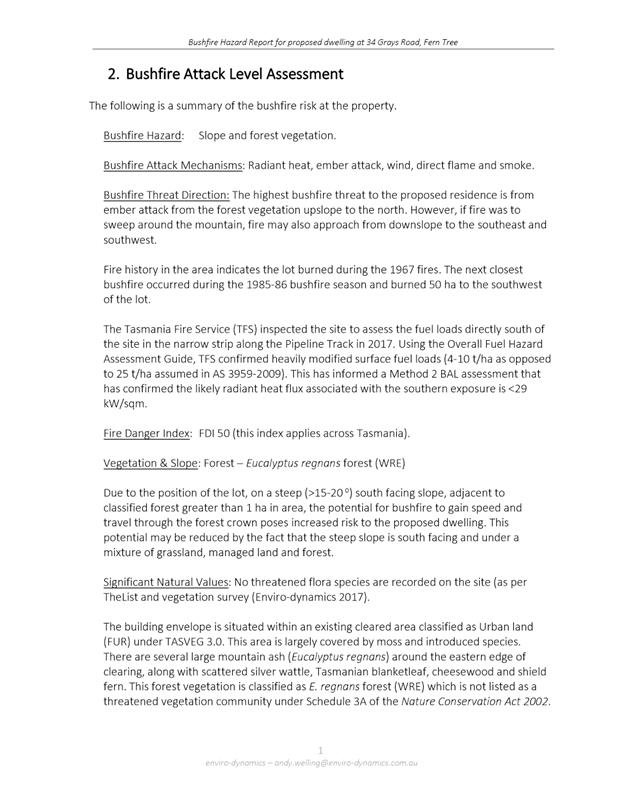
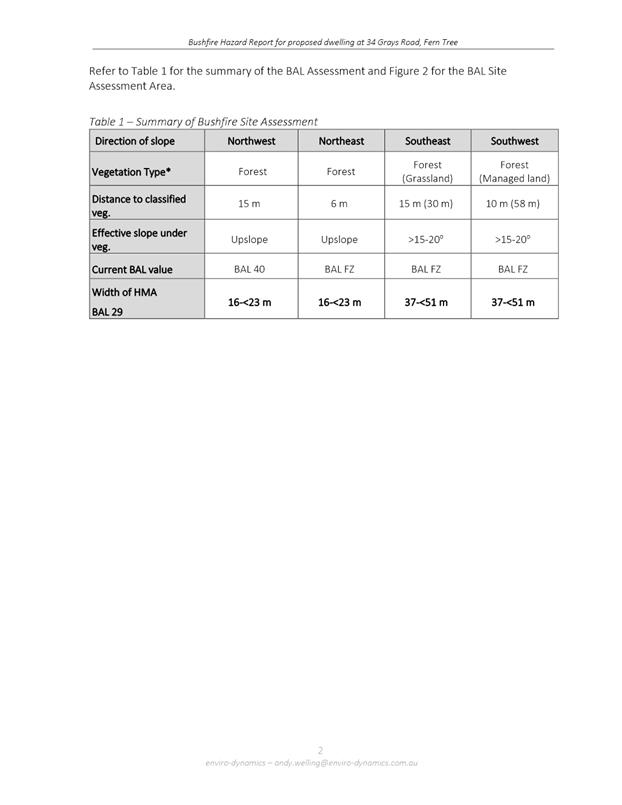
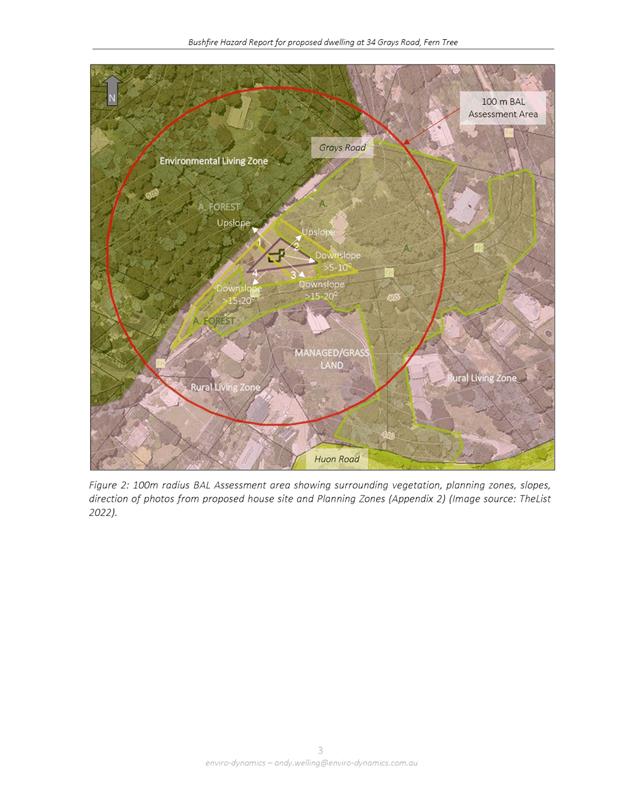
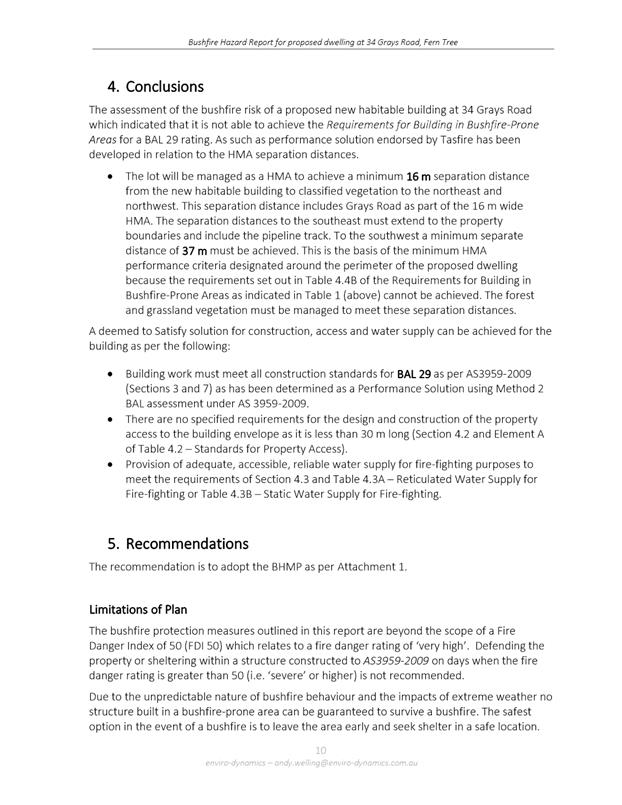
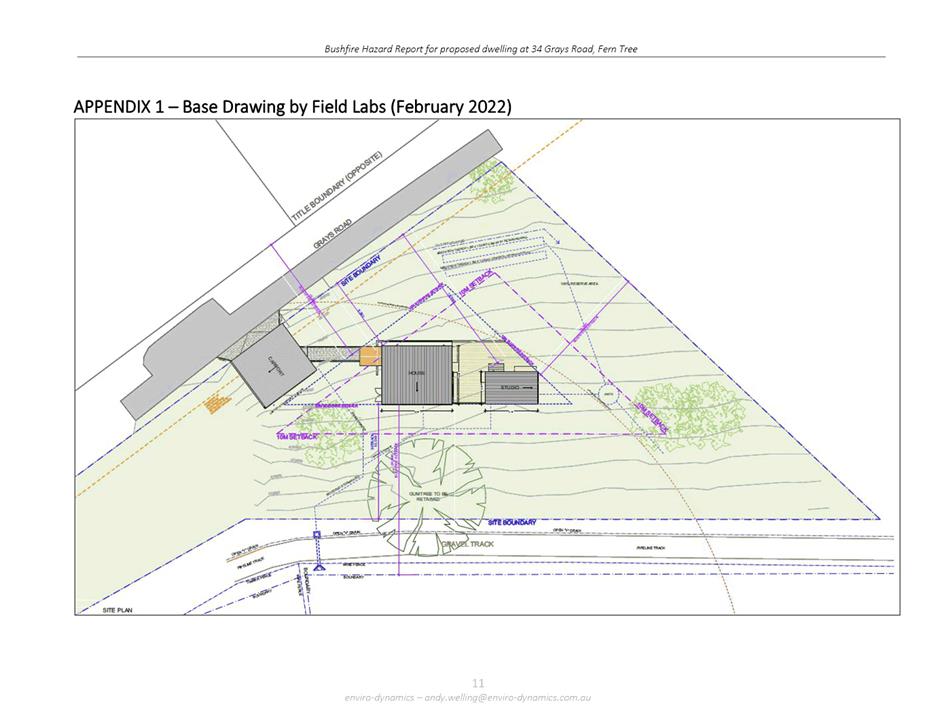
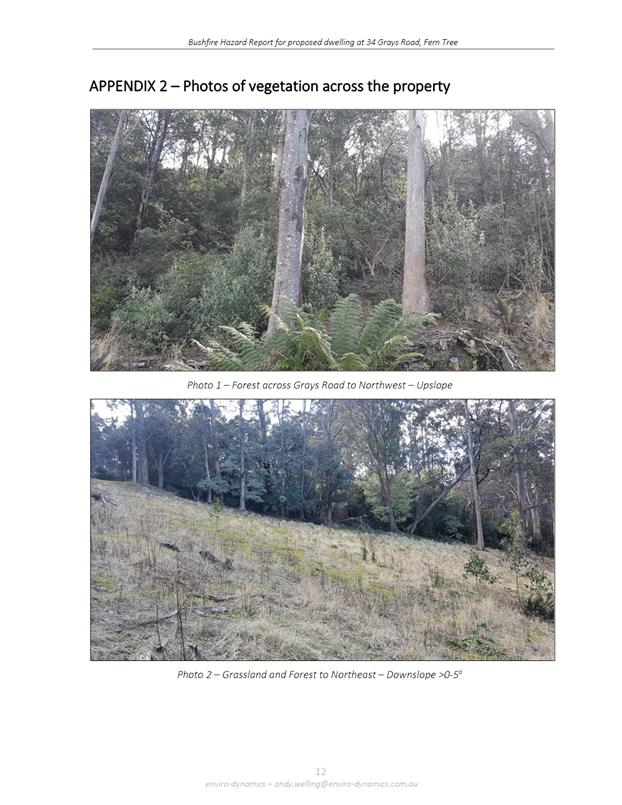
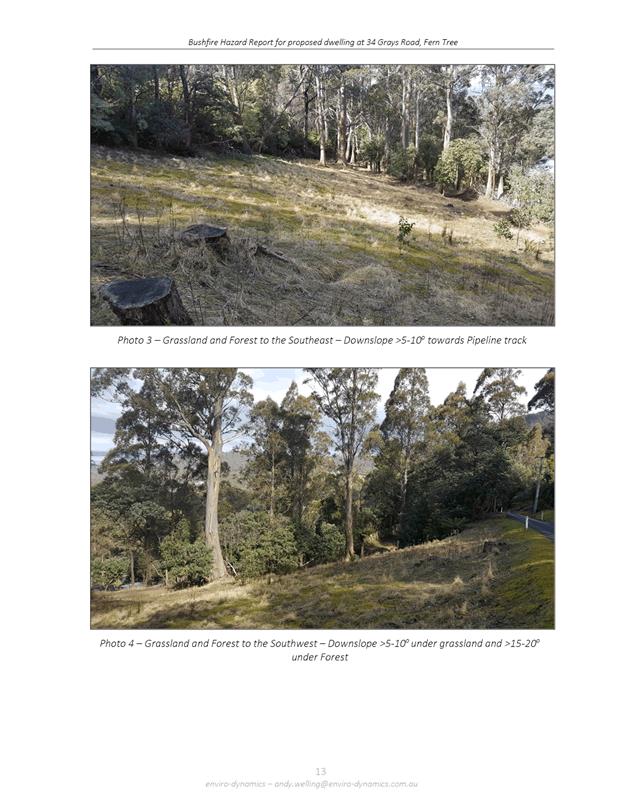
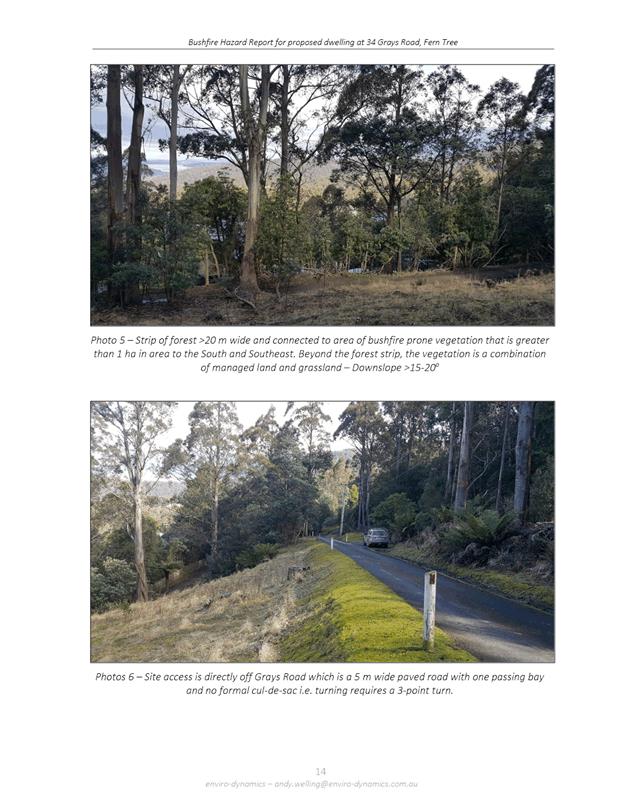
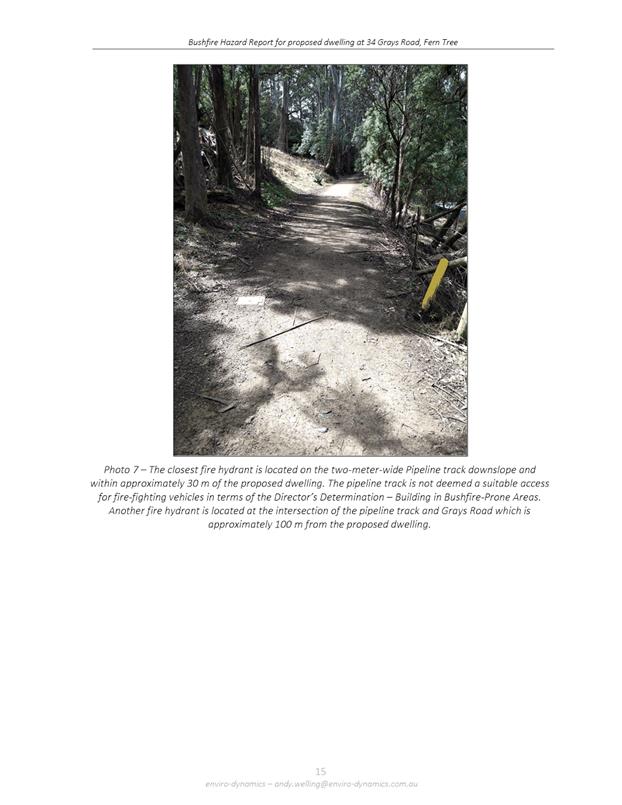
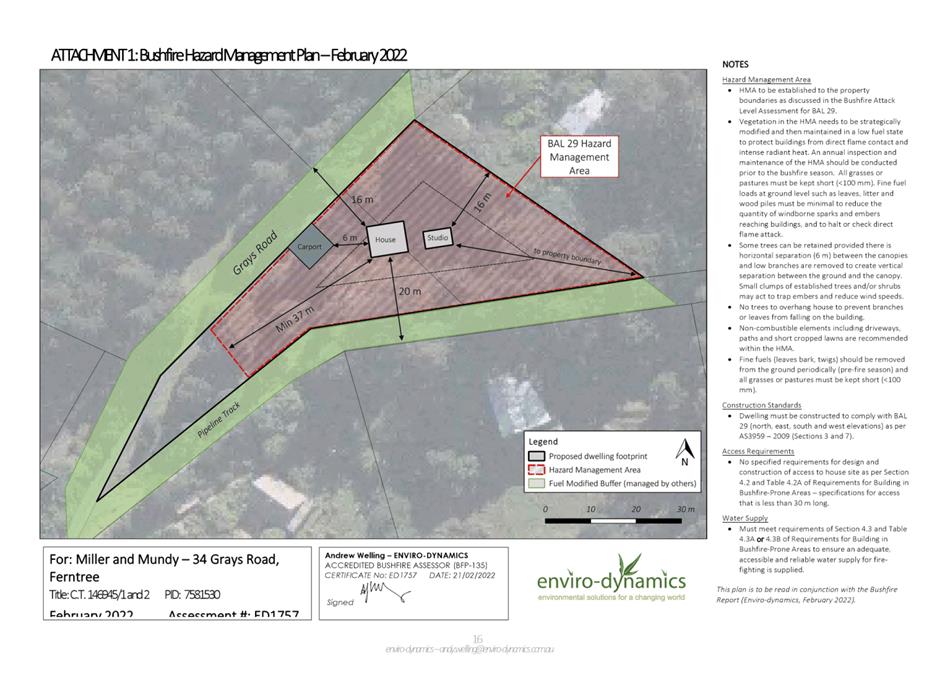
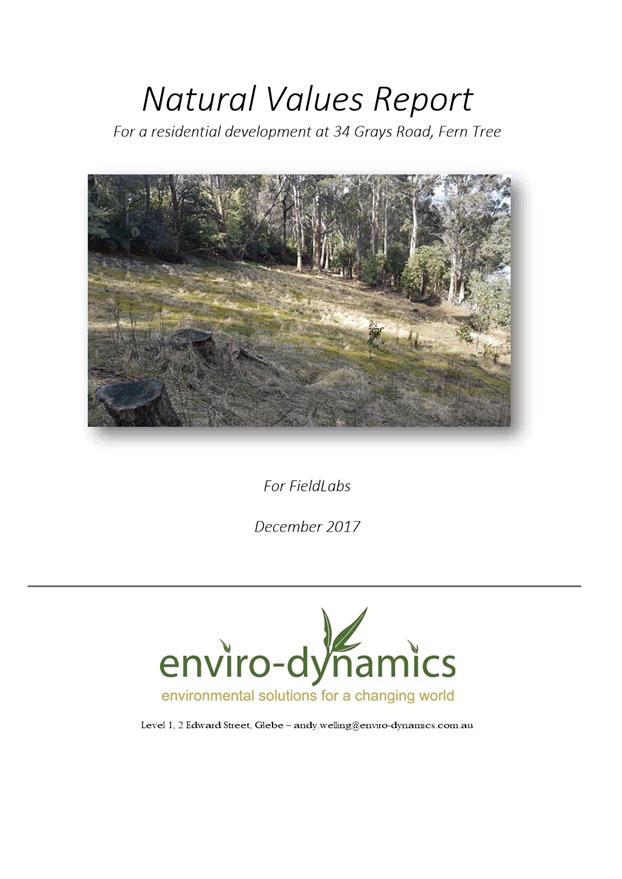
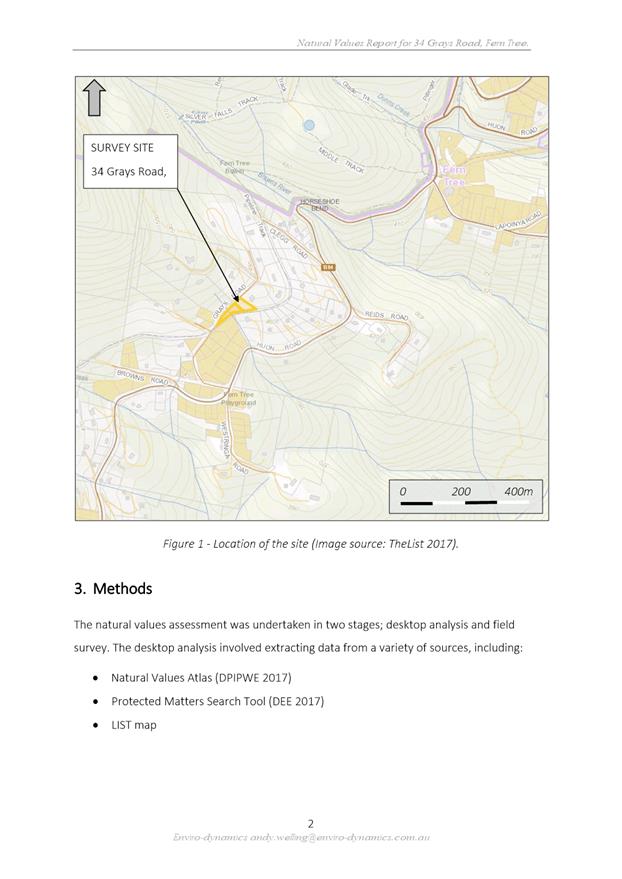
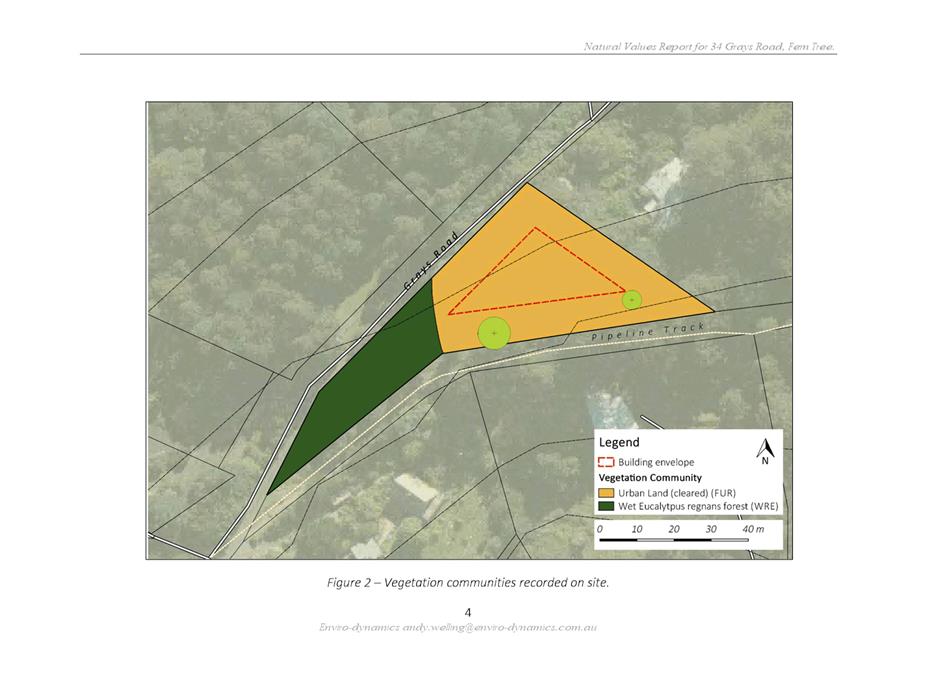
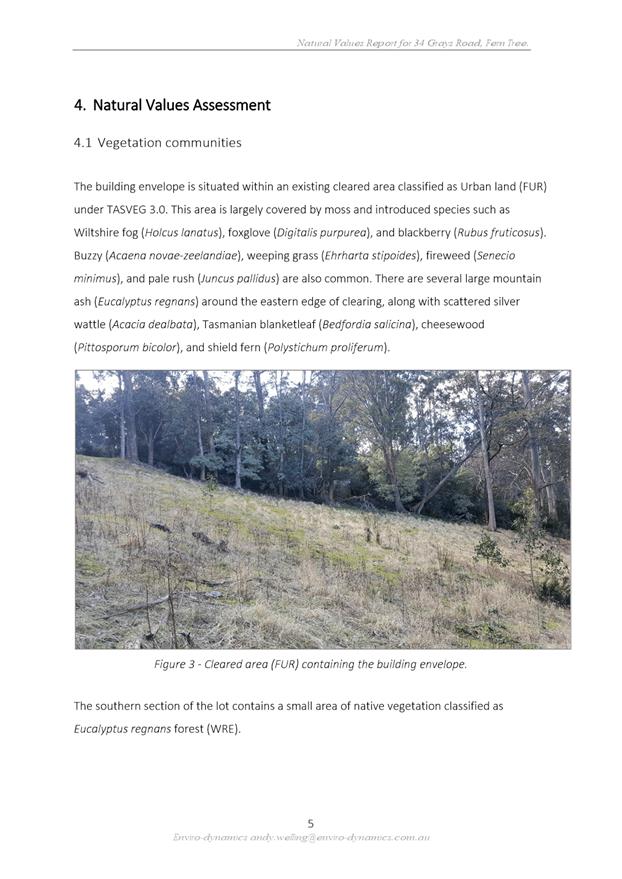
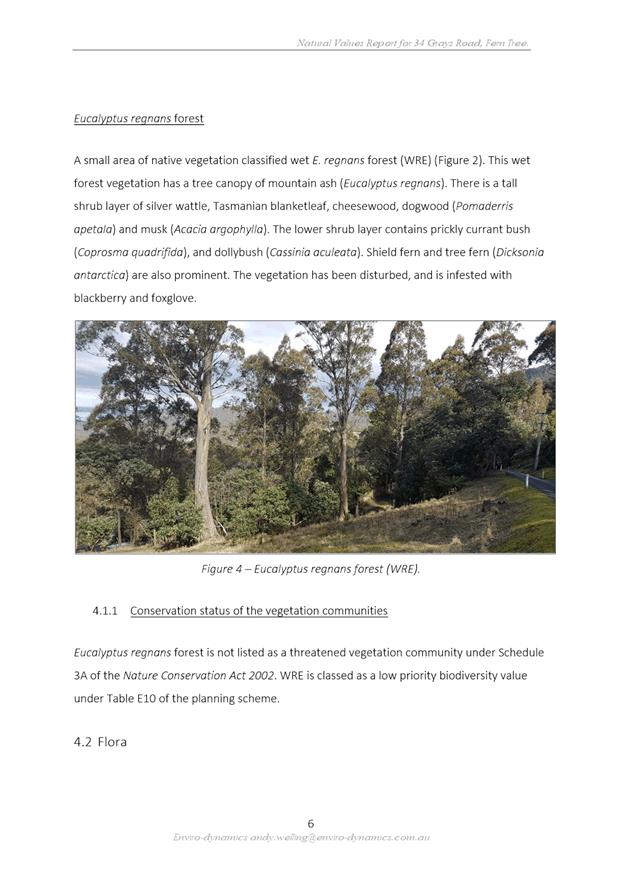
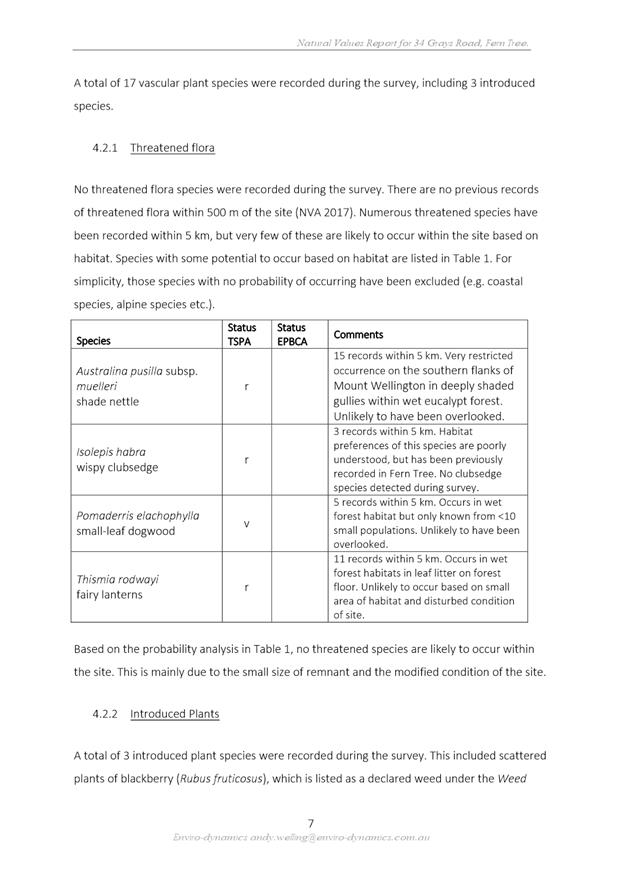
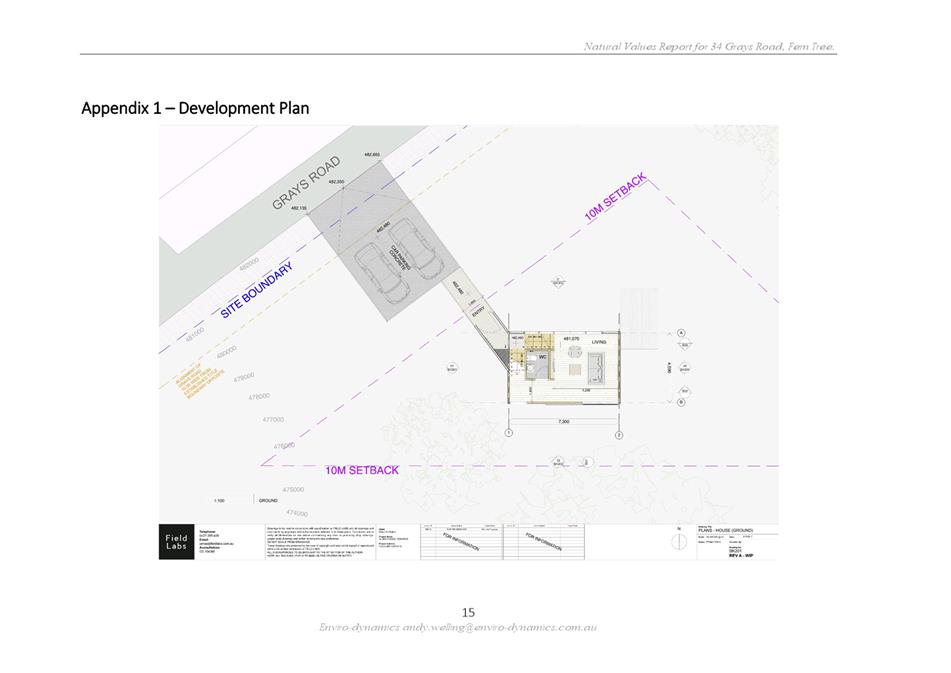
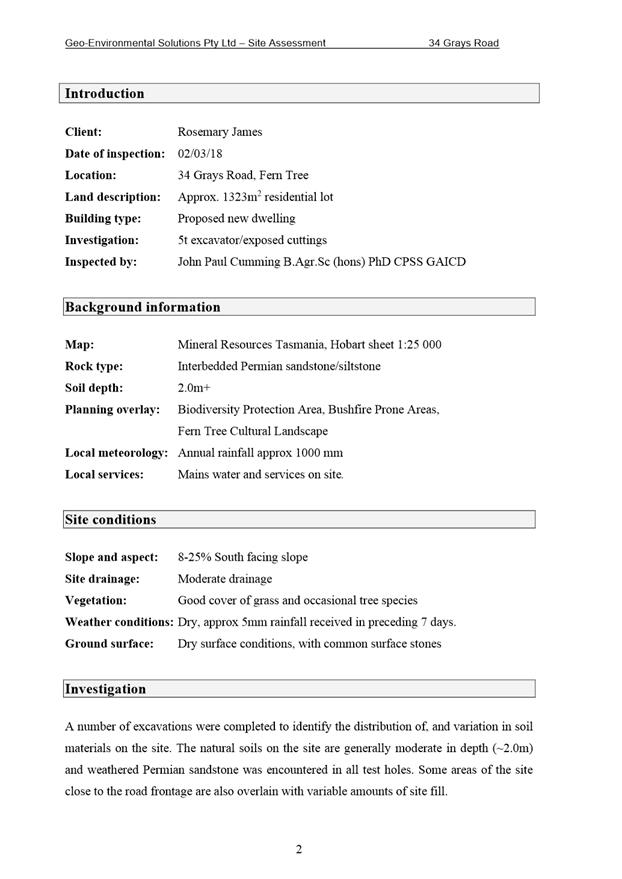
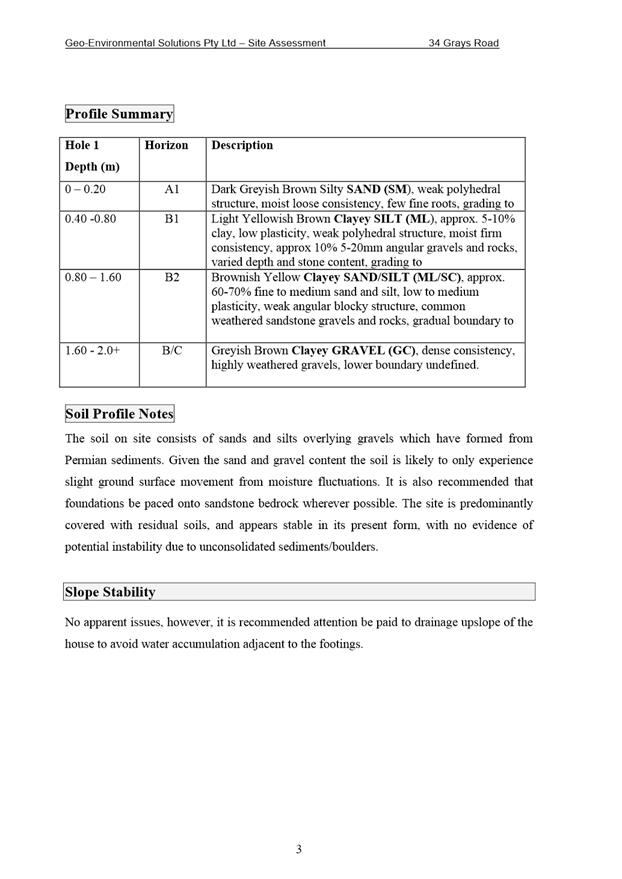
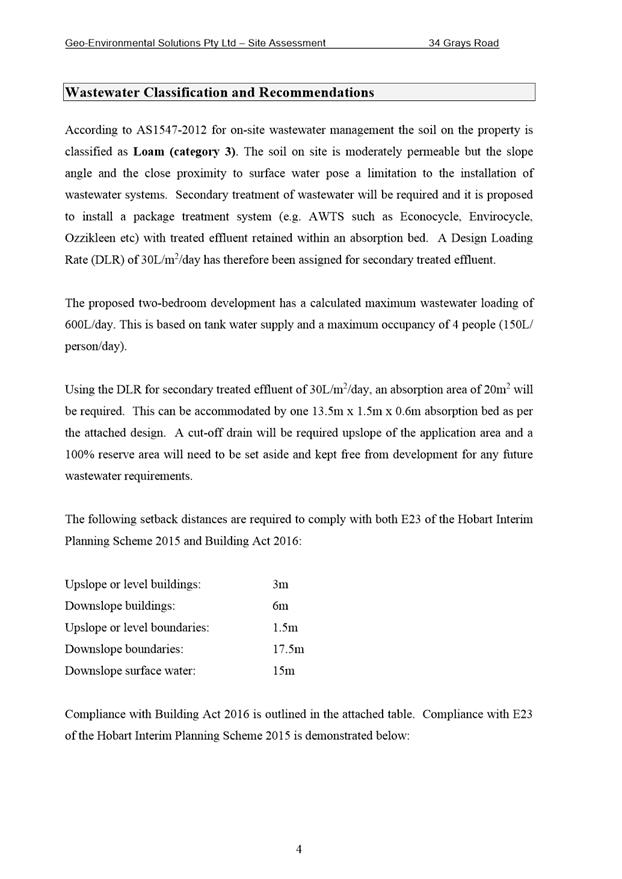
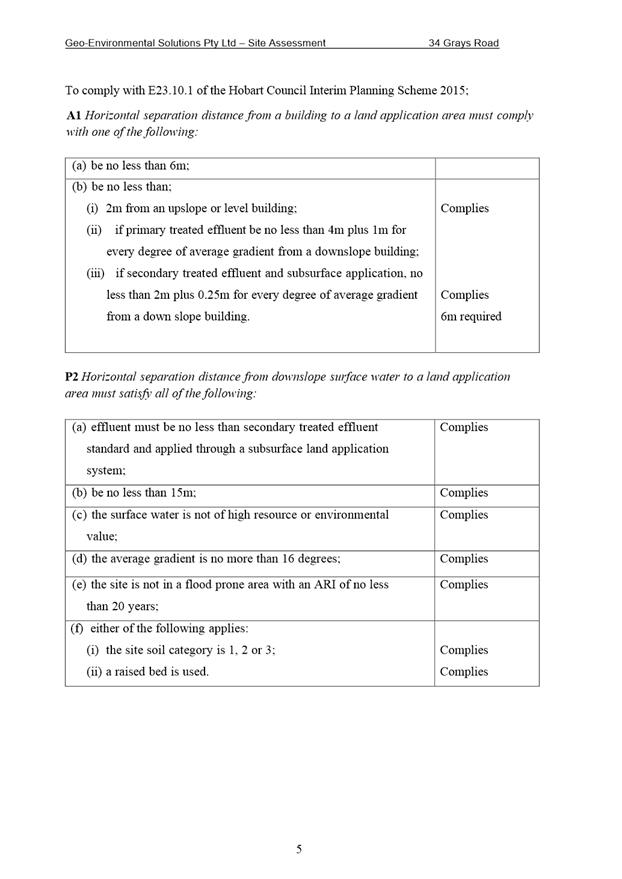
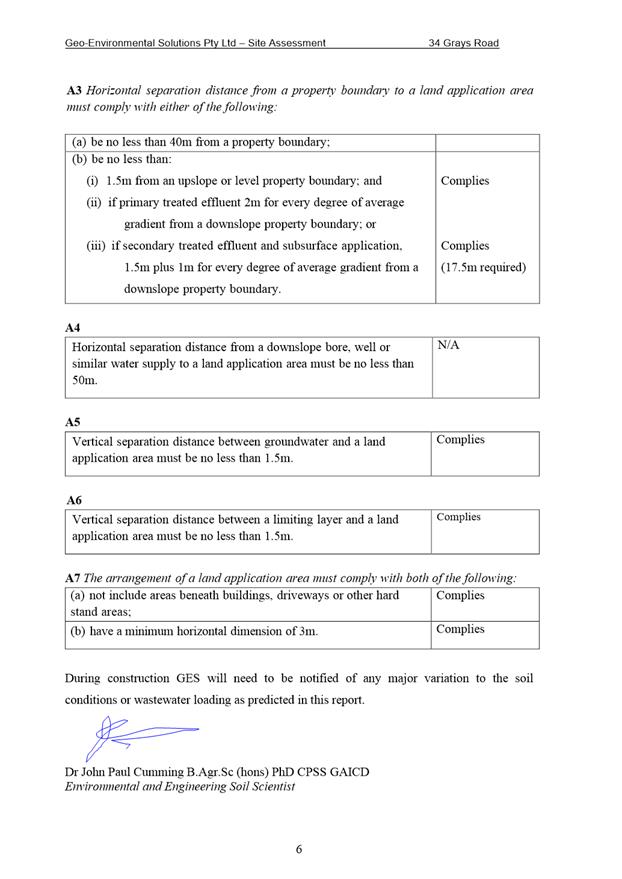
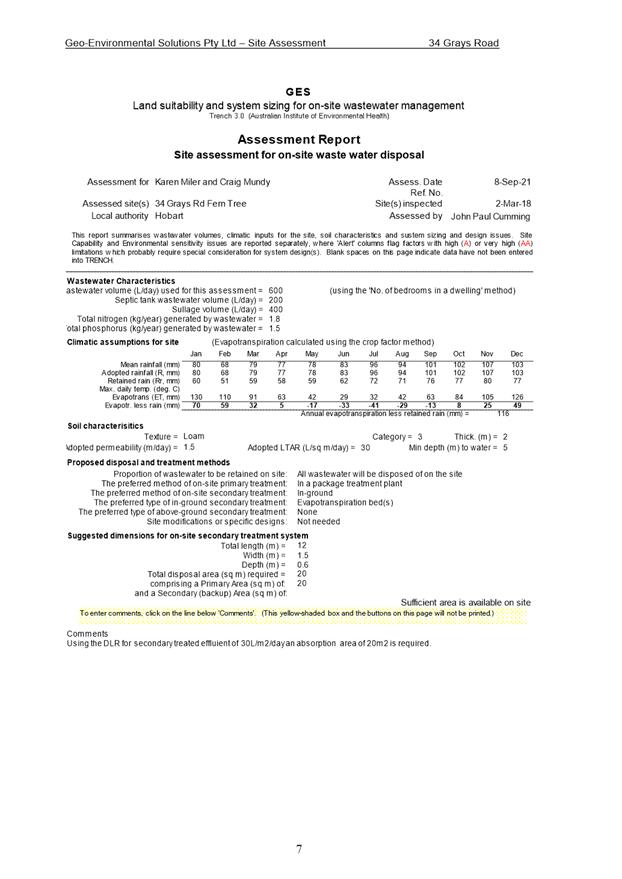
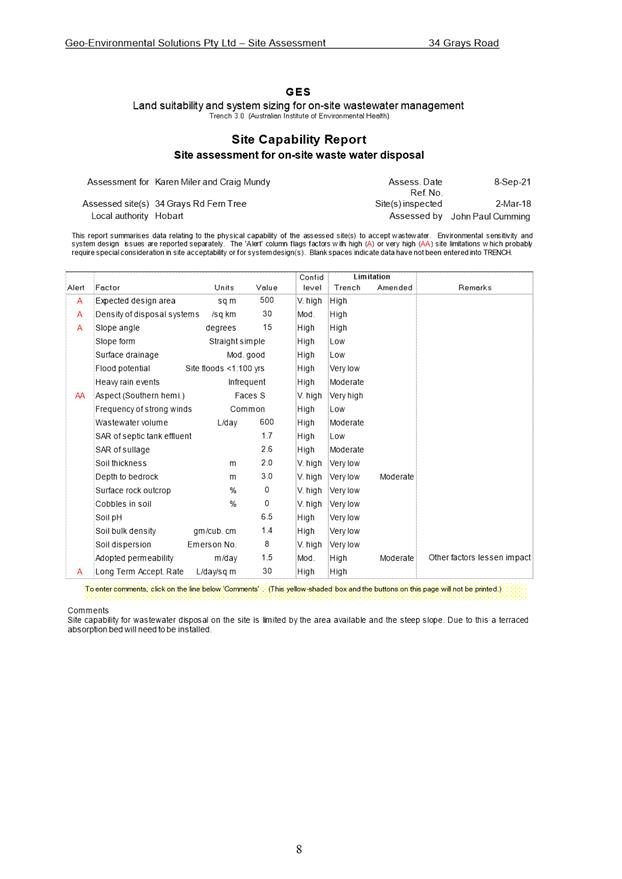
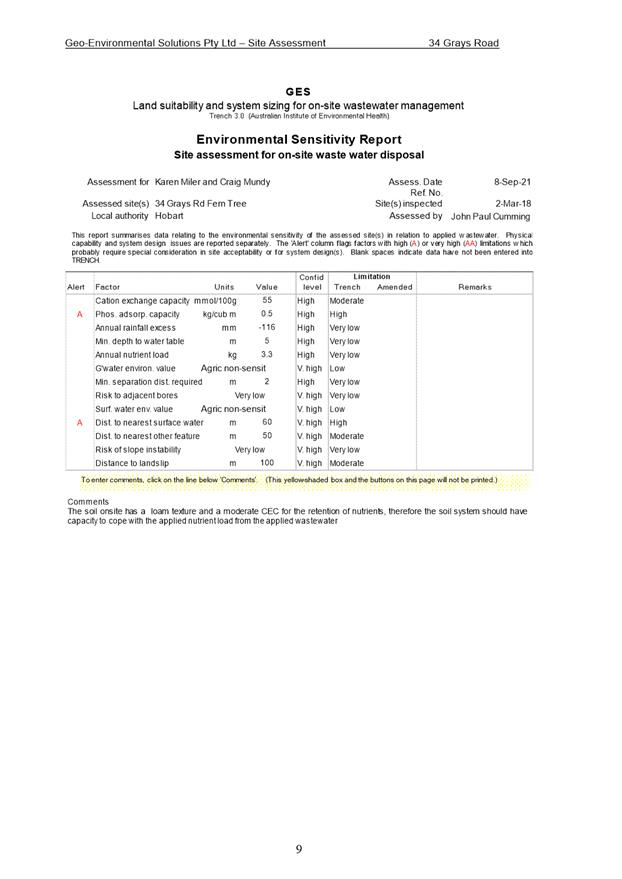
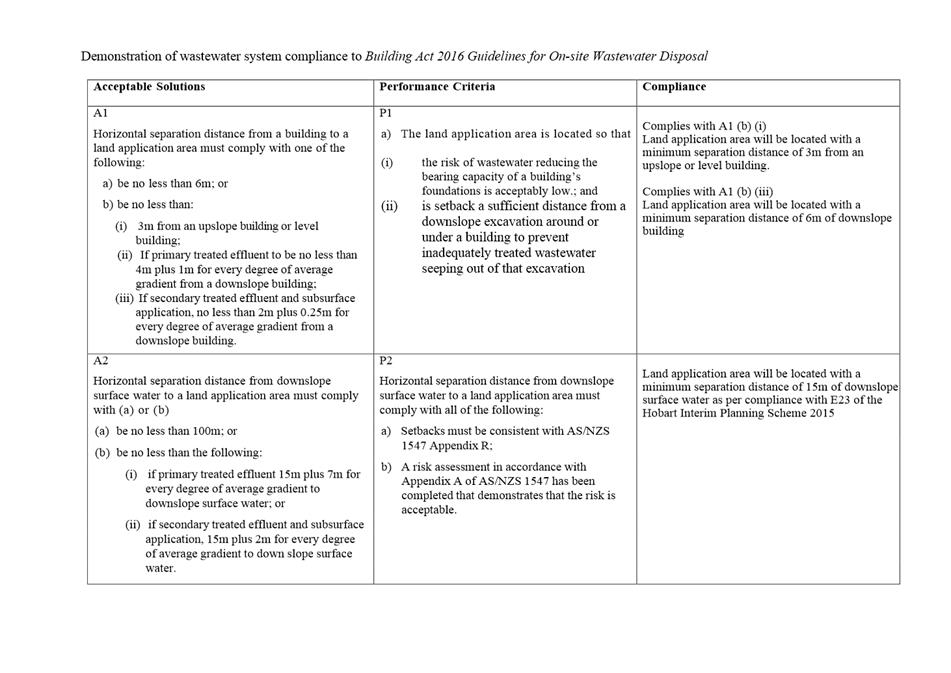
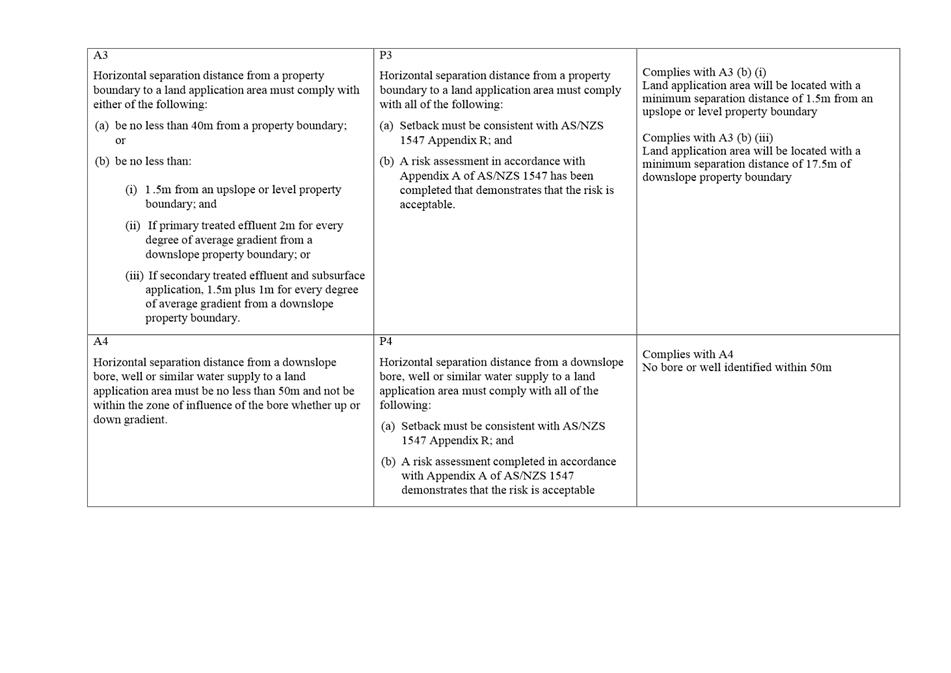
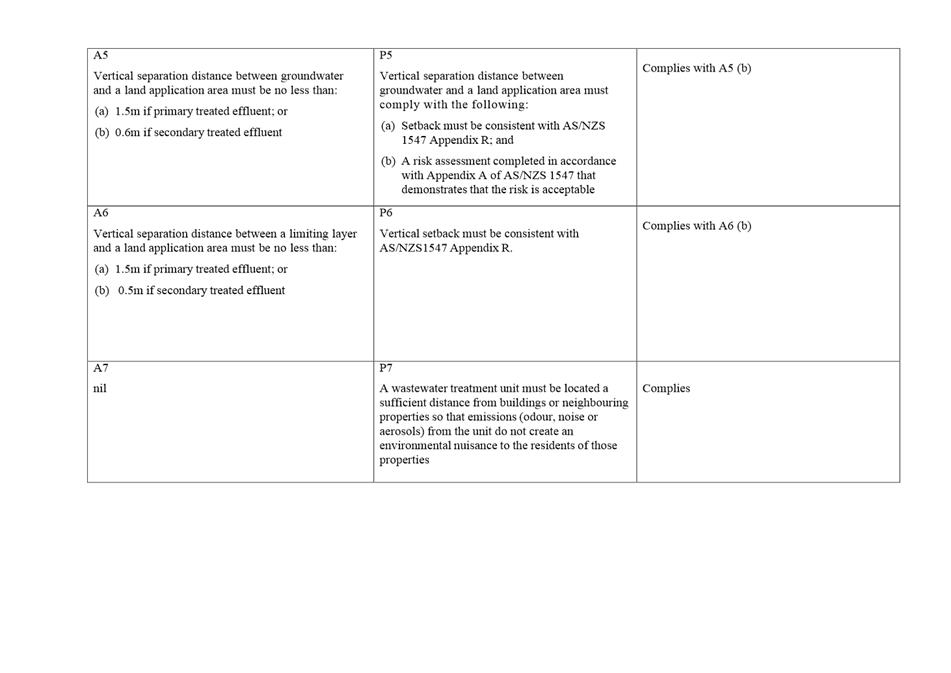
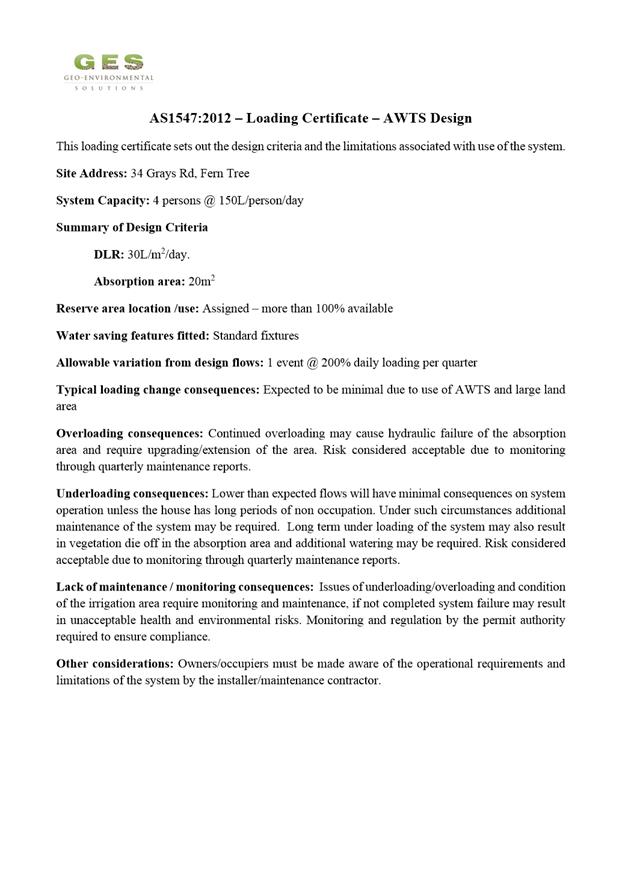
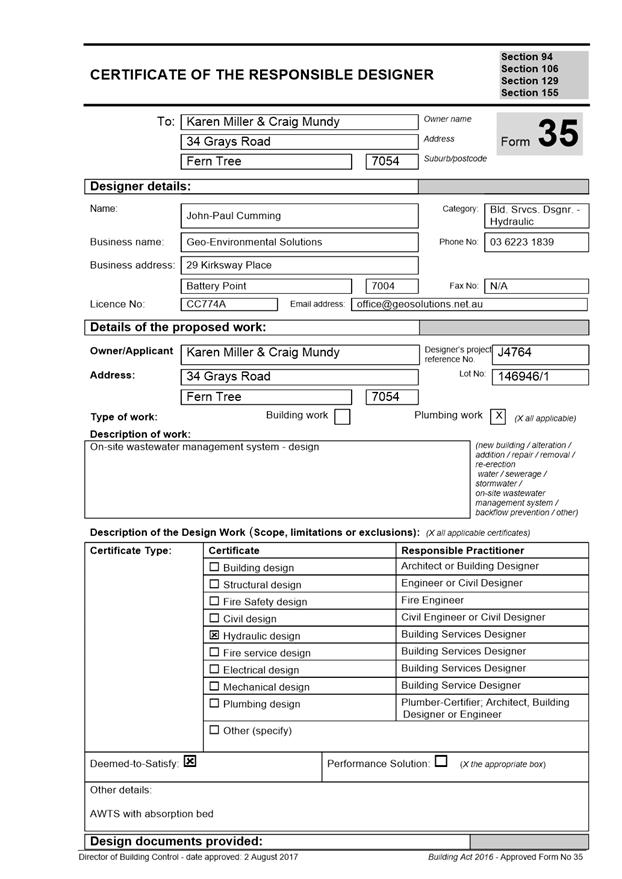
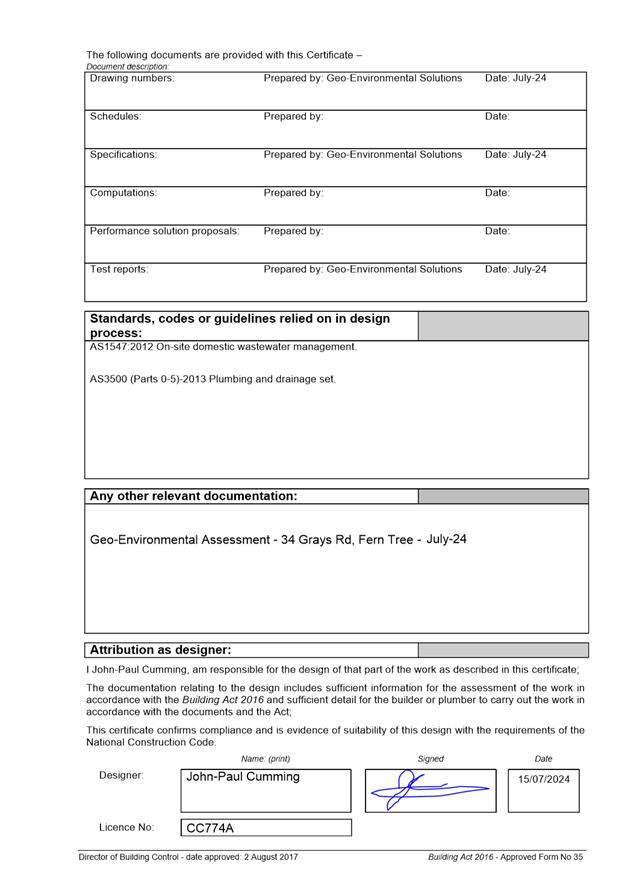
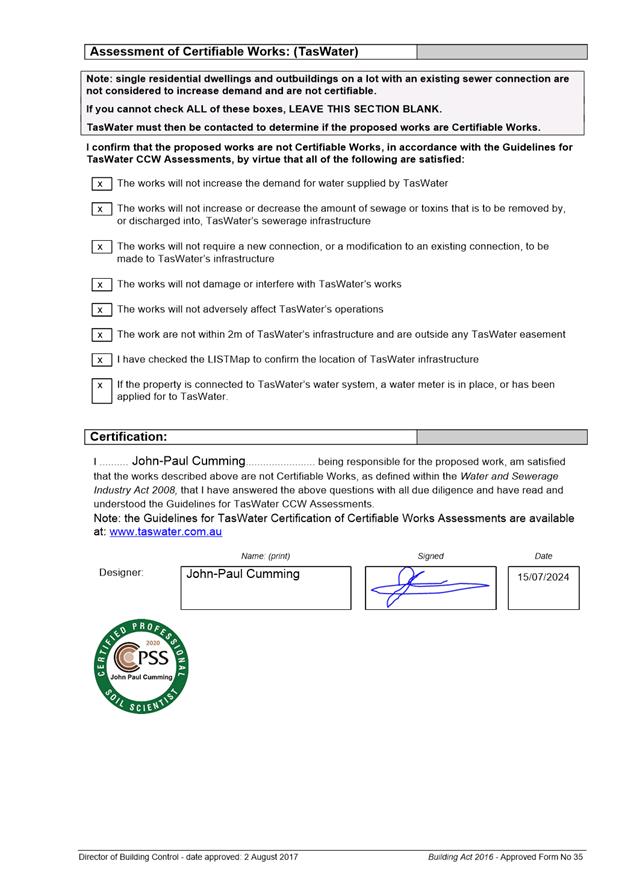
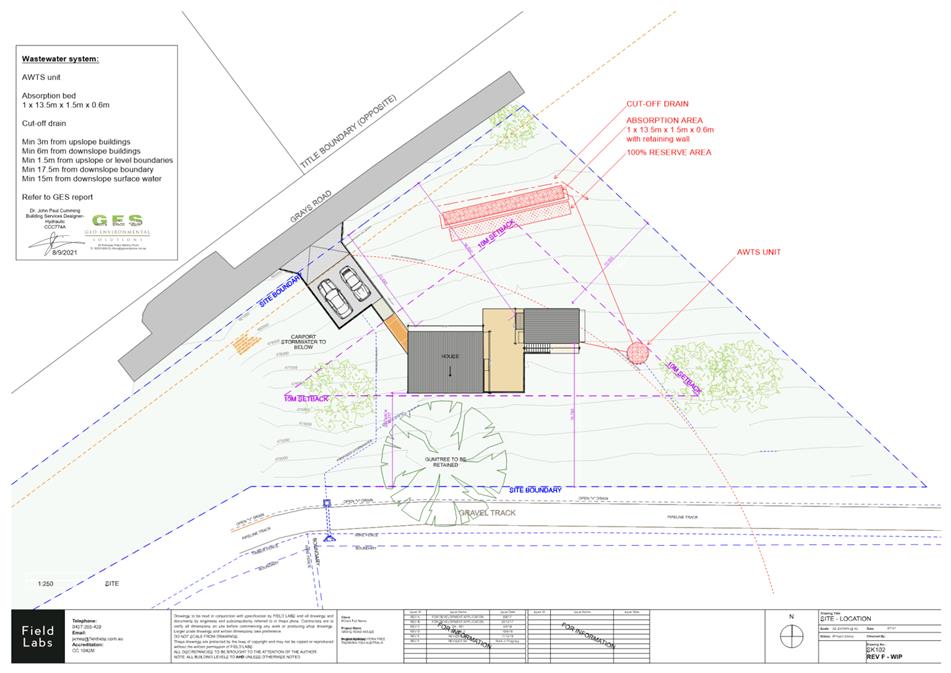
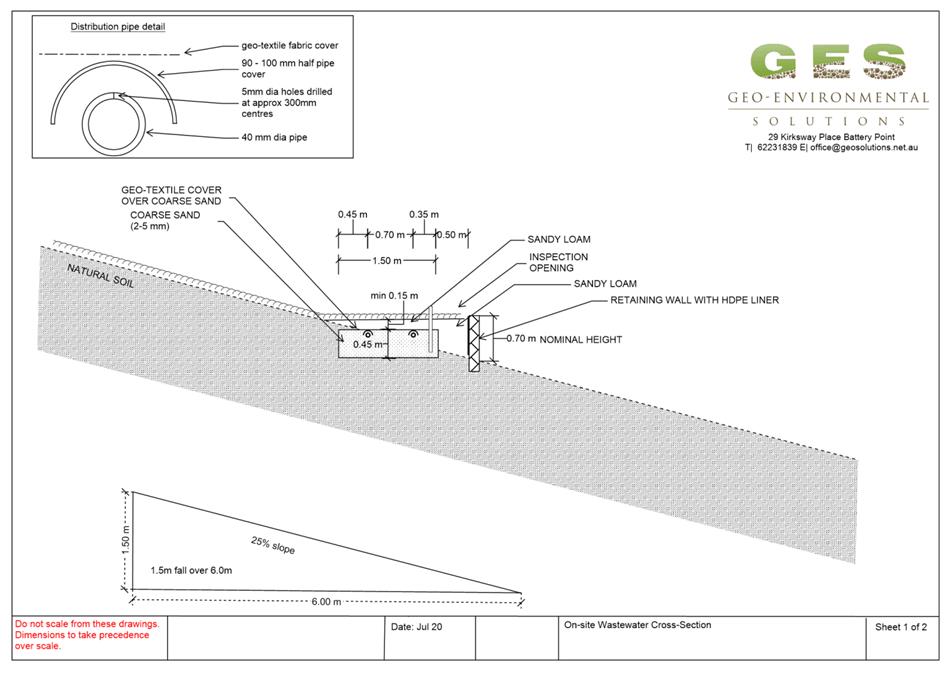
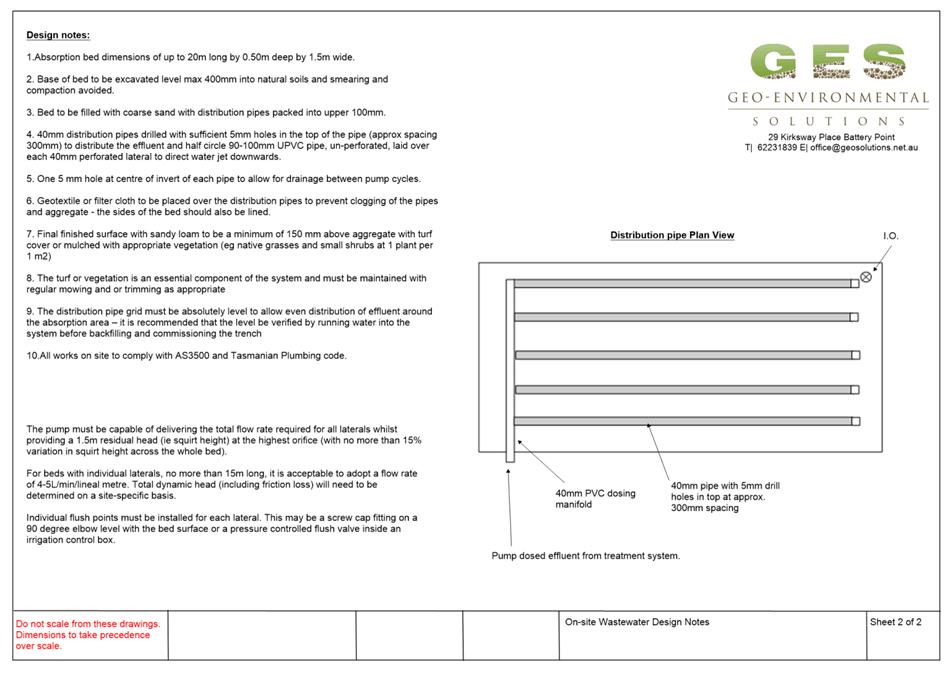
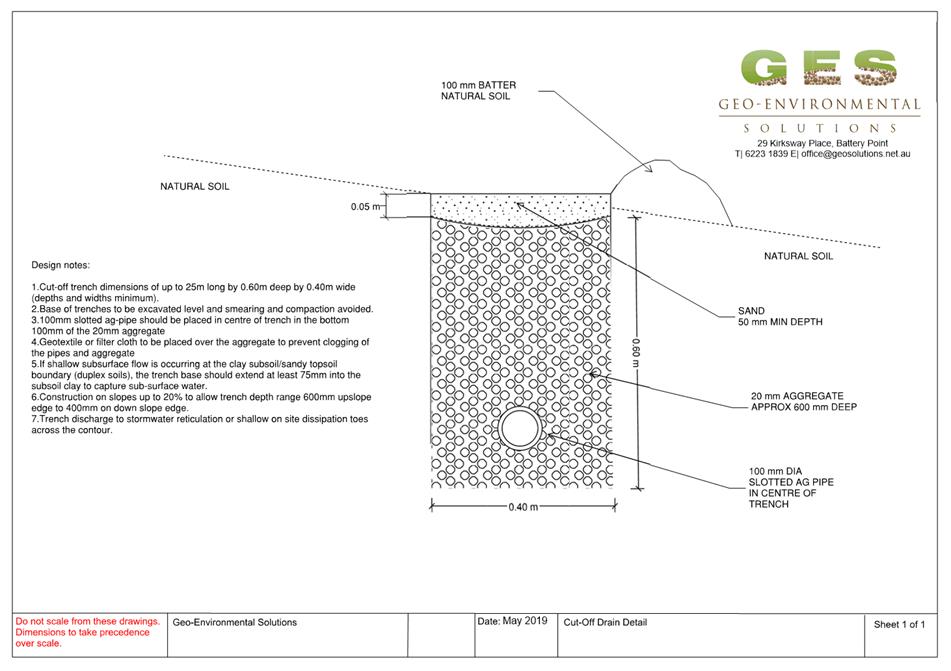
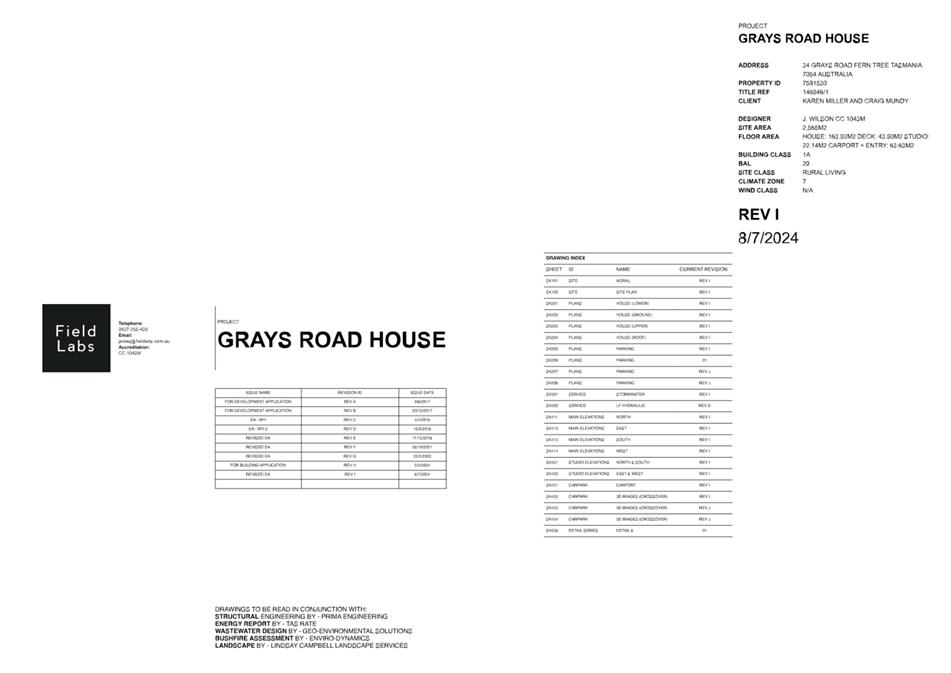
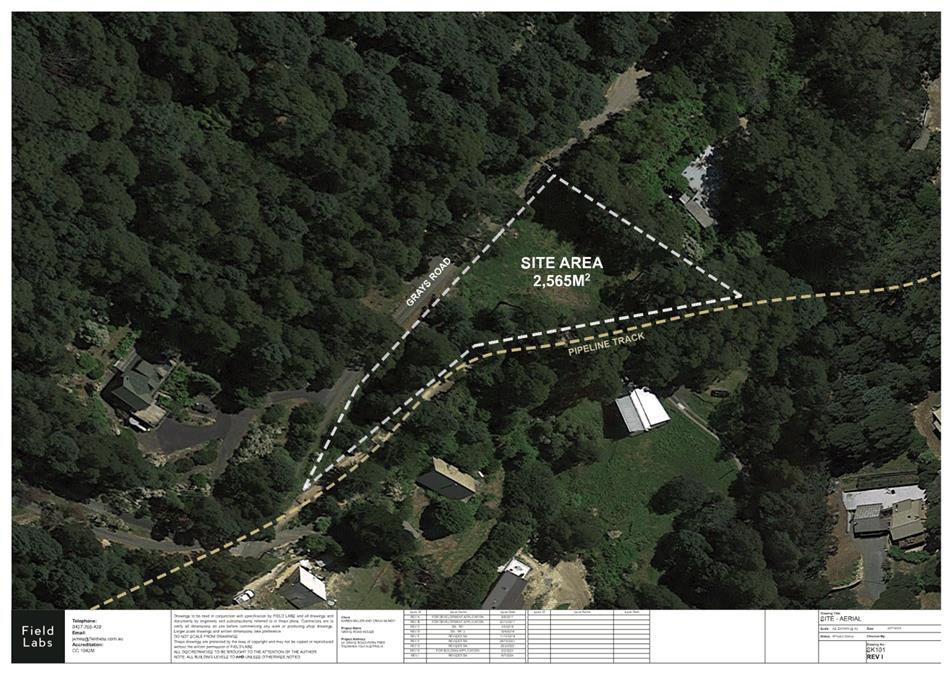
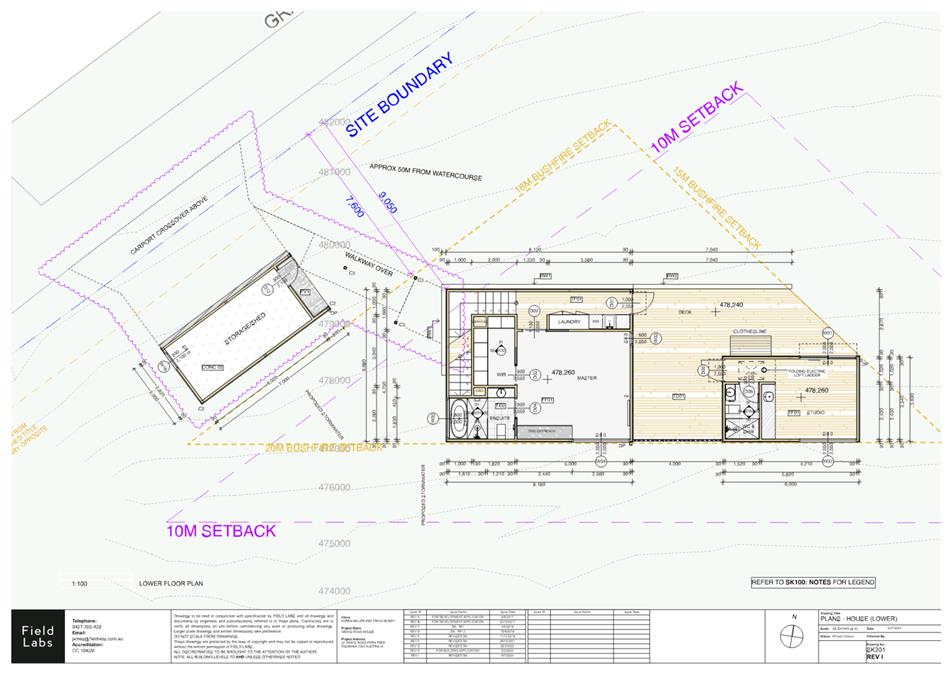
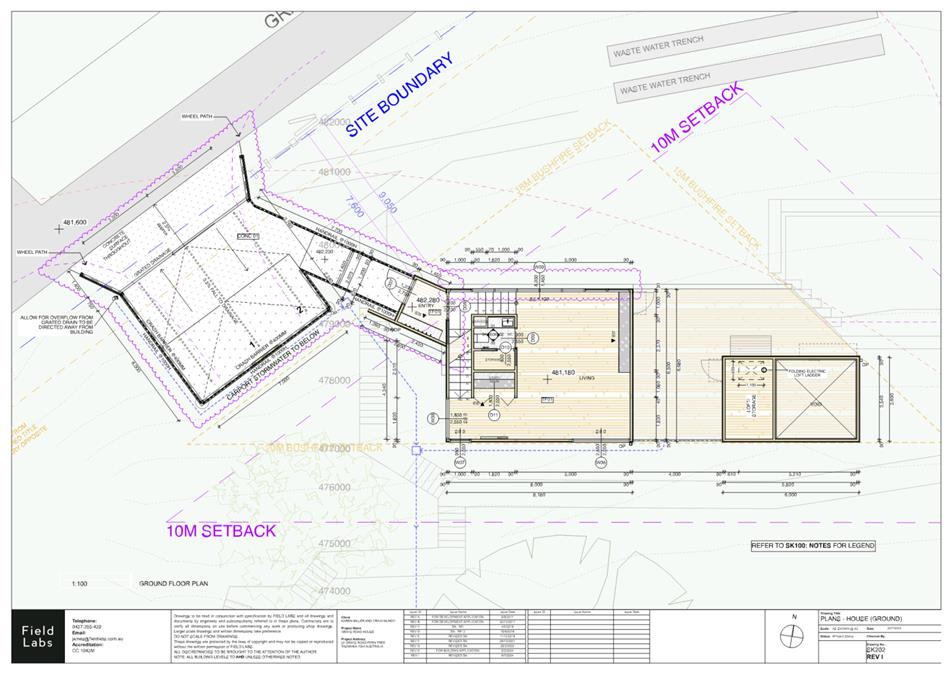
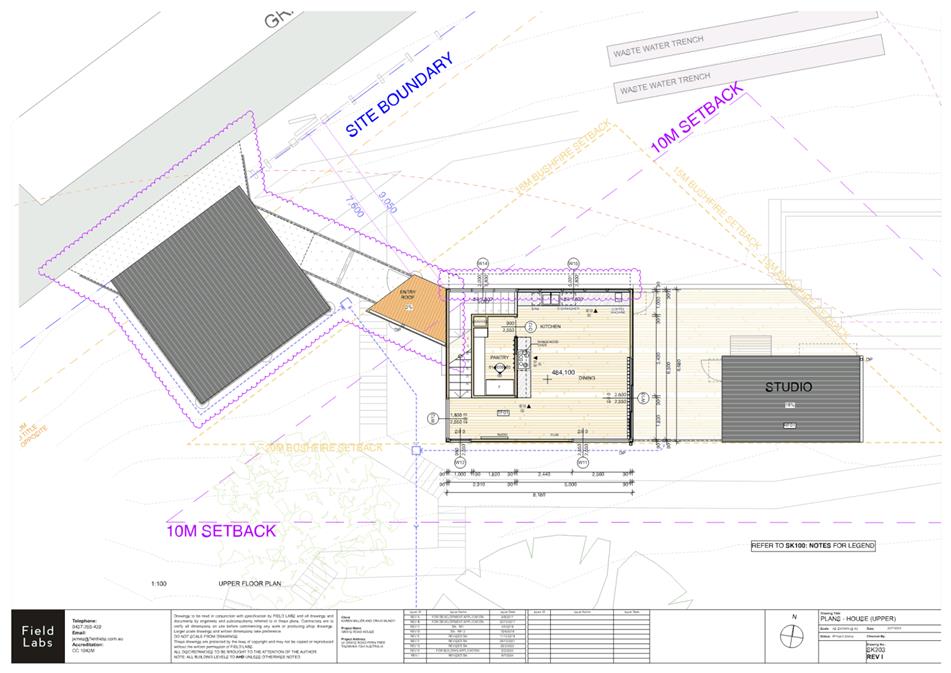
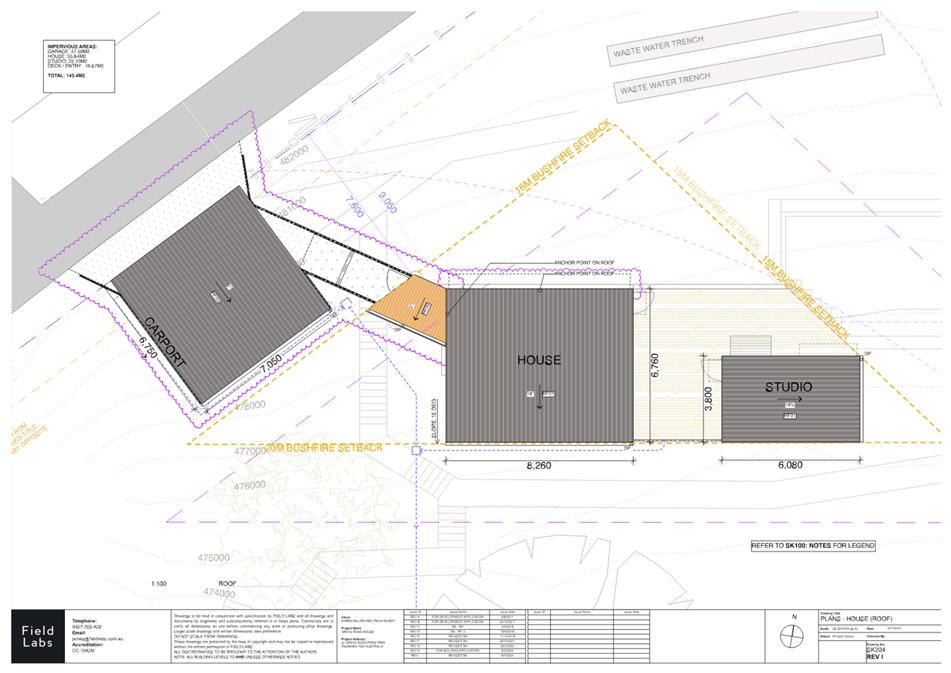
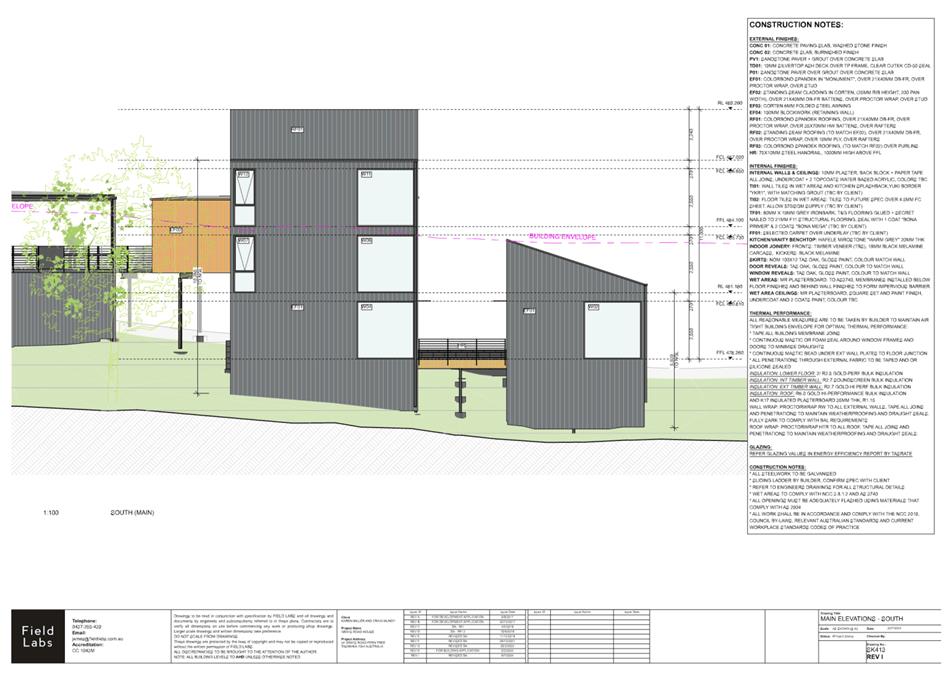
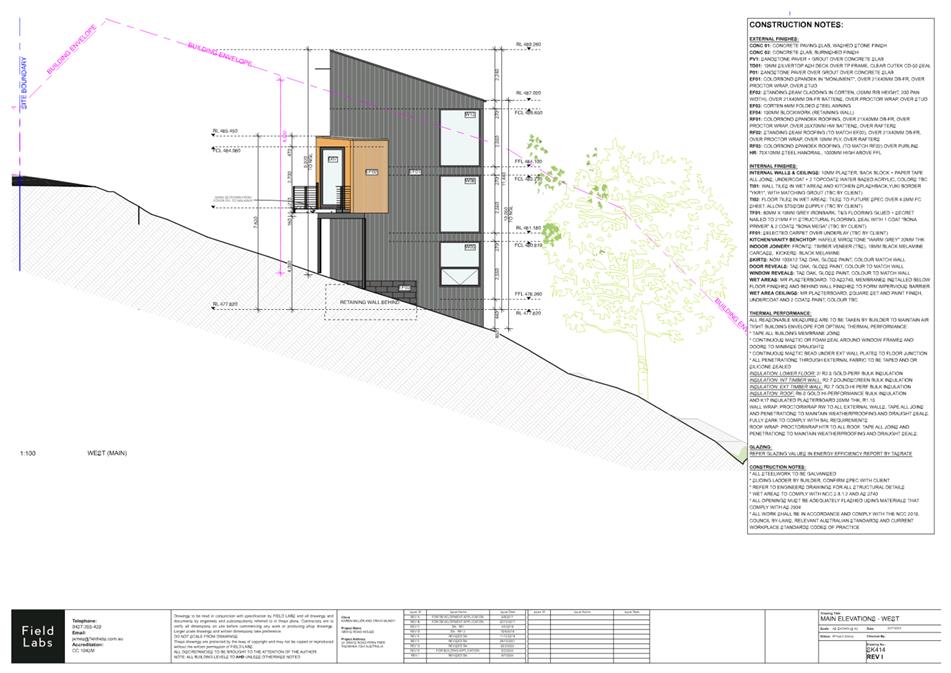
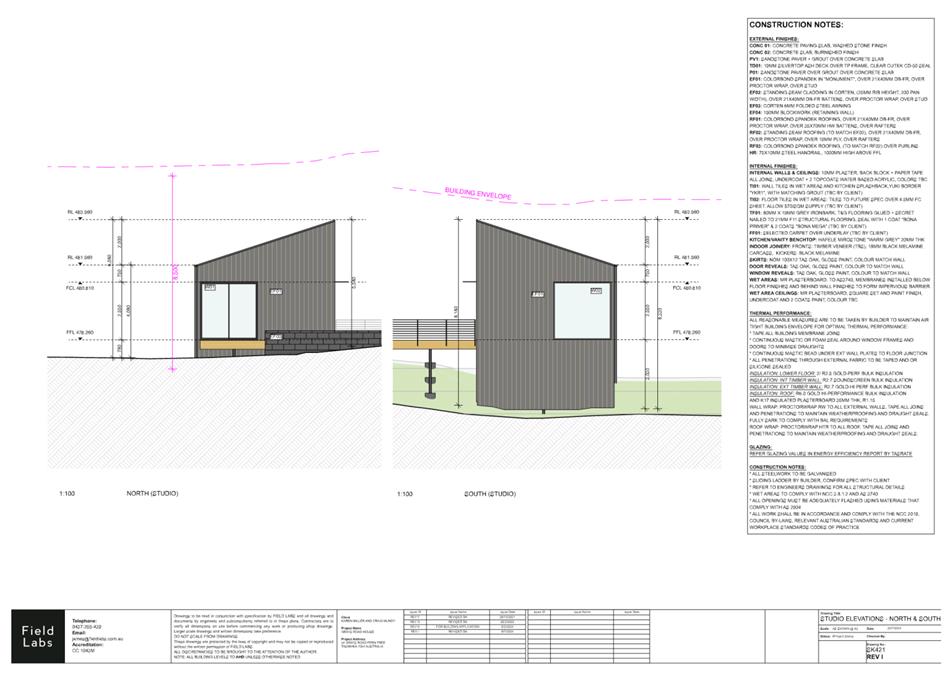
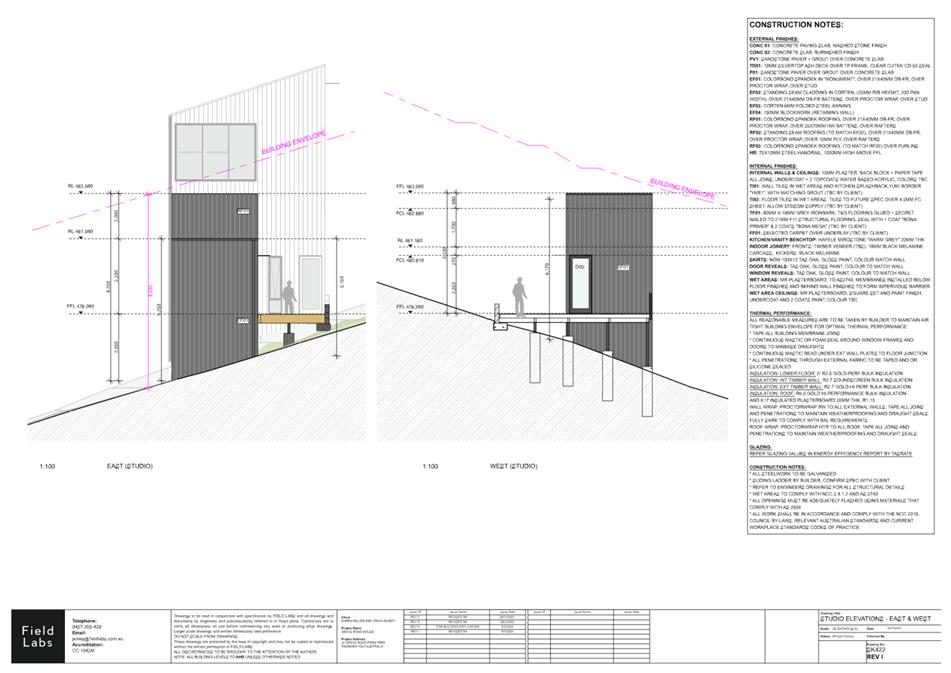
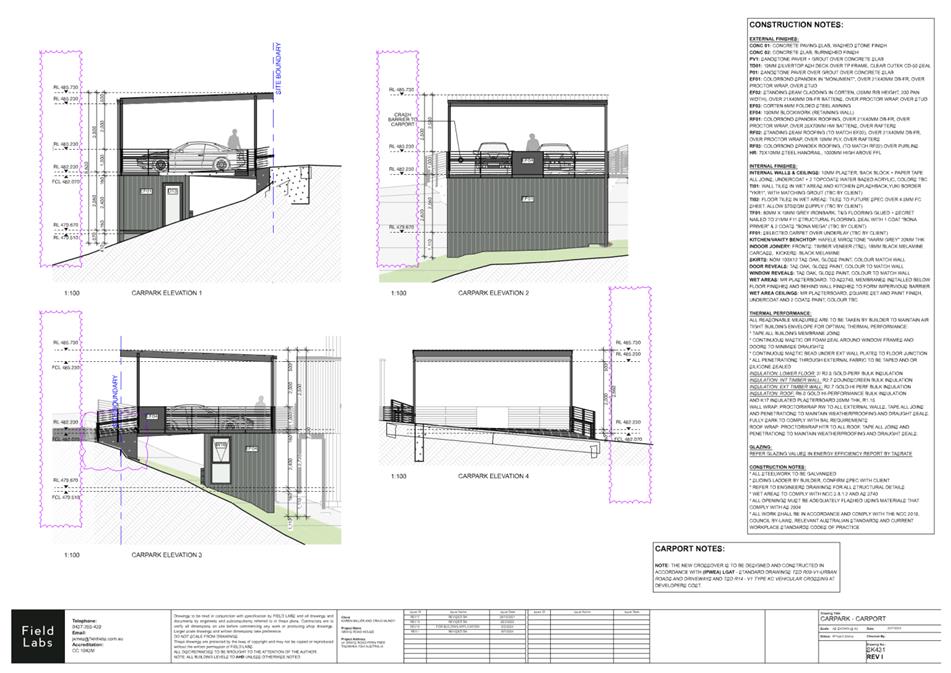
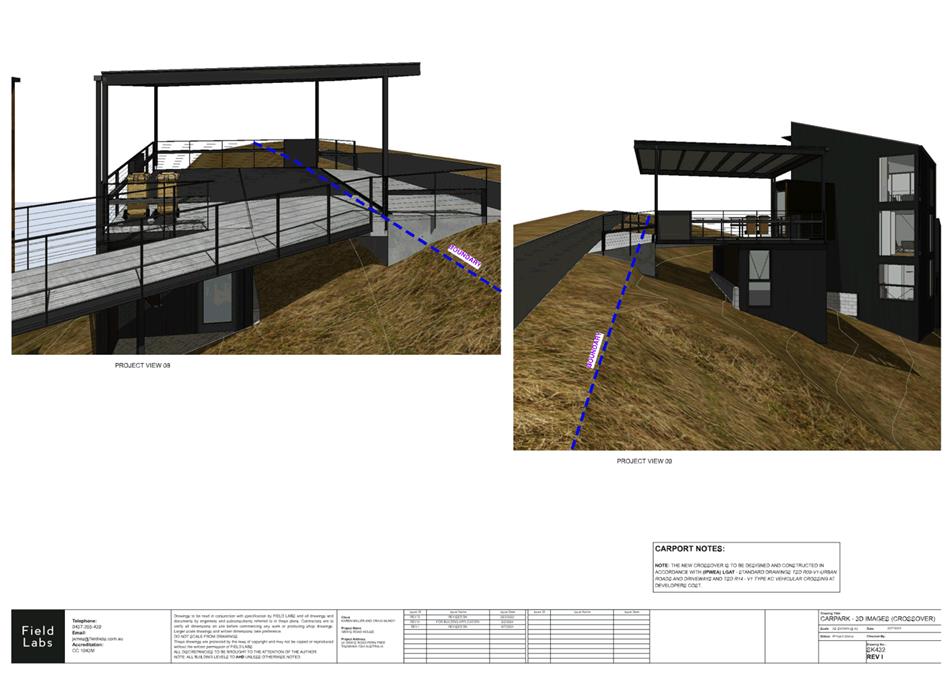
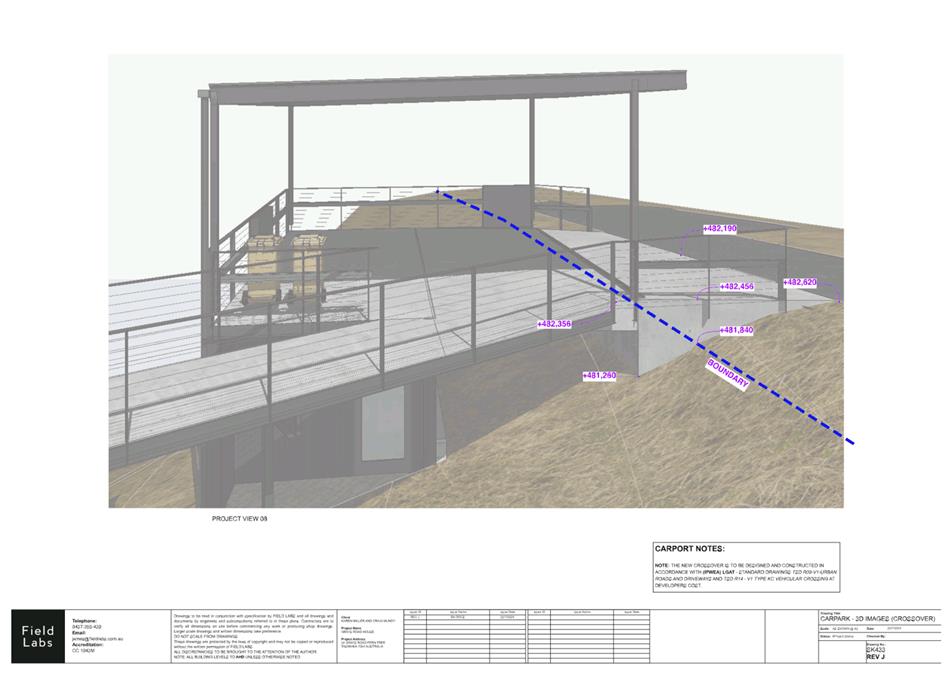
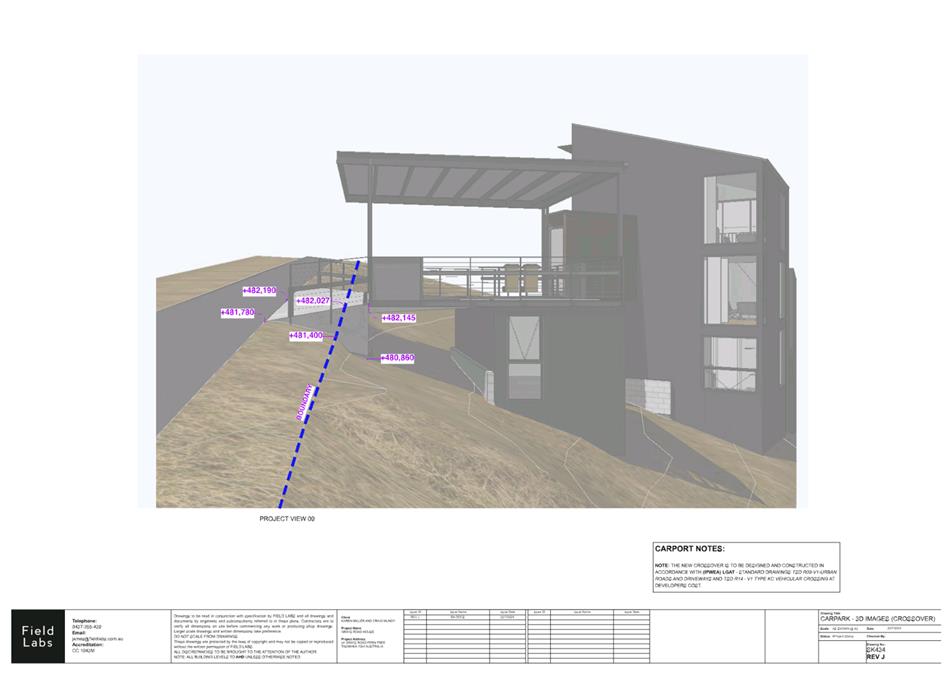
6.1.1 30-34 Grays Road Fern Tree and adjacent road reserve and Pipeline Track (100 Pinnacle Road, Wellington Park) - dwelling, carport and studio
Address: 30-34 Grays Road Fern Tree and adjacent road reserve and Pipeline Track (100 Pinnacle Road, Wellington Park)
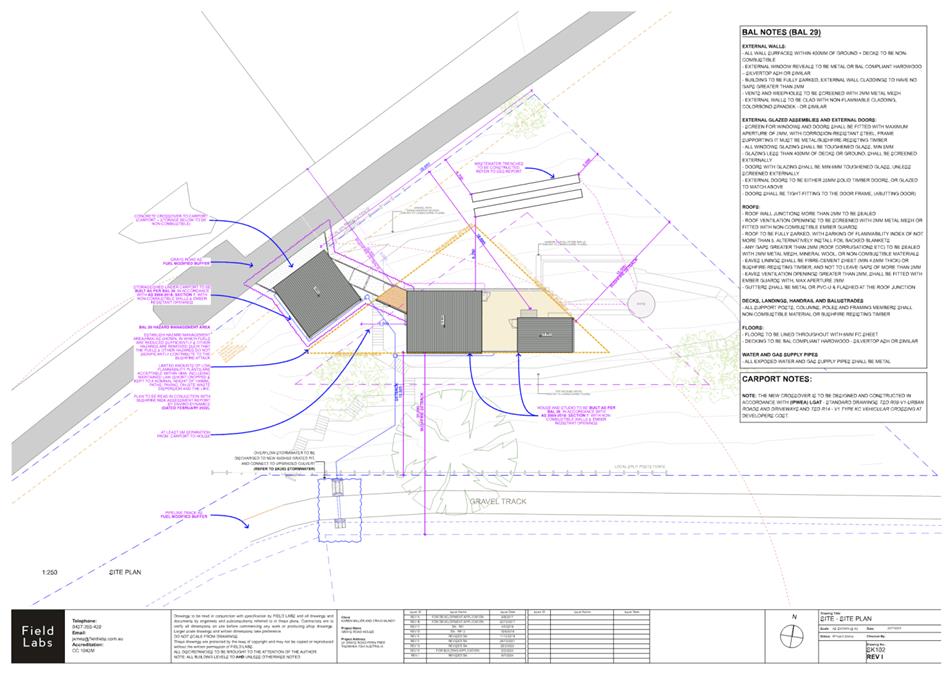
Proposal: Dwelling, Carport and Studio
Expiry Date: 7 October 2024
Extension of Time: Not applicable
Author: Adam Smee
|
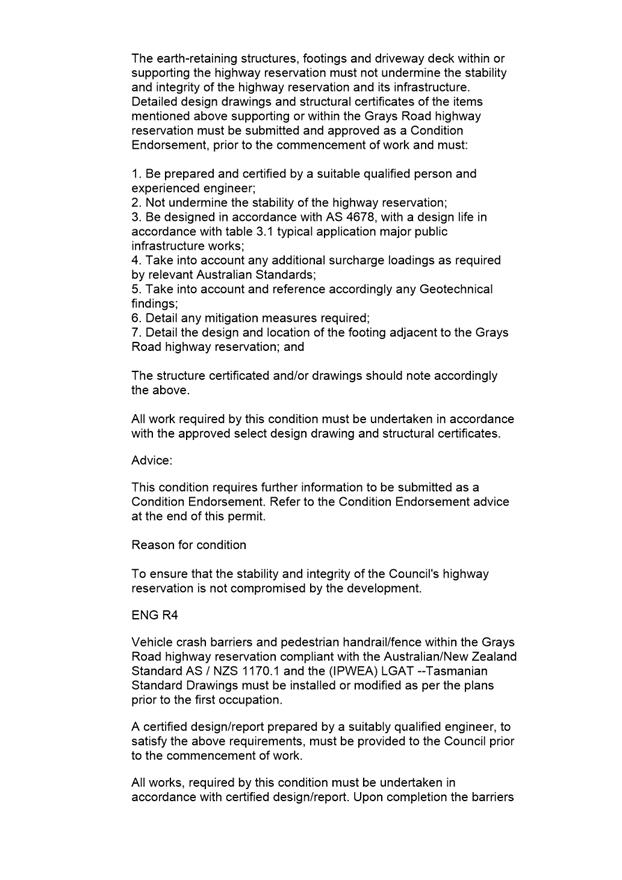
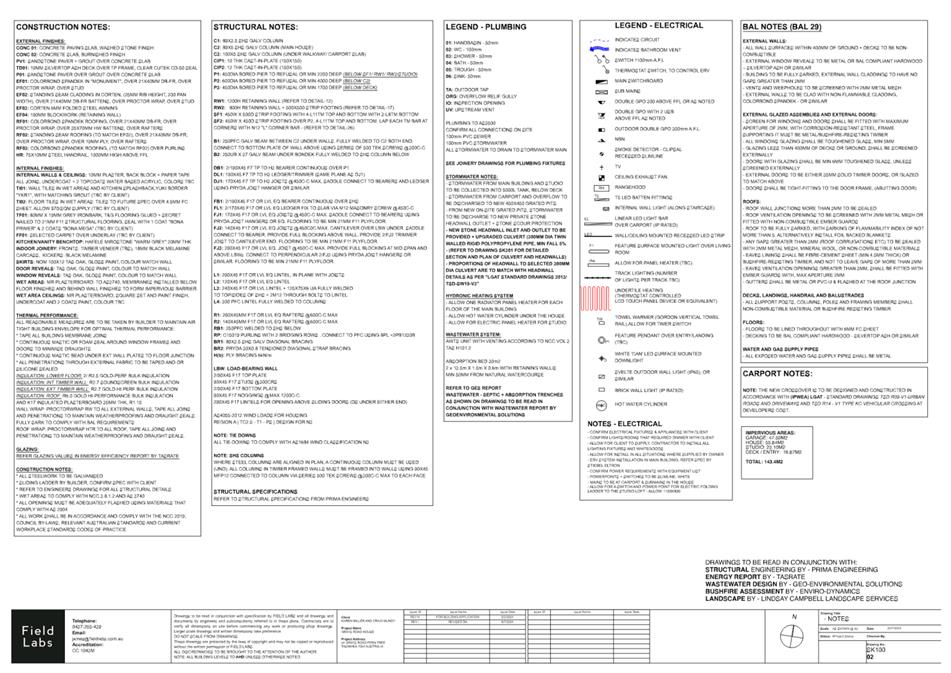
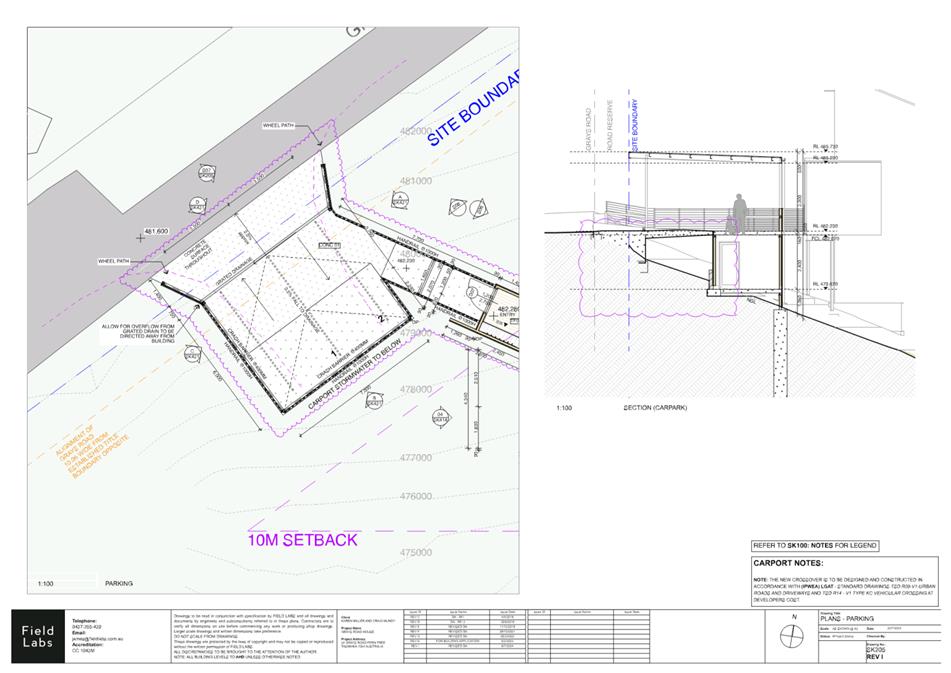
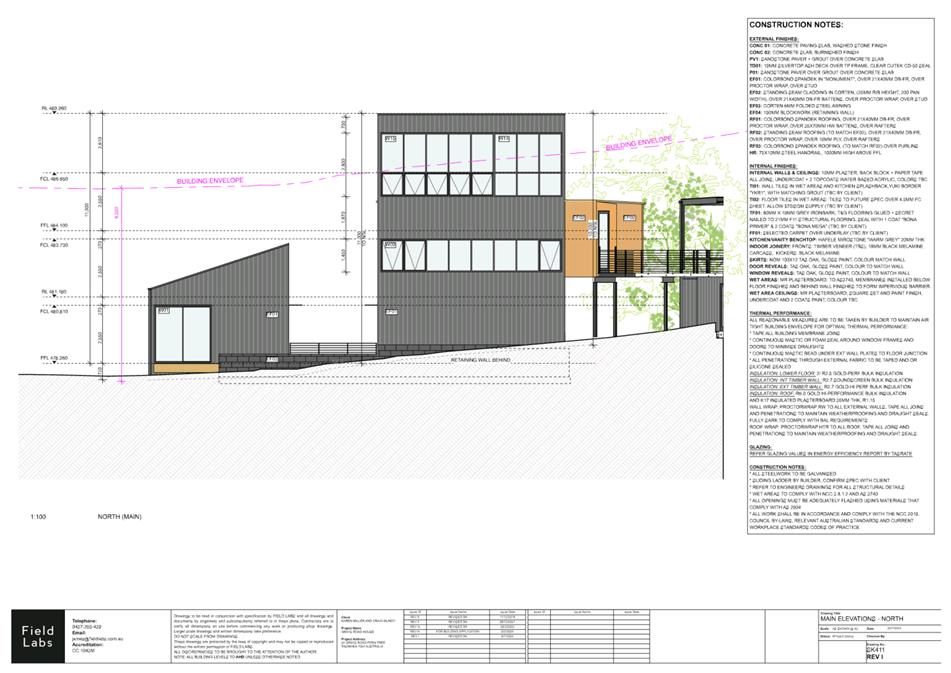
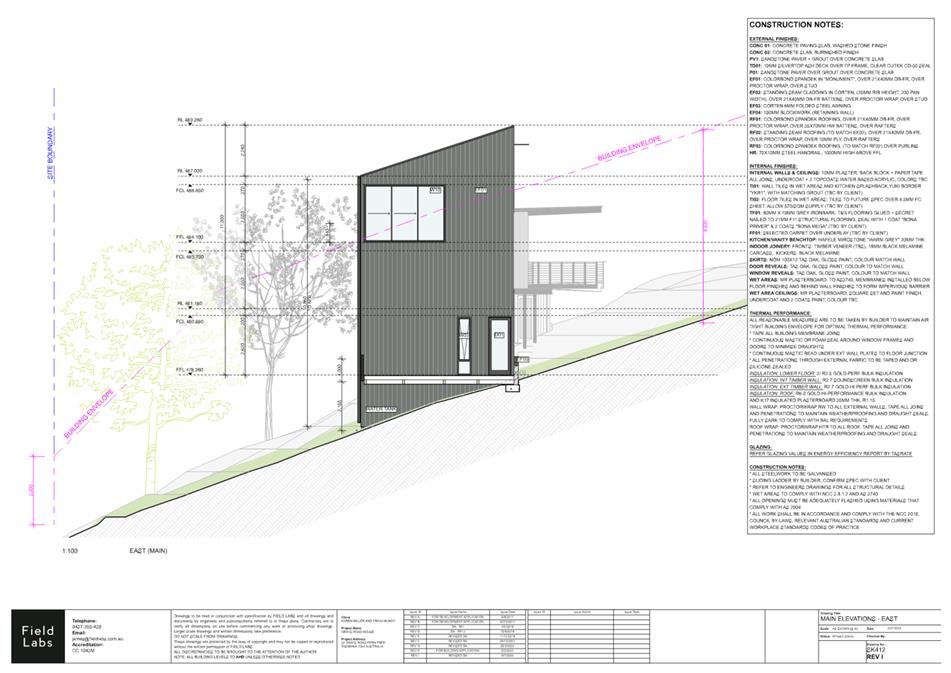
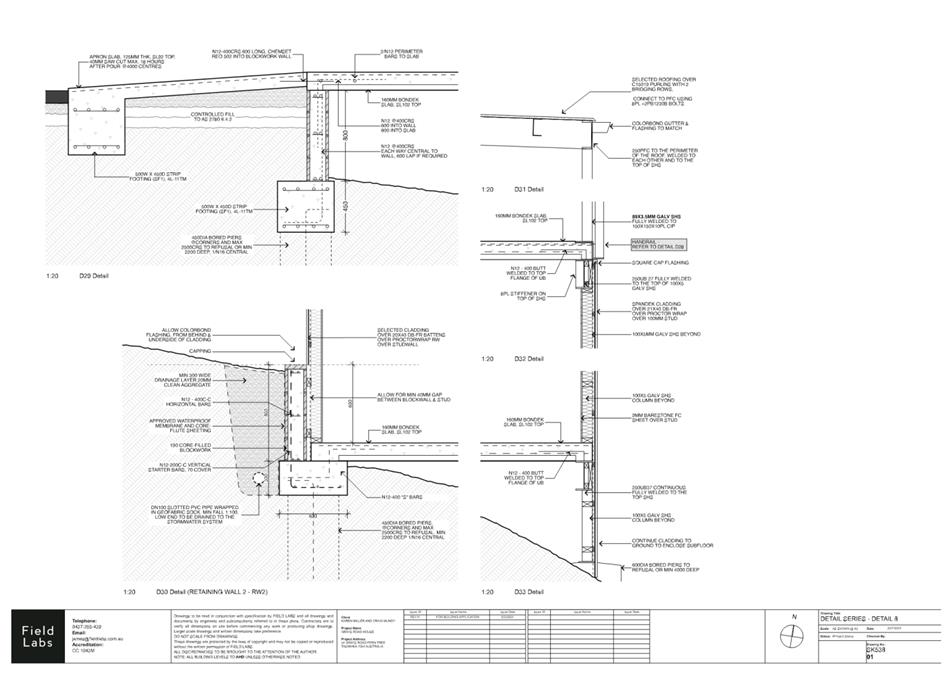
REcommendation That pursuant to the Hobart Interim Planning Scheme 2015, the Planning Committee in accordance with the delegations contained in its terms of reference, approve the application dwelling, carport, and studio at 30-34 Grays Road, Fern Tree and adjacent road reserve and Pipeline Track (100 Pinnacle Road, Wellington Park) for the reasons outlined in the officer’s report and a permit containing the following conditions be issued: GEN - General The use and/or development must be substantially in accordance with the documents and drawings that comprise PLN-24-326 - 30-34 GRAYS ROAD FERN TREE TAS 7054 - Final Planning Documents except where modified below.
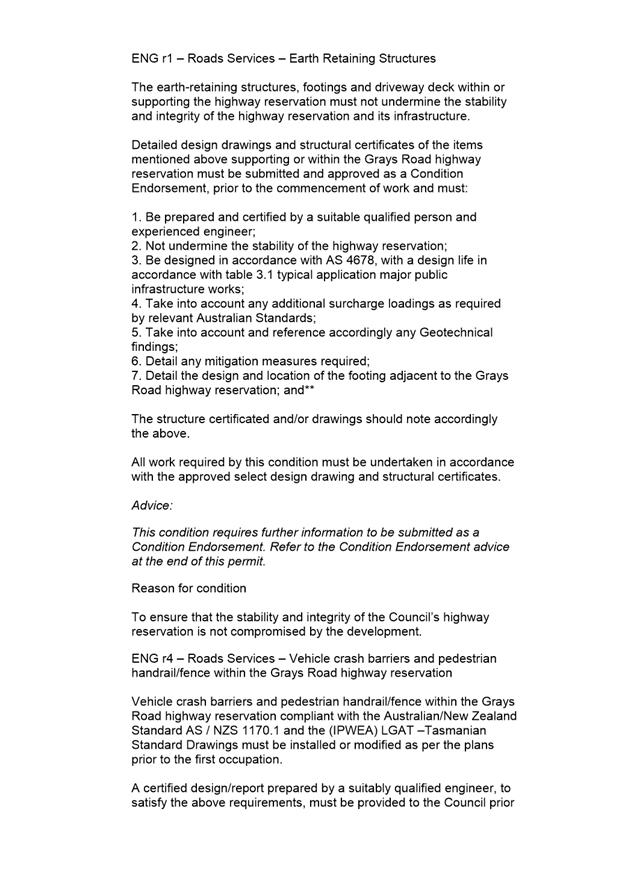
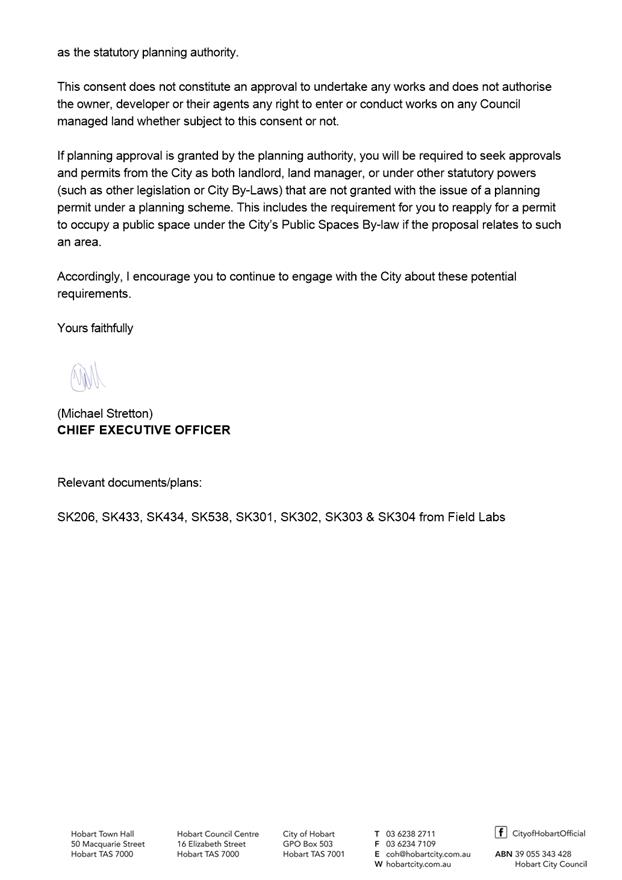
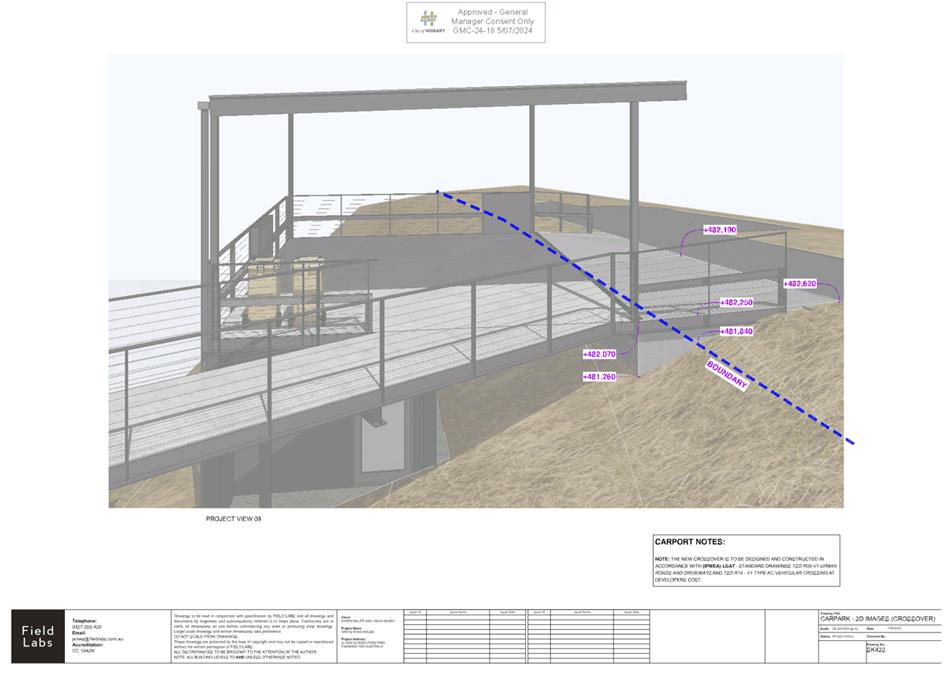
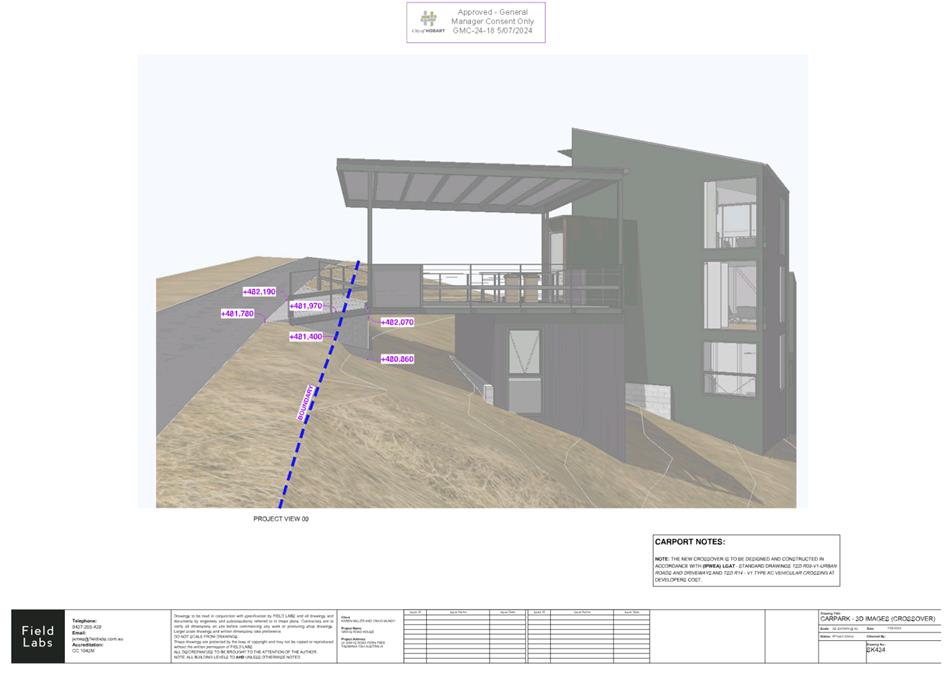
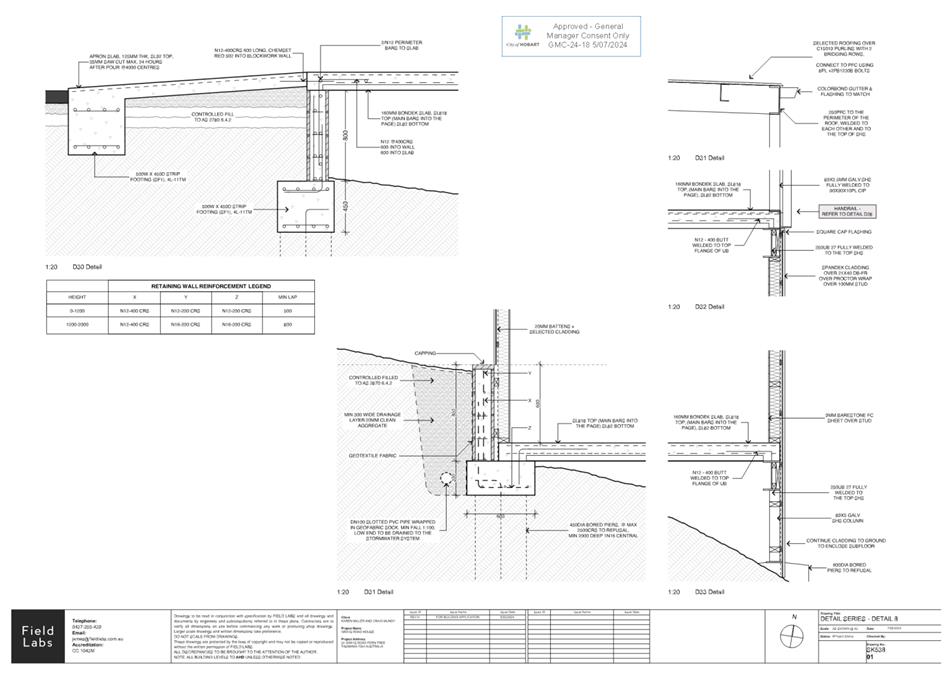
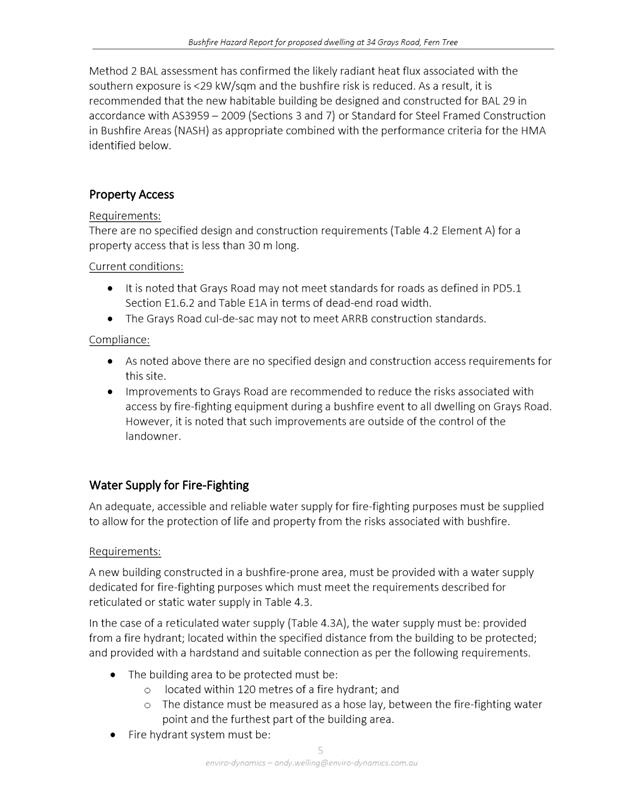
ENG R1 The earth-retaining structures, footings and driveway deck within or supporting the highway reservation must not undermine the stability and integrity of the highway reservation and its infrastructure. Detailed design drawings and structural certificates of the items mentioned above supporting or within the Grays Road highway reservation must be submitted and approved as a Condition Endorsement, prior to the commencement of work and must: 1. Be prepared and certified by a suitable qualified person and experienced engineer; 2. Not undermine the stability of the highway reservation; 3. Be designed in accordance with AS 4678, with a design life in accordance with table 3.1 typical application major public infrastructure works; 4. Take into account any additional surcharge loadings as required by relevant Australian Standards; 5. Take into account and reference accordingly any Geotechnical findings; 6. Detail any mitigation measures required; 7. Detail the design and location of the footing adjacent to the Grays Road highway reservation; and
The structure certificated and/or drawings should note accordingly the above. All work required by this condition must be undertaken in accordance with the approved select design drawing and structural certificates. Advice: This condition requires further information to be submitted as a Condition Endorsement. Refer to the Condition Endorsement advice at the end of this permit. Reason for condition To ensure that the stability and integrity of the Council's highway reservation is not compromised by the development.
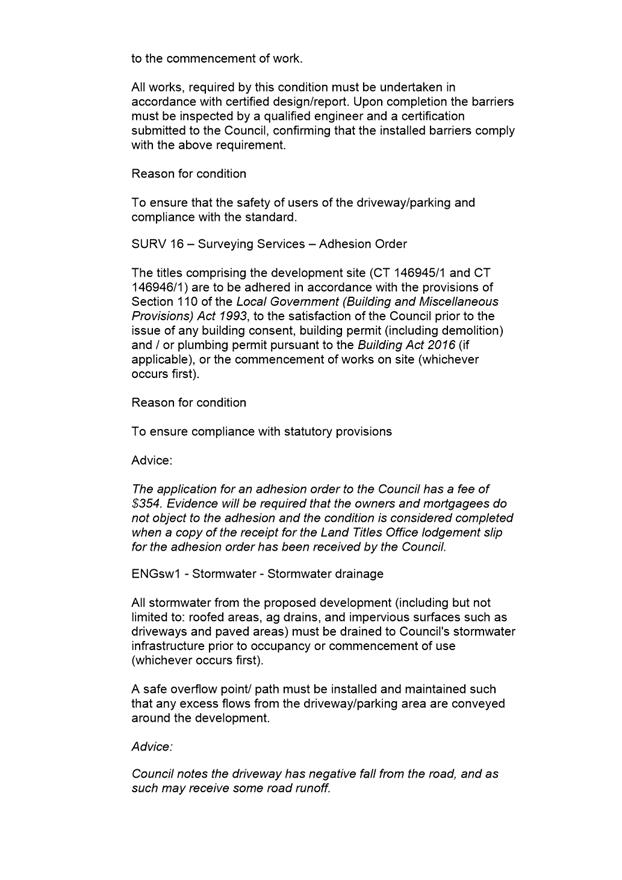
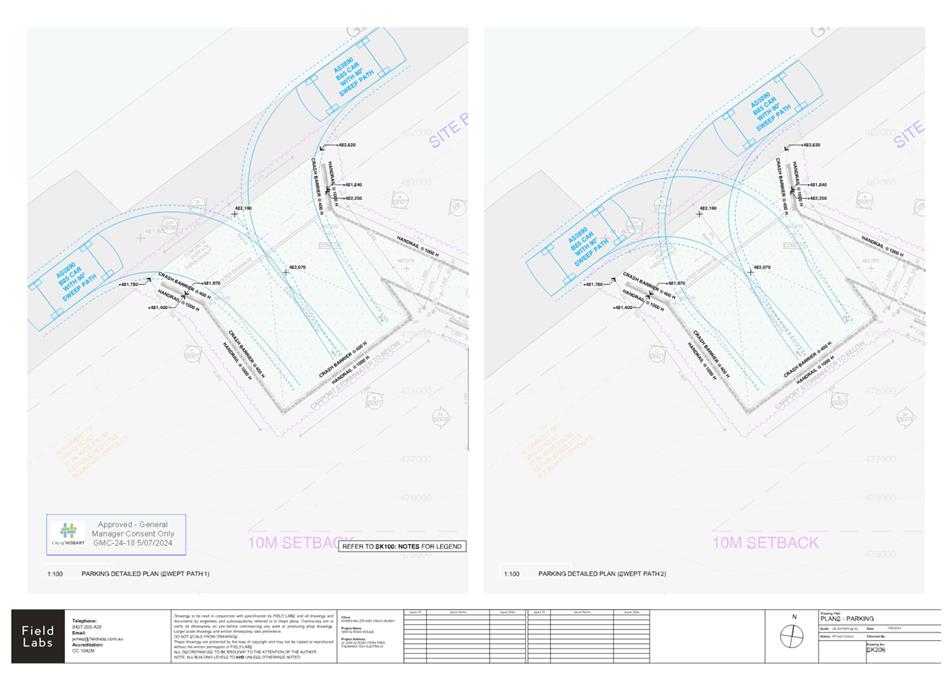
ENG R4 Vehicle crash barriers and pedestrian handrail/fence within the Grays Road highway reservation compliant with the Australian/New Zealand Standard AS / NZS 1170.1 and the (IPWEA) LGAT --Tasmanian Standard Drawings must be installed or modified as per the plans prior to the first occupation. A certified design/report prepared by a suitably qualified engineer, to satisfy the above requirements, must be provided to the Council prior to the commencement of work. All works, required by this condition must be undertaken in accordance with certified design/report. Upon completion the barriers must be inspected by a qualified engineer and a certification submitted to the Council, confirming that the installed barriers comply with the above requirement. Reason for condition To ensure that the safety of users of the driveway/parking and compliance with the standard.
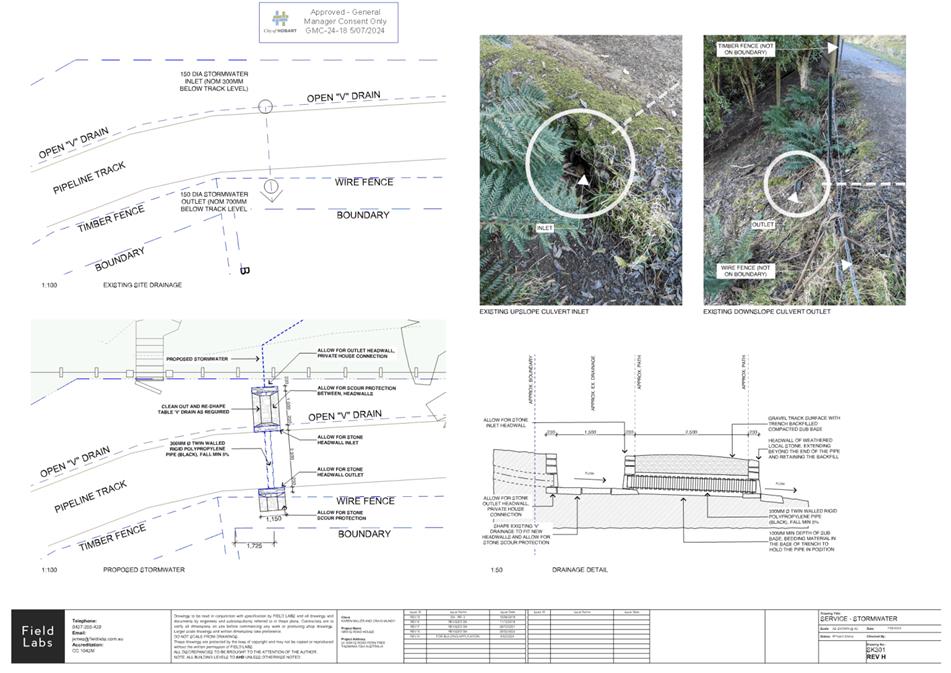
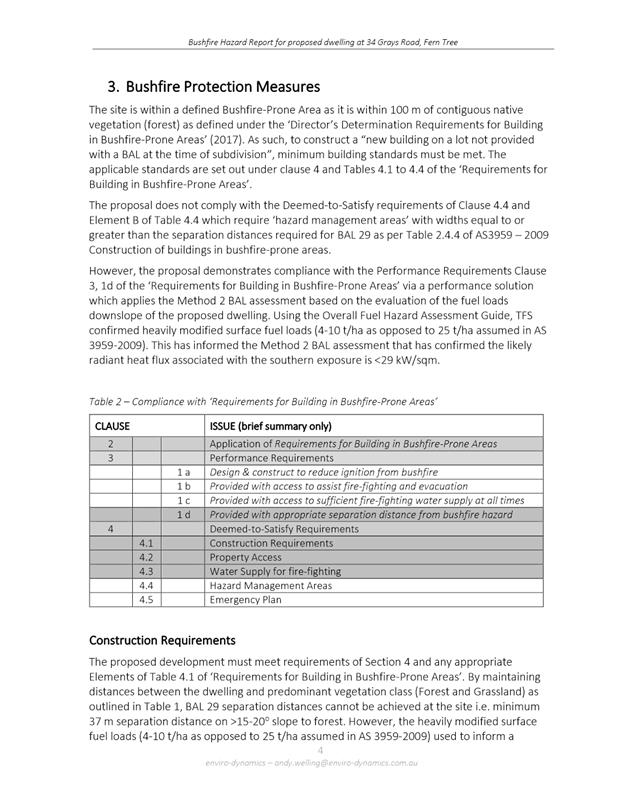
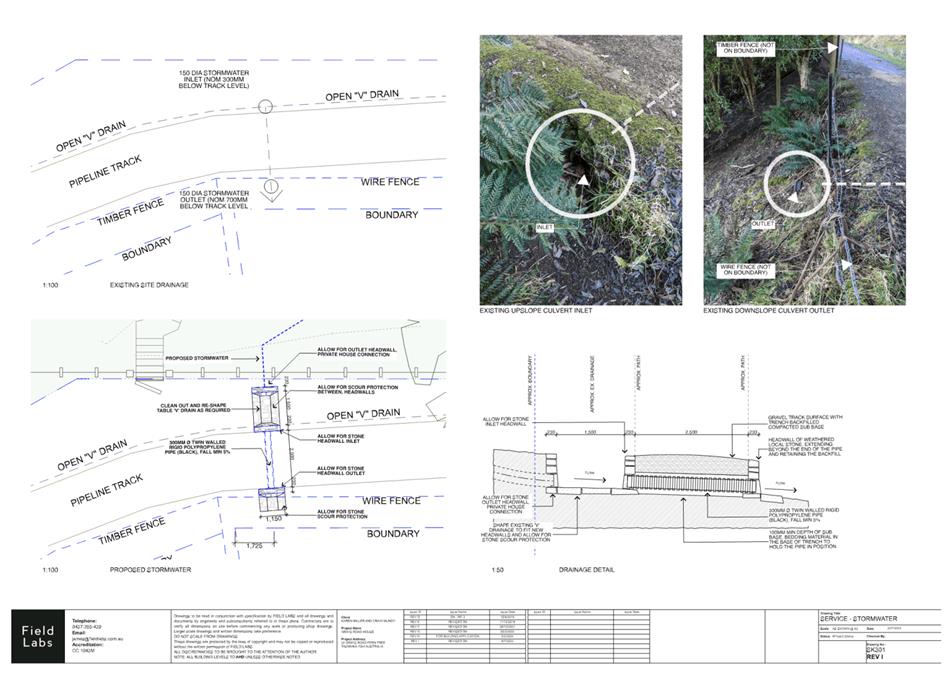
HER S1 The proposed stormwater infrastructure as shown in drawing SK301 Rev H must be constructed of the natural stone found in the local area. No impact, demolition or removal of any historic pipe infrastructure within the Pipeline Track is to occur.
Reason for condition To ensure that demolition and new development does not result in the loss of historic cultural heritage values of the historic Pipeline Track and Pipeline Track Cultural Landscape Precinct.
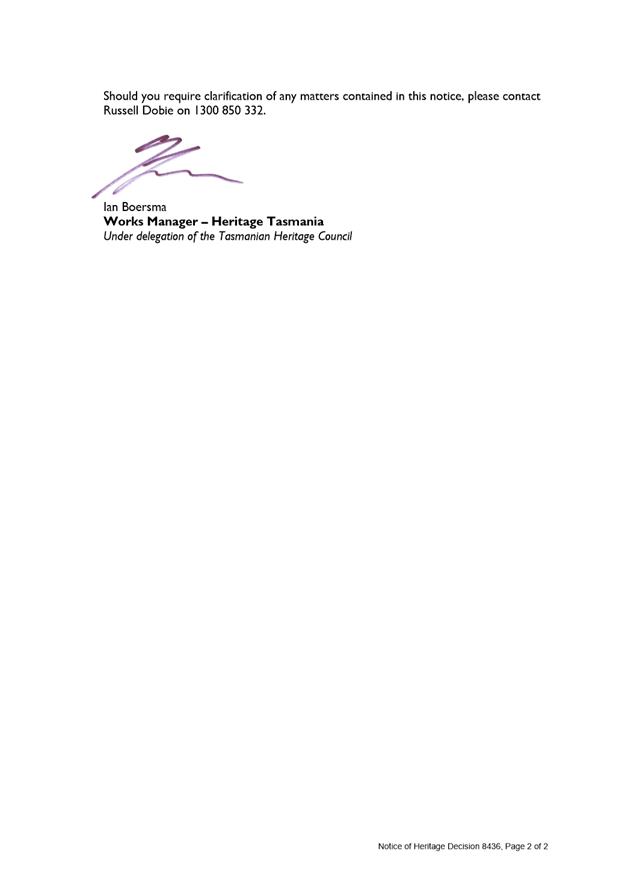
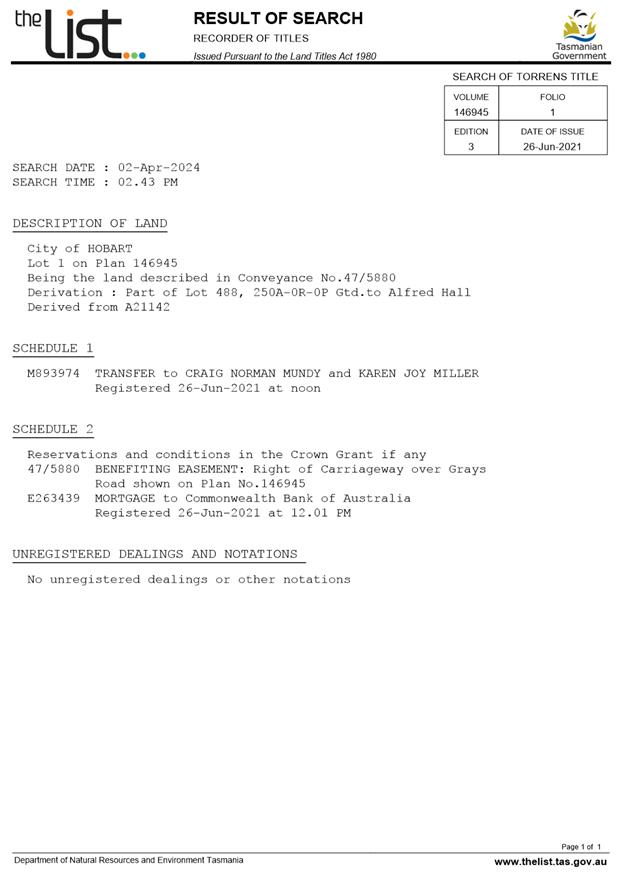
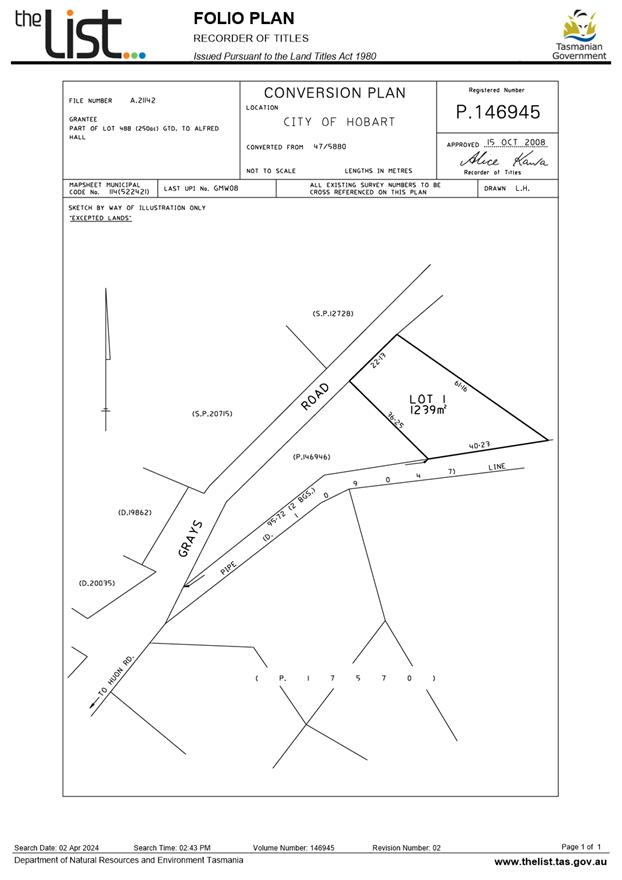
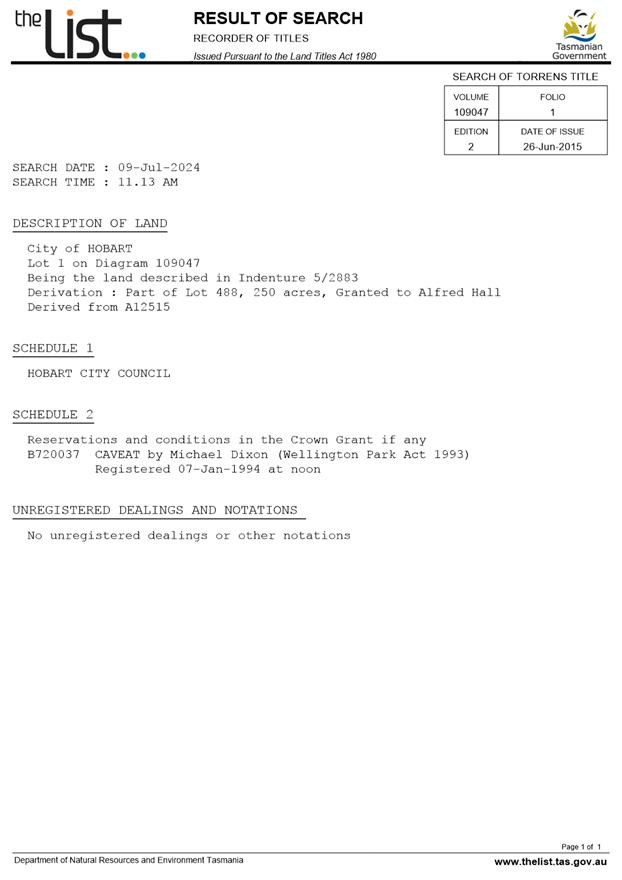
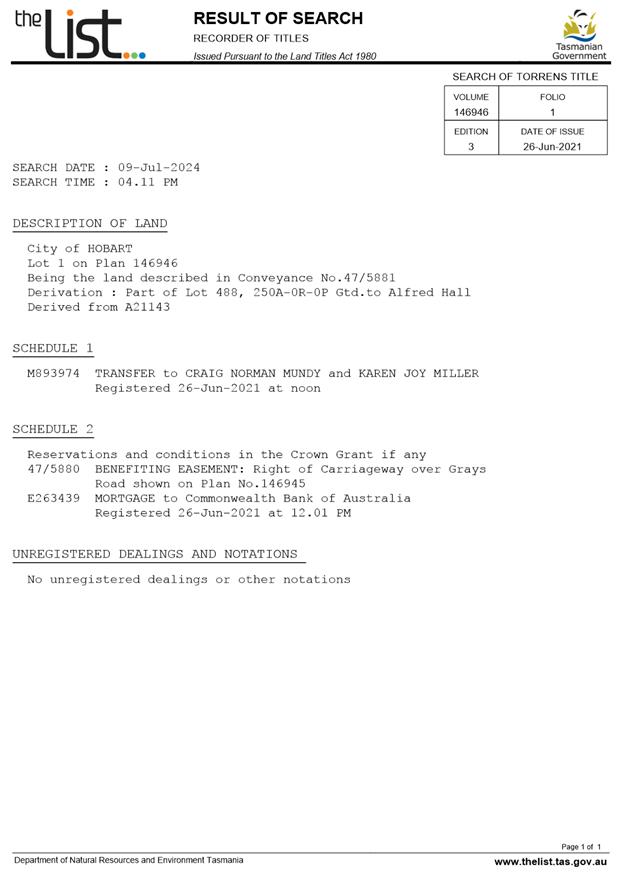
SURV 16 The titles comprising the development site (CT 146945/1 and CT 146946/1) are to be adhered in accordance with the provisions of Section 110 of the Local Government (Building and Miscellaneous Provisions) Act 1993, to the satisfaction of the Council prior to the issue of any building consent, building permit (including demolition) and / or plumbing permit pursuant to the Building Act 2016 (if applicable), or the commencement of works on site (whichever occurs first). Reason for condition To ensure compliance with statutory provisions. Advice: The application for an adhesion order to the Council has a fee of $354. Evidence will be required that the owners and mortgagees do not object to the adhesion and the condition is considered completed when a copy of the receipt for the Land Titles Office lodgement slip for the adhesion order has been received by the Council.
ENV 1 - Environmental Planning - Soil Water Management Plan Sediment and erosion control measures sufficient to prevent sediment from leaving the site must be installed prior to any disturbance of the site, and maintained until all areas of disturbance have been stabilized or re-vegetated. Advice For guidance on preparing the soil and water management plan, the Derwent Estuary Program has published soil and water management on building and construction sites fact sheets. These are available online at derwentestuary.org.au.
ENV 26 - Environmental Planning - Biodiversity No soil is to be imported onto the site unless determined as being free of weed propagules when tested in accordance with Australian Standard AS 4419:2018 Soils for landscaping and garden use.
ENV S1 All construction vehicles and machinery must be effectively cleaned of soil in accordance with the Tasmanian Washdown Guidelines for Weed and Disease Control (April, 2004) both before entering and before leaving the property. Soil cleaned from construction vehicles and machinery must not be allowed, either directly or indirectly, to enter waterways or the Council’s stomwater system.
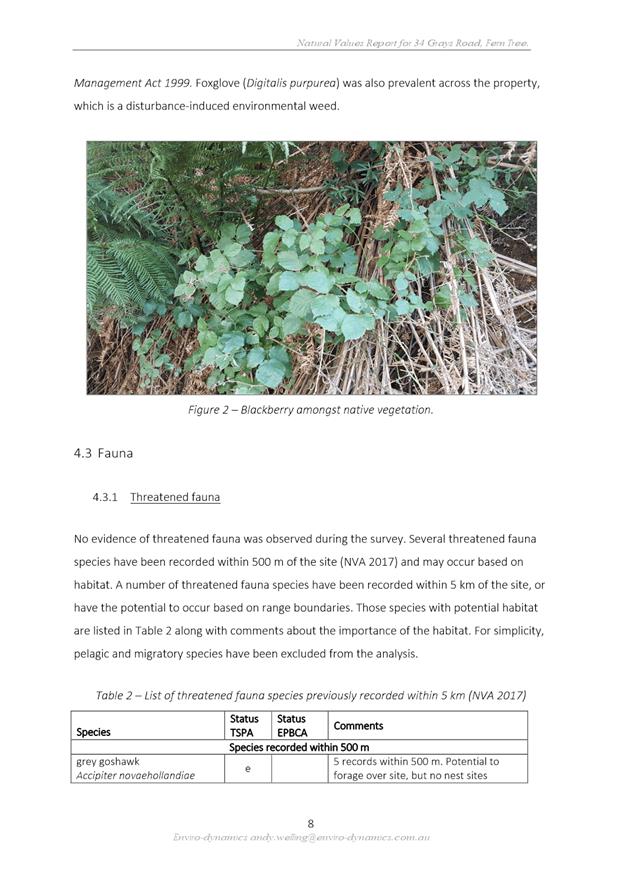
ENV S2 Prior to the commencement of any other works, all blackberry individuals on the lot must be controlled in accordance with the recommendations for blackberry control in the Declared Weeds Index on the Department of Natural Resources and Environment Tasmania website. Further blackberry monitoring and control must be undertaken for an additional two-year period at intervals of no greater than 12 months.
ENG 2B - Development Engineering - Vehicle Barriers Further detailed designs are required for vehicle barriers in the following locations: 1. Driveway 2. Car parking area
This documentation must be submitted and approved as a condition endorsement, prior to the issuing of any approval under the Building Act 2016. The detailed designs must: 1. be prepared and certified by a suitably qualified person; 2. be in accordance with the Australian Standard AS/NZS 1170.1:2002, if possible; and 3. show dimensions, levels, gradients and transitions, and other details as Council deem necessary to satisfy the above requirement.
The vehicle barriers must be installed in accordance with the approved detailed designs prior to first occupation.
ENG 2C - Development Engineering - Vehicle Barriers Prior to the first occupation, a suitably qualified person must certify that the vehicle barriers have been installed in accordance design drawings approved by condition ENG 2B. Advice: An example certificate is available on our website.
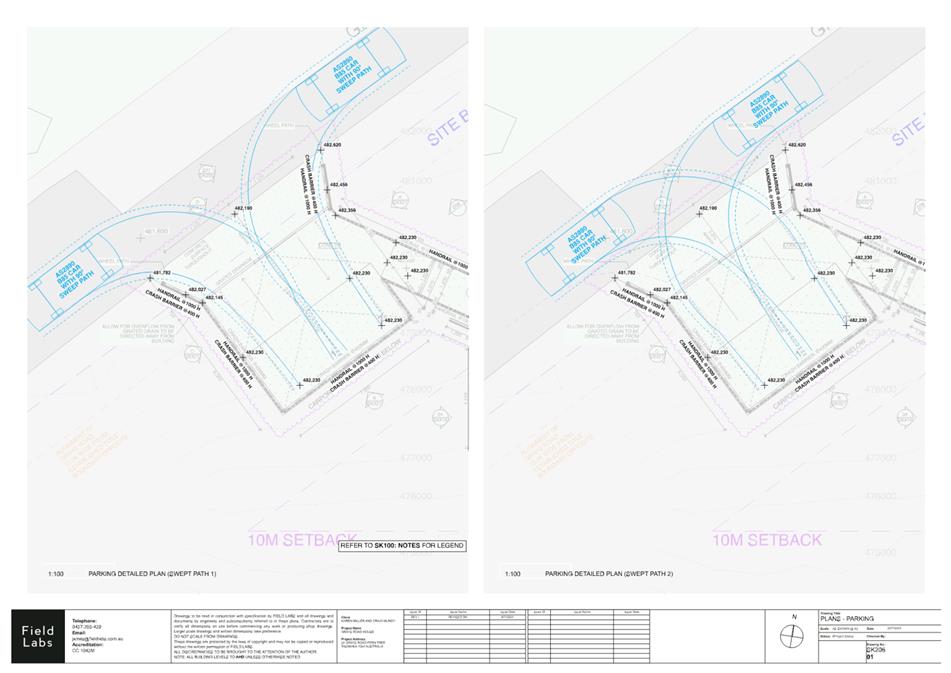
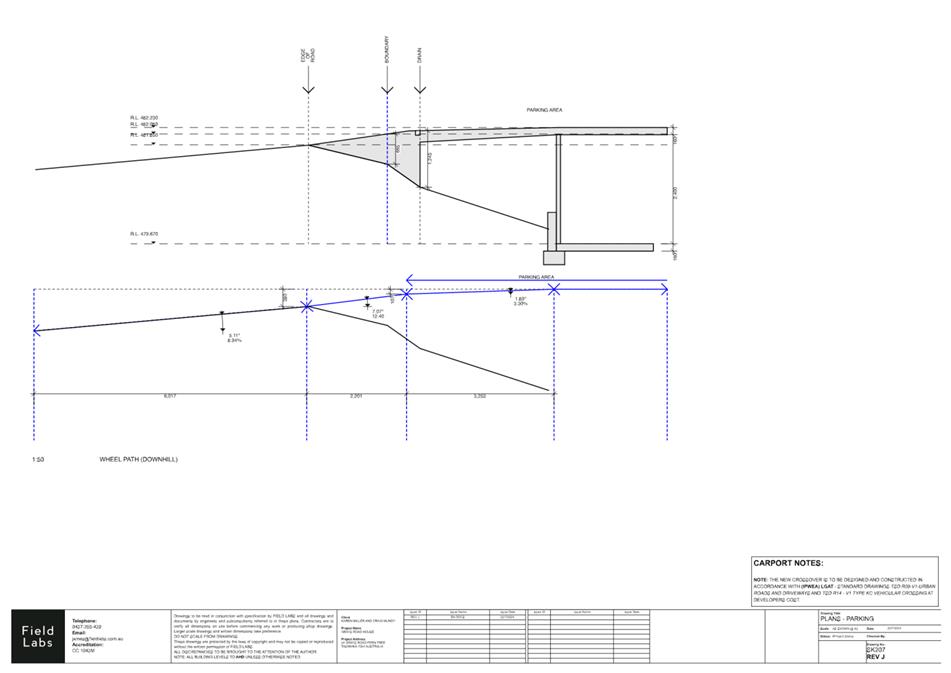
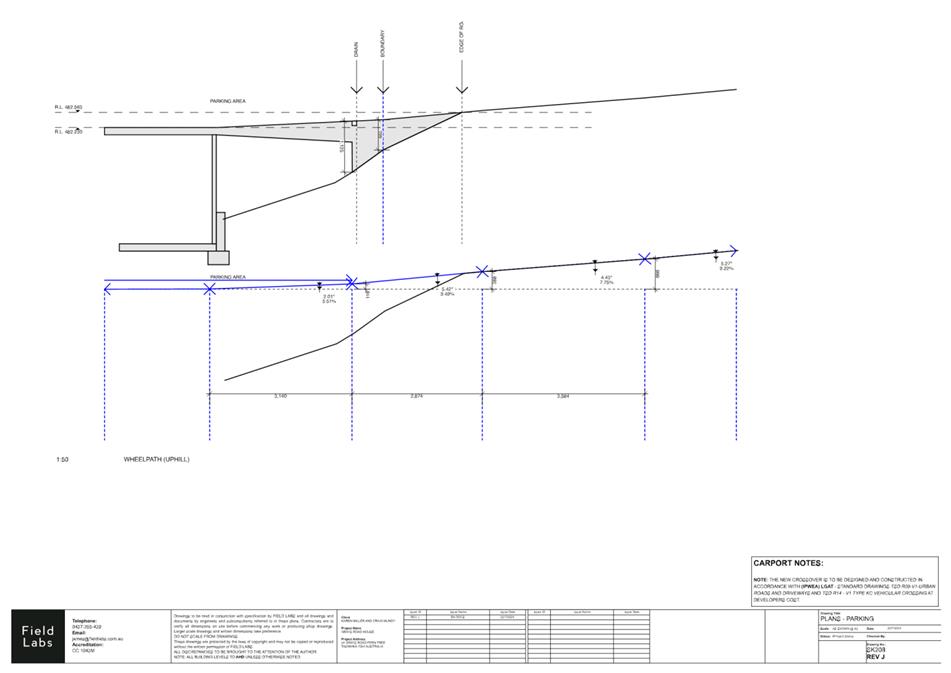
ENG 3C - Development Engineering - Parking and Access Design Prior to the first occupation, a suitably qualified engineer must certify that the access driveway and parking area has been constructed in accordance with design drawings approved by condition ENG 3B. Advice: We strongly encourage you to speak to your engineer before works begin so that you can discuss the number and nature of the inspections they will need to do during the works in order to provide this certification. It may be necessary for a surveyor to also be engaged to ensure that the driveway will be constructed as approved. The reason this condition has been imposed as part of your planning permit is that the driveway is outside the Australian Standard gradients or design parameters. If the driveway is not constructed as it has been approved then this may mean that the driveway will either be unsafe or will not function properly. An example certificate is available on our website.
ENG 4 - Development Engineering - Parking and Access Design The access driveway and parking module (car parking spaces and manoeuvring area) approved by this permit must be constructed to a sealed standard (spray seal, asphalt, concrete, pavers or equivalent Council approved) and surface drained to the Council's stormwater infrastructure prior to the first occupation.
HER s1 - Heritage - Special The proposed stormwater infrastructure as shown in drawing SK301 Rev H must be constructed of the natural stone found in the local area. No impact, demolition or removal of any historic pipe infrastructure within the Pipeline Track is to occur. Reason for condition To ensure that demolition and new development does not result in the loss of historic cultural heritage values of the historic Pipeline Track and Pipeline Track Cultural Landscape Precinct.
ENG 1A - Development Engineering - Protection of Council Assets Any damage to the Hobart City Council’s infrastructure must be reported to City of Hobart as soon as practicable. Any damage to the Hobart City Council’s infrastructure resulting from the implementation of this permit, must, at the election of the Council and within 30 days of demand: 1. be met by the owner by way of reimbursement (cost of repair and reinstatement to be paid by the owner to the City of Hobart); or 2. be repaired and reinstated by the owner to the satisfaction of the City of Hobart.
ENG 3B - Development Engineering - Parking and Access Design The following aspects of the access driveway and parking area require further detailed designs: 1. Driveway 2. Car parking area
This documentation must be submitted and approved as a condition endorsement, prior to the issuing of any approval under the Building Act 2016. The detailed designs must: 1. be prepared and certified by a suitably qualified person,2. be in accordance with the Australian Standard AS/NZS 2890.1:2004, if possible,3. where the design deviates from AS/NZS 2890.1:2004 the designer must demonstrate that the design will provide a safe and efficient access, and enable safe, easy and efficient use; and 2. show dimensions, levels, gradients and transitions, and other details as Council deem necessary to satisfy the above requirement.
The access driveway and parking area must be constructed in accordance with the approved detailed designs prior to first occupation Advice: The detailed design of the access, driveway, and manoeuvring area should be considered prior to finalising the finished floor level of the parking spaces (particularly if located within a garage intrinsic to a dwelling); failure to do so may result in difficulty complying with this condition. ENG r1 – Roads Services – Earth Retaining Structures The earth-retaining structures, footings and driveway deck within or supporting the highway reservation must not undermine the stability and integrity of the highway reservation and its infrastructure. Detailed design drawings and structural certificates of the items mentioned above supporting or within the Grays Road highway reservation must be submitted and approved as a Condition Endorsement, prior to the commencement of work and must: 1. Be prepared and certified by a suitable qualified person and experienced engineer; 2. Not undermine the stability of the highway reservation; 3. Be designed in accordance with AS 4678, with a design life in accordance with table 3.1 typical application major public infrastructure works; 4. Take into account any additional surcharge loadings as required by relevant Australian Standards; 5. Take into account and reference accordingly any Geotechnical findings; 6. Detail any mitigation measures required; 7. Detail the design and location of the footing adjacent to the Grays Road highway reservation.
The structure certificated and/or drawings should note accordingly the above. All work required by this condition must be undertaken in accordance with the approved select design drawing and structural certificates. Advice: This condition requires further information to be submitted as a Condition Endorsement. Refer to the Condition Endorsement advice at the end of this permit. Reason for condition To ensure that the stability and integrity of the Council’s highway reservation is not compromised by the development.
ENG r4 – Roads Services – Vehicle crash barriers and pedestrian handrail/fence within the Grays Road highway reservation Vehicle crash barriers and pedestrian handrail/fence within the Grays Road highway reservation compliant with the Australian/New Zealand Standard AS / NZS 1170.1 and the (IPWEA) LGAT –Tasmanian Standard Drawings must be installed or modified as per the plans prior to the first occupation. A certified design/report prepared by a suitably qualified engineer, to satisfy the above requirements, must be provided to the Council prior to the commencement of work. All works, required by this condition must be undertaken in accordance with certified design/report. Upon completion the barriers must be inspected by a qualified engineer and a certification submitted to the Council, confirming that the installed barriers comply with the above requirement. Reason for condition To ensure that the safety of users of the driveway/parking and compliance with the standard.
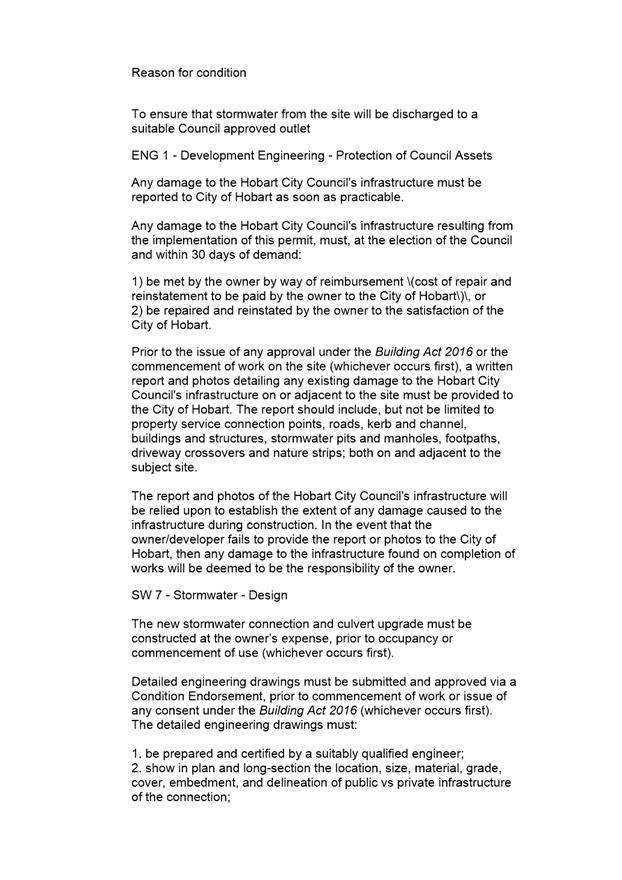
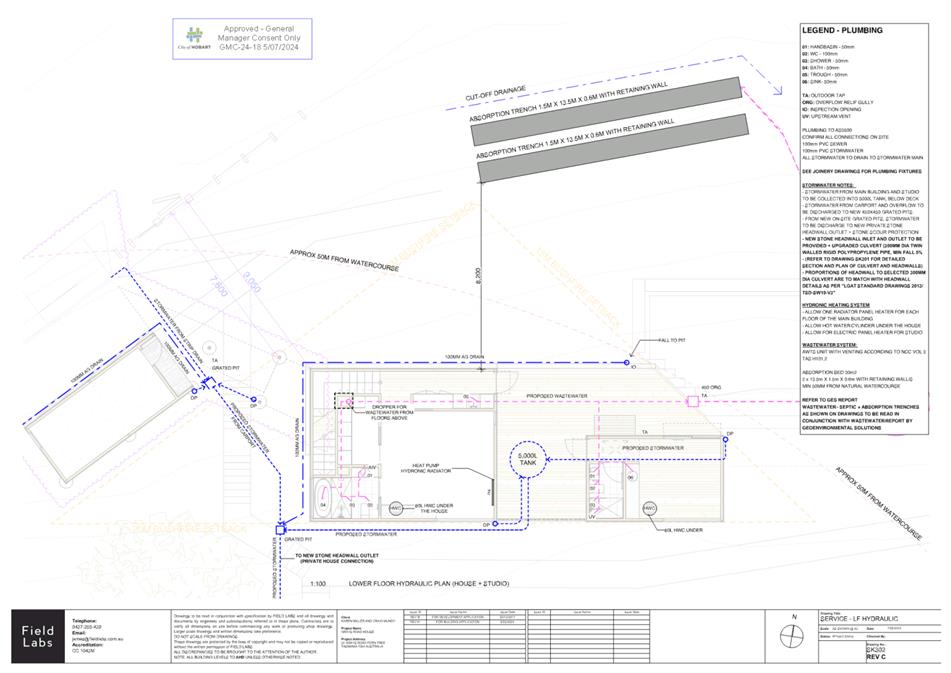
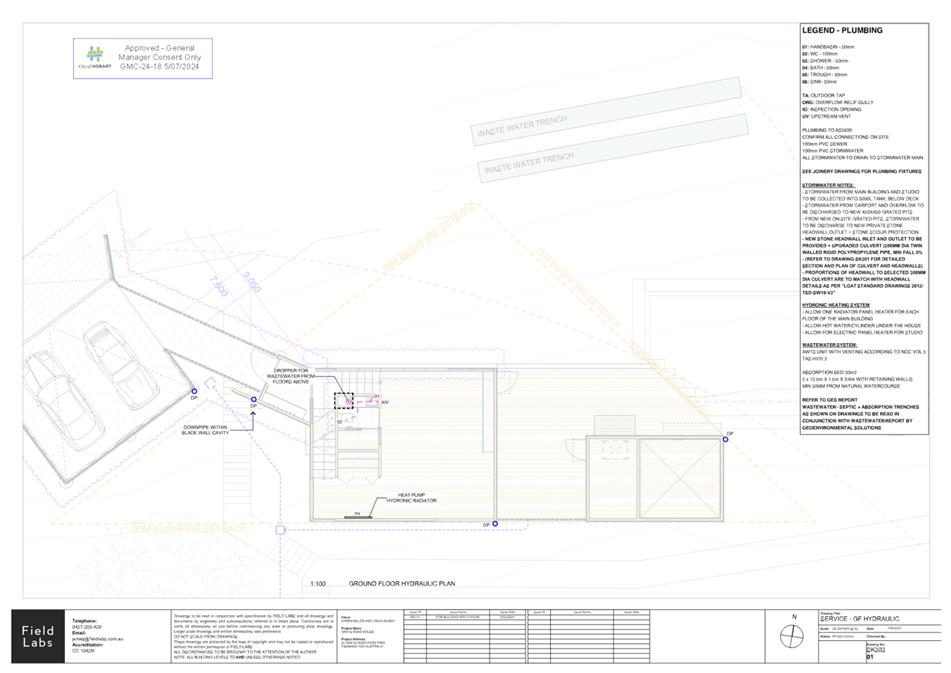
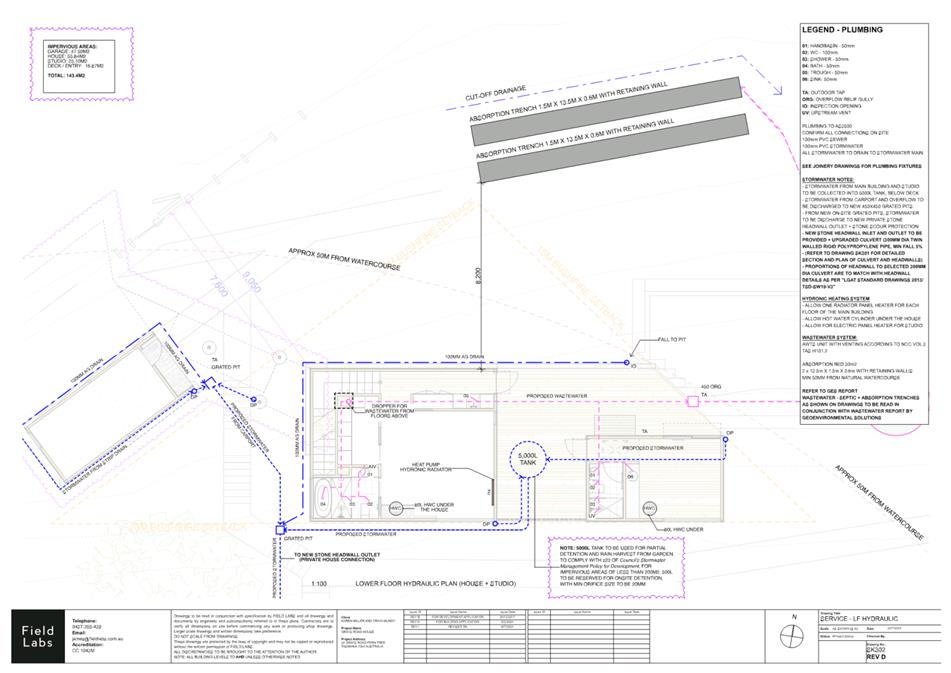
SURV 16 – Surveying Services – Adhesion Order The titles comprising the development site (CT 146945/1 and CT 146946/1) are to be adhered in accordance with the provisions of Section 110 of the Local Government (Building and Miscellaneous Provisions) Act 1993, to the satisfaction of the Council prior to the issue of any building consent, building permit (including demolition) and / or plumbing permit pursuant to the Building Act 2016 (if applicable), or the commencement of works on site (whichever occurs first). Reason for condition To ensure compliance with statutory provisions Advice: The application for an adhesion order to the Council has a fee of $354. Evidence will be required that the owners and mortgagees do not object to the adhesion and the condition is considered completed when a copy of the receipt for the Land Titles Office lodgement slip for the adhesion order has been received by the Council. ENGsw1 - Stormwater - Stormwater drainage All stormwater from the proposed development (including but not limited to: roofed areas, ag drains, and impervious surfaces such as driveways and paved areas) must be drained to Council's stormwater infrastructure prior to occupancy or commencement of use (whichever occurs first). A safe overflow point/ path must be installed and maintained such that any excess flows from the driveway/parking area are conveyed around the development. Advice: Council notes the driveway has negative fall from the road, and as such may receive some road runoff. Reason for condition To ensure that stormwater from the site will be discharged to a suitable Council approved outlet
ENG 1 - Development Engineering - Protection of Council Assets Any damage to the Hobart City Council's infrastructure must be reported to City of Hobart as soon as practicable. Any damage to the Hobart City Council's infrastructure resulting from the implementation of this permit, must, at the election of the Council and within 30 days of demand: 1. be met by the owner by way of reimbursement \(cost of repair and reinstatement to be paid by the owner to the City of Hobart\)\, or 2. be repaired and reinstated by the owner to the satisfaction of the City of Hobart.
Prior to the issue of any approval under the Building Act 2016 or the commencement of work on the site (whichever occurs first), a written report and photos detailing any existing damage to the Hobart City Council's infrastructure on or adjacent to the site must be provided to the City of Hobart. The report should include, but not be limited to property service connection points, roads, kerb and channel, buildings and structures, stormwater pits and manholes, footpaths, driveway crossovers and nature strips; both on and adjacent to the subject site. The report and photos of the Hobart City Council's infrastructure will be relied upon to establish the extent of any damage caused to the infrastructure during construction. In the event that the owner/developer fails to provide the report or photos to the City of Hobart, then any damage to the infrastructure found on completion of works will be deemed to be the responsibility of the owner.
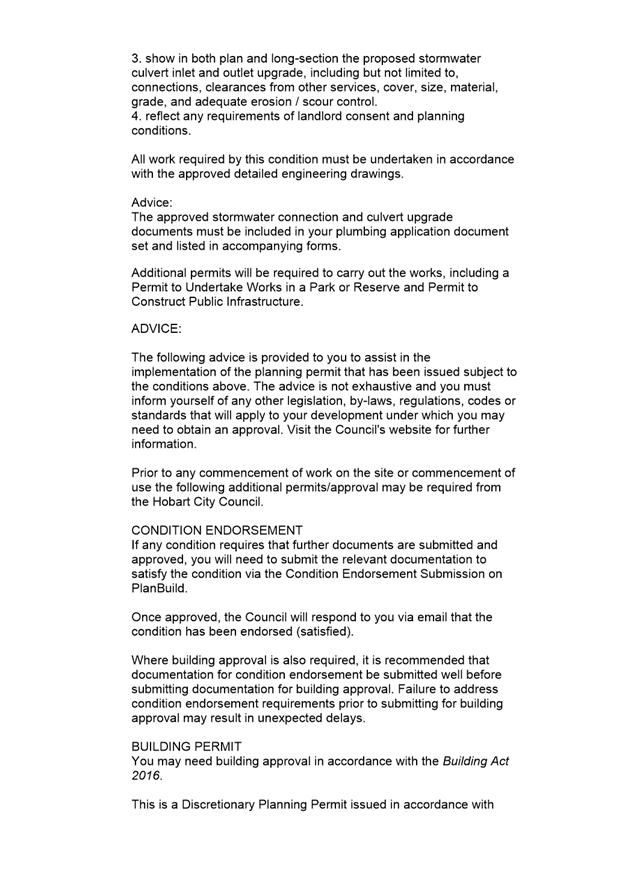
SW 7 - Stormwater - Design The new stormwater connection and culvert upgrade must be constructed at the owner’s expense, prior to occupancy or commencement of use (whichever occurs first). Detailed engineering drawings must be submitted and approved via a Condition Endorsement, prior to commencement of work or issue of any consent under the Building Act 2016 (whichever occurs first). The detailed engineering drawings must: 1. be prepared and certified by a suitably qualified engineer; 2. show in plan and long-section the location, size, material, grade, cover, embedment, and delineation of public vs private infrastructure of the connection; 3. show in both plan and long-section the proposed stormwater culvert inlet and outlet upgrade, including but not limited to, connections, clearances from other services, cover, size, material, grade, and adequate erosion / scour control. 4. reflect any requirements of landlord consent and planning conditions.
All work required by this condition must be undertaken in accordance with the approved detailed engineering drawings. Advice: The approved stormwater connection and culvert upgrade documents must be included in your plumbing application document set and listed in accompanying forms. Additional permits will be required to carry out the works, including a Permit to Undertake Works in a Park or Reserve and Permit to Construct Public Infrastructure.
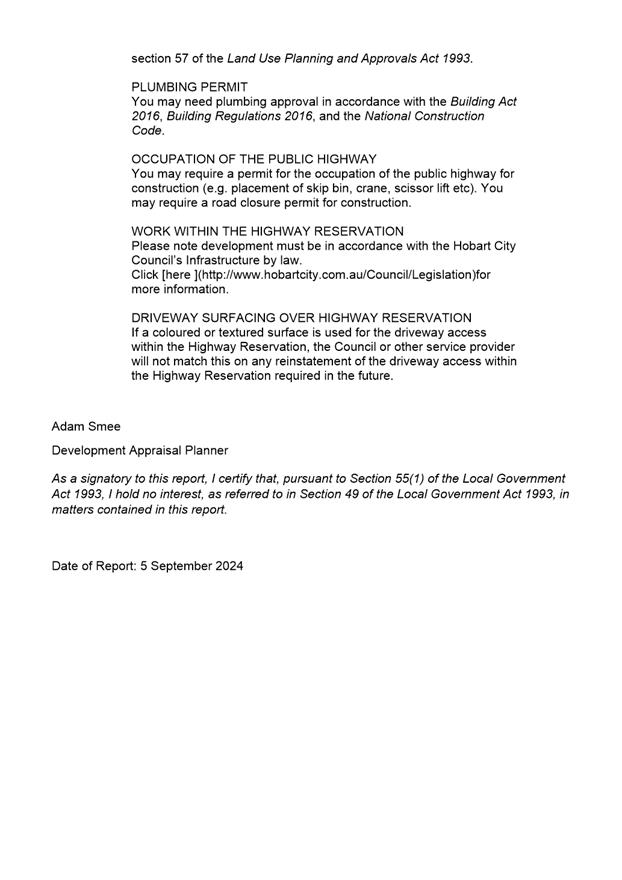
ADVICE: The following advice is provided to you to assist in the implementation of the planning permit that has been issued subject to the conditions above. The advice is not exhaustive and you must inform yourself of any other legislation, by-laws, regulations, codes or standards that will apply to your development under which you may need to obtain an approval. Visit the Council's website for further information. Prior to any commencement of work on the site or commencement of use the following additional permits/approval may be required from the Hobart City Council. CONDITION ENDORSEMENT If any condition requires that further documents are submitted and approved, you will need to submit the relevant documentation to satisfy the condition via the Condition Endorsement Submission on PlanBuild. Once approved, the Council will respond to you via email that the condition has been endorsed (satisfied). Where building approval is also required, it is recommended that documentation for condition endorsement be submitted well before submitting documentation for building approval. Failure to address condition endorsement requirements prior to submitting for building approval may result in unexpected delays.
BUILDING PERMIT You may need building approval in accordance with the Building Act 2016. This is a Discretionary Planning Permit issued in accordance with section 57 of the Land Use Planning and Approvals Act 1993.
PLUMBING PERMIT You may need plumbing approval in accordance with the Building Act 2016, Building Regulations 2016, and the National Construction Code.
OCCUPATION OF THE PUBLIC HIGHWAY You may require a permit for the occupation of the public highway for construction (e.g. placement of skip bin, crane, scissor lift etc). You may require a road closure permit for construction.
WORK WITHIN THE HIGHWAY RESERVATION Please note development must be in accordance with the Hobart City Council’s Infrastructure by law. Click here for more information.
DRIVEWAY SURFACING OVER HIGHWAY RESERVATION If a coloured or textured surface is used for the driveway access within the Highway Reservation, the Council or other service provider will not match this on any reinstatement of the driveway access within the Highway Reservation required in the future.
|
Attachment a: Planning
Assessment Report - 30-34 Grays Rd Fern Tree ⇩ 
Attachment
b: PLN-24-326
- 30-34 GRAYS ROAD FERN TREE TAS 7054 - PC Agenda Documents ⇩ 
|
Agenda (Open Portion) Planning Committee Meeting |
Page 1 |
|
|
|
11/9/2024 |
|
7. Reports
7.1 Medium Density Design Guidelines & Improving Residential Standards in Tasmania – Draft City of Hobart Submissions
Report of the Manager Land Use and Development Planning and the Acting Director City Futures of 6 September 2024 and attachments.
Delegation: Committee
|
Item No. 7.1 |
Agenda (Open Portion) Planning Committee Meeting |
Page 1 |
|
|
11/9/2024 |
|
REPORT TITLE: Medium Density Design Guidelines & Improving Residential Standards in Tasmania – Draft City of Hobart Submissions
REPORT PROVIDED BY: Manager Land Use and Development Planning
Acting Director City Futures
1. Report Summary
1.1. The State Government is seeking feedback on the draft Medium Density Design Guidelines (the Guidelines) and the Improving Residential Standards in Tasmania Draft Report (the Standards).
1.1.1. The Guidelines respond to the need to facilitate a higher standard of medium density residential development in Tasmania, particularly in greater Hobart.
1.1.2. The Standards respond to the significant changes being pursued through the implementation of the Tasmanian Planning Scheme (TPS), introduction of the Tasmanian Planning Policies (TPP), and review of the Regional Land Use Strategies (RLUS). More broadly, they respond to the Tasmanian Government’s commitment to the National Planning Reform Blueprint.
1.1.3. The City has drafted submissions to inform the development of both projects and has considered the draft documents in the Hobart LGA context, as well as considering our draft Local Provisions Schedule (TPS) work completed to-date, noting we are still operating under the Hobart Interim Planning Scheme 2015.
2. Key Issues
2.1. The submissions, firstly, commend the State Government for the development of these two projects and welcomes these documents at a time when the need for improving housing design could not be more significant in shaping and delivering a more compact city through high-quality built form responses that adequately serve the City’s residents and visitors.
We acknowledge that City of Hobart (CoH) officers have attended multiple workshops in the lead up to the draft Guidelines being released for community engagement and are satisfied that feedback given by officers has been reflected in the draft guidelines. We also note, that one of our strategic land use planning officers has been a member of the Technical Reference Group for the development of the Standards.
2.2. Notwithstanding the above, the submissions identify several key areas that require further consideration and seek clarification as detailed in the submissions. These have been summarised below:
2.2.1. The Guidelines submission (Attachment A)
The City is highly supportive of the Guidelines and notes they align well with the Standards. However, whilst the aim of the guidelines is to apply to a wide range of medium density housing typologies, they appear to focus mostly on terrace and townhouses. This could be addressed by having more variety in relation to diagrams, photos and design responses.
2.2.2. The Standards submission (Attachment B)
The City is highly supportive of the Standards and welcomes the report at a critical time for Tasmania’s housing sector. We support the introduction of the new controls such as plot ratios, revised setback and building height controls (noting some caveats and clarifications as detailed in the submission) and the new controls for solar access and landscaping and open space controls.
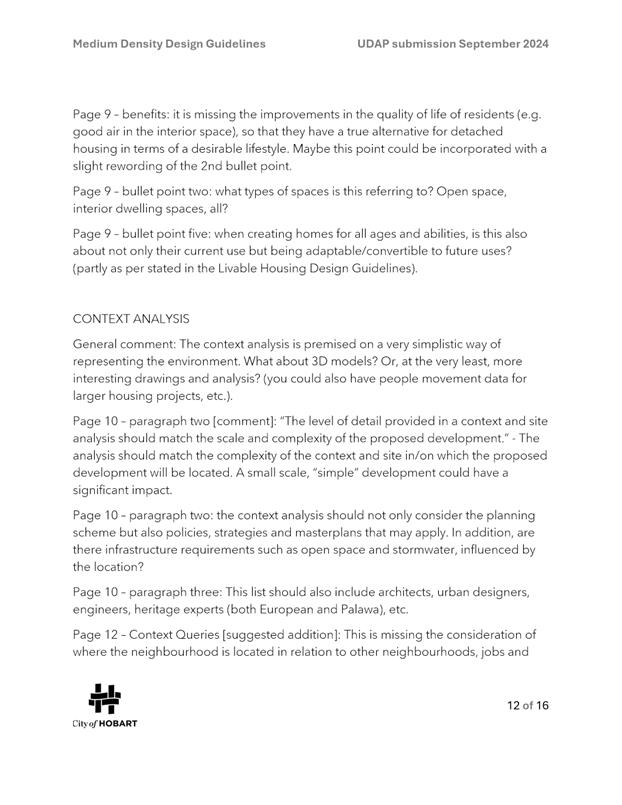
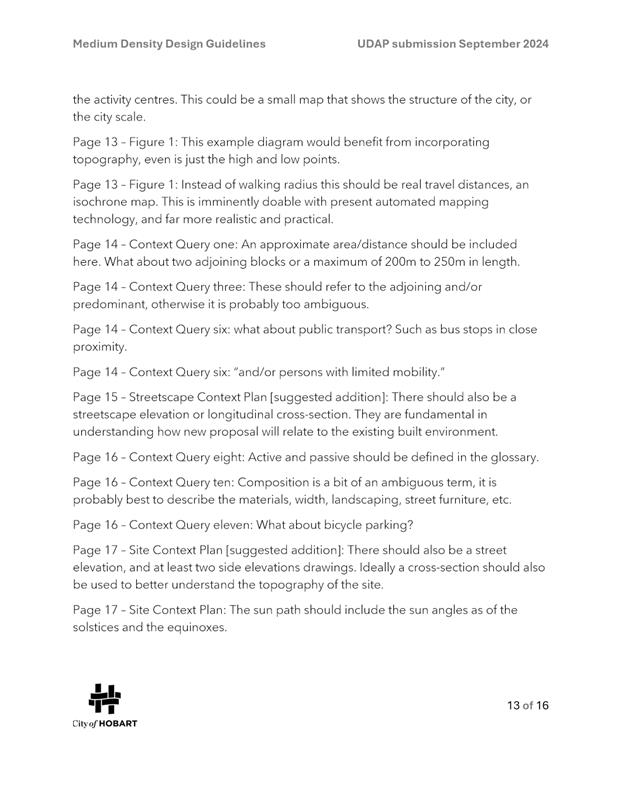
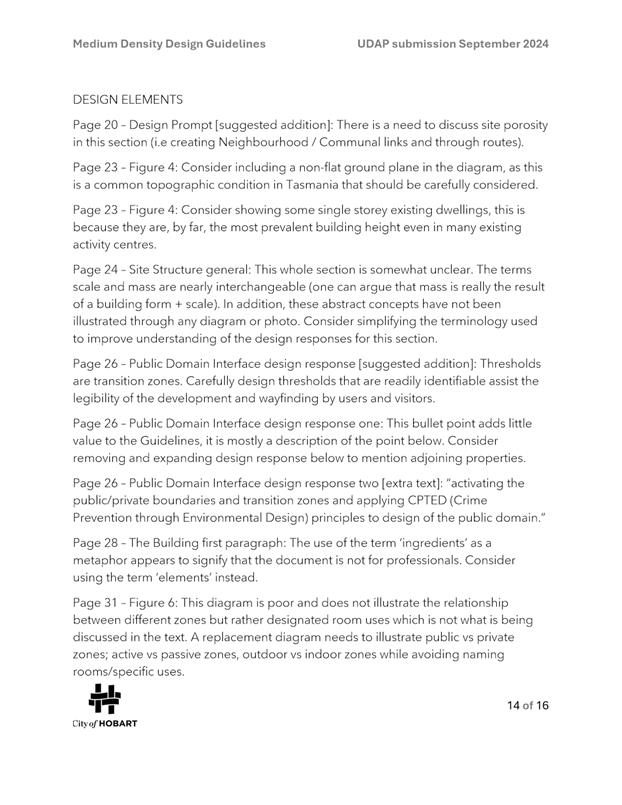
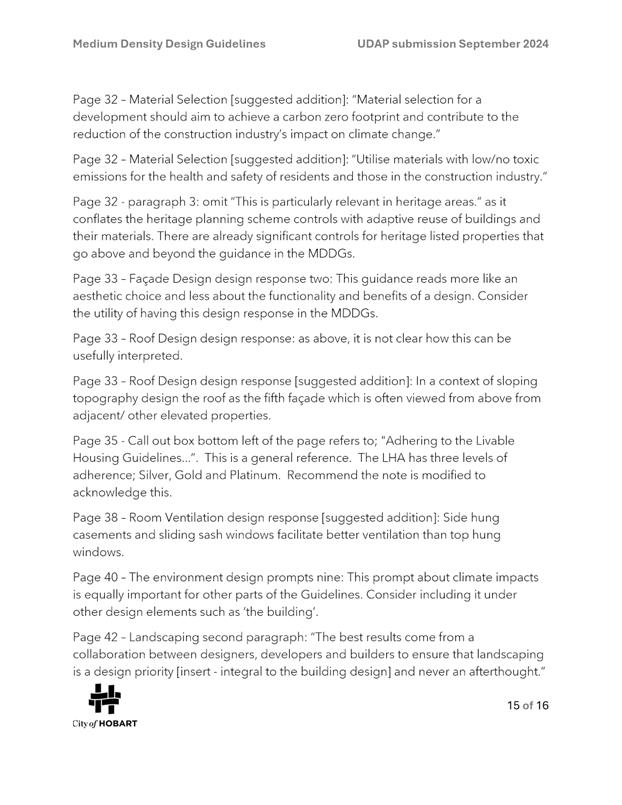
2.3. The City’s Urban Design Advisory Panel (UDAP) has also prepared feedback for the Guidelines and we have attached the feedback to this Report (Attachment C).
|
1. The Planning Committee notes the officer recommendations and feedback on the draft Medium Density Design Guidelines and Improving Residential Standards in Tasmania, and notes the draft submissions as prepared in response to these Guidelines and Standards. |
4. Background
4.1. Medium Density Design Guidelines
The guidelines have been prepared for a diverse audience and are intended to facilitate a higher standard of medium density residential development in Tasmania, particularly Greater Hobart.
The guidelines aim to:
· Support innovative design in medium density housing development
· Promote housing that caters to different ages and needs, including small family, large family and non-family households
· Encourage development that sets a good precedent and contributes to a positive community perception of medium density housing
· Promote designs that respond to the natural and built features of the area and, for precincts undergoing transition, the desired character as stated in the local planning framework and relevant strategic planning strategies
· Encourage development that is appropriate in scale and minimises impacts from building bulk, overlooking, and overshadowing
· Improve liveability by designing for:
o Sufficient sunlight and natural ventilation
o High quality private open space and communal open space
o Climate resilience and resource efficiency
o A strong sense of ownership, privacy and security for residents
o Appropriate vehicle access and parking options
o Locally appropriate landscaping and urban greening.
4.2. Improving Residential Standards in Tasmania
Many important residential standards seen in other states and territories are not currently covered by the planning system in Tasmania.
The draft report details a range of potential improvements to the existing development standards. The three primary initiatives include new controls for:
· Residential diversity and density
· To enable increased diversity and density in the right locations by introducing new plot ratio controls
· Building height and setbacks
· To improve the design response to location and housing type by revising building heights and setback controls
· Landscaping and common space
· To improve liveability, climate resilience, and design quality by introducing controls for landscaping, deep soil areas, and provision of both private and common open space areas.
5. Legal, Risk and Legislative Considerations
5.1. Other than reputational and normal project management risk considerations, no specific legal, risk and legislative issues are seen to apply to the submissions being lodged with the respective state government agencies.
5.2. The Guidelines and Standards:
5.2.1. The Guidelines is a non-statutory document, and the implementation methodology is still yet to be determined.
5.2.2. For the Standards to be effective, these will need to be implemented in the Tasmanian Planning Scheme however the implementation methodology is still yet to be determined.
5.3. Ultimately, the City of Hobart needs to maintain trust with its stakeholders (community, business/investors, and other tiers of government) by continuing its involvement in the development of the Guidelines and Standards. Not doing so could result in significant reputational consequences, which may also impact development and investor confidence.
6. Discussion
6.1. The Standards
The Standards are presented in three sections. Our feedback has been set out to align with these sections and the survey questions.
6.1.1. Section 1: Development Standards
The City generally supports the introduction of the new standards as set out in the report. However, we have included in our submission some specific commentary and sought clarifications around some issues, including (but not limited to):
· The application of new building setback controls and how they would apply in heritage precincts or adjacent to heritage buildings and sought clarifications around specific metrics.
· The application of new building setback controls and how they will work with other amenity controls to ensure amenity and solar access is maintained for the subject site and adjoining sites.
· The City supports the provisions of controls for Private Open Space (POS) and Common Open Space (COS), however, questions some of the ratios as documented and seeks clarifications. For example, why ground floor apartments require 15m2 POS as opposed to the number of bedrooms being the deciding factor on size of POS.
· The City is supportive of the solar access controls and acknowledge we could not support an increase to heights or chances to side setbacks without them. However, consideration should be given to a standardised method of measuring sunlight/daylight or verification of methodology to ensure they can be clearly assessed by planners.
6.1.2. Section 2: Subdivision Standards
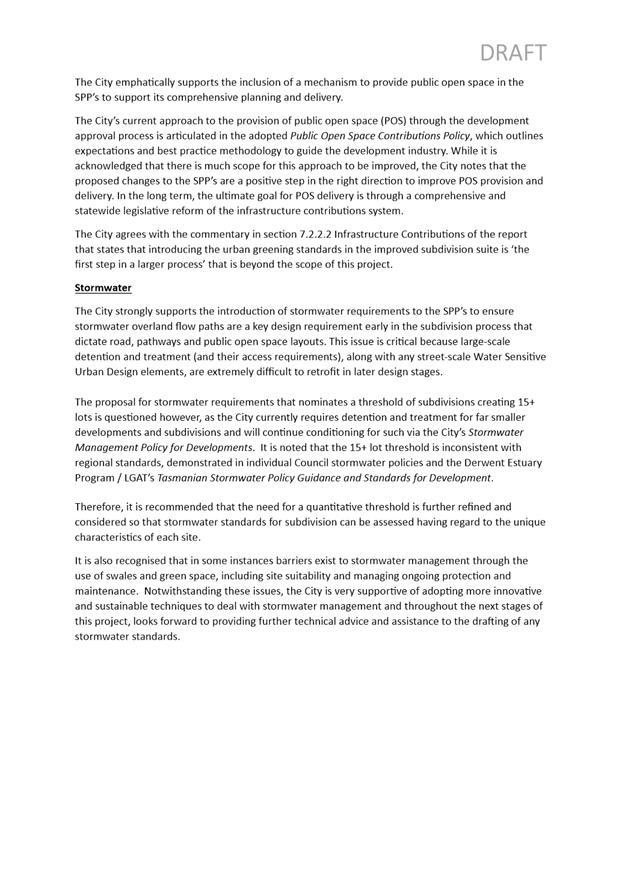
The City strongly supports the range of potential improvements proposed to the existing suite of subdivision standards that are explored in the report, in particular, lot design, subdivision design and lot layout, urban greening and landscaping, movement networks, and services.
A detailed analysis is further provided in the submission on the topics of urban greening and services (stormwater). Points cover supporting the inclusion of a mechanism to provide public open space in the SPP’s to support its comprehensive planning.
The City also strongly supports the introduction of stormwater requirements to the SPP’s to ensure stormwater overland flow paths are a key design requirement early in the subdivision process that dictate road, pathways and public open space layouts.
This issue is critical because large-scale detention and treatment (and their access requirements), along with any street-scale Water Sensitive Urban Design elements, are extremely difficult to retrofit in later design stages.
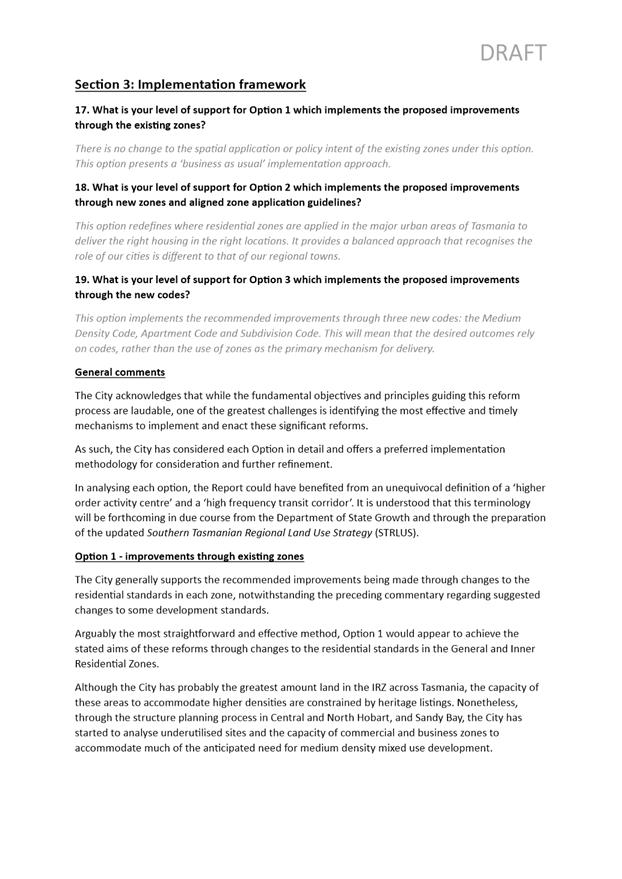
6.1.3. Section 3: Implementation framework
Three options have been provided for stakeholders and the community to provide feedback on. The options focus on amendments to zones and codes, which are the key tools we have available through the State Planning Provisions. The three options are:
1. Delivering the new standards through amendments to the existing zones,
2. Delivering the new standards through the creation and application of new zones, or
3. Improvements through the delivery of new codes.
It is worth noting, the same set of amendments to the residential standards could be brought in under any of the implementation pathways. There may also be variations to the implementation options to align with priorities.
For example, it may be preferable to deliver improvements in stages, some through the existing zoning suite but others through the development of a new code.
As such, the City has considered each Option in detail and offers a preferred implementation methodology for consideration and further refinement.
In analysing each option, the Report could have benefited from an unequivocal definition of a ‘higher order activity centre’ and a ‘high frequency transit corridor’. It is understood that this terminology will be forthcoming in due course from the Department of State Growth and through the preparation of the updated Southern Tasmanian Regional Land Use Strategy (STRLUS).
6.1.4. Implementation Option 1
The City generally supports the recommended improvements being made through changes to the residential standards in each zone, notwithstanding the preceding commentary regarding suggested changes to some development standards.
Arguably the most straightforward and effective method, Option 1 would appear to achieve the stated aims of these reforms through changes to the residential standards in the General and Inner Residential Zones (IRZ).
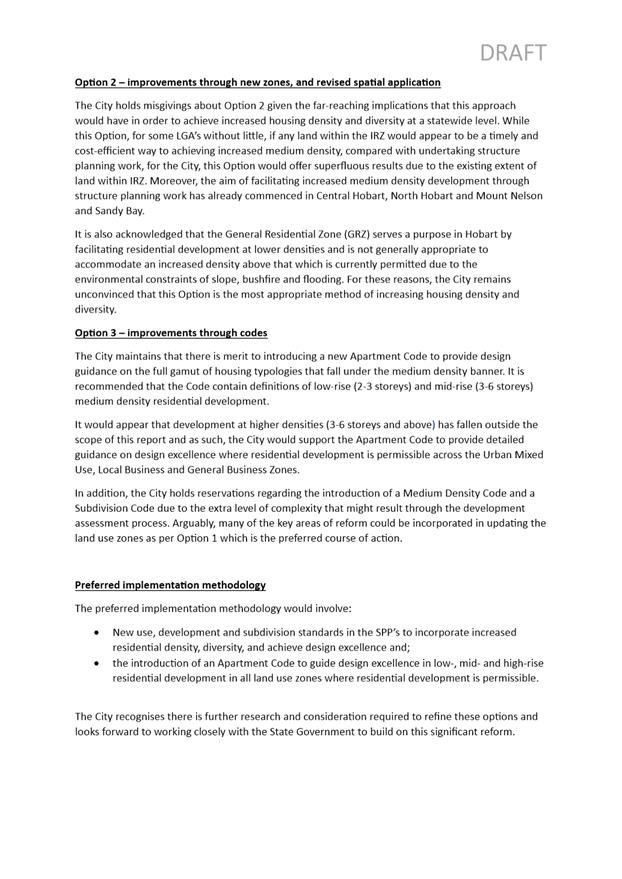
6.1.5. Implementation Option 2
The City has concerns about Option 2 due to its broad implications for achieving increased housing density and diversity statewide. While this option may be efficient for LGAs with little or no land within the IRZ, it would yield unnecessary results for the City, given the existing IRZ land.
The City has already begun facilitating increased medium-density development through structure planning in Central Hobart, North Hobart, Mount Nelson, and Sandy Bay.
Additionally, the General Residential Zone (GRZ) in Hobart is appropriate for lower-density development, considering environmental constraints like slope, bushfire risk, and flooding. Therefore, the City is not convinced that Option 2 is the best method to increase housing density and diversity at this stage.
6.1.6. Implementation Option 3
The City still supports introducing a new Apartment Code to guide the design of all medium-density housing types, recommending it include definitions for low-rise (2-3 storeys) and mid-rise (3-6 storeys) developments.
Given higher-density developments (3-6 storeys and above) have fallen out of the scope of the current report, the City supports the Apartment Code to provide design excellence guidance for where residential development is permissible in the Urban Mixed Use, Local Business, and General Business Zones.
However, the City is cautious about introducing a Medium Density Code and Subdivision Code, fearing added complexity in the development assessment process. Many key reforms could be addressed by updating land use zones, as recommended in Option 1, which is the City’s preferred approach.
6.2. The Guidelines: The Guidelines have been separated into 3 sections. The introduction, Context Analysis and Design Elements. Our feedback thus reflects this structure and has been summarised into key points below:
6.2.1. The document's clarity could be improved by simplifying terminology, adding diagrams, and including passive surveillance in the checklist, while enhancing the dwelling layout diagram to better illustrate daylight, ventilation, and surrounding context.
6.2.2. While the Guidelines aim to apply to a wide range of housing typologies they appear to focus mostly on terrace and townhouses. These may indeed be preferable and easier to be delivered across the state, however, they are not the only form of medium density housing. This could be addressed by either circumscribing more clearly what typologies the Guidelines apply to or by having more variety in relation to the diagrams, photos and design responses.
6.2.3. More references to associated planning codes would be useful throughout the document, such as the Landslip Hazard Code in the Sloping Site section.
6.2.4. The context analysis appears to be premised on a very simplified representation of the natural and built environment, in particular, the example diagrams. This would not be an issue if the analysis also included other tools and methods that are now standard practice, such as 3D models, movement and dwell data, especially for larger and more complex proposals.
6.2.5. Implementation of the Guidelines
At this stage, the State Government has not communicated how it expects the Guidelines to be used/implemented, particularly by local governments. However, through discussion in the workshops, we are expecting that they may become (non-statutory) checklists for planning review panels such as UDAP and may be referred to generally by planners and the community in assessments and submissions. We expect further clarifications on the implementation of the guidelines in the coming months.
7. Hobart: A Community Vision For Our Island Capital
7.1. The ongoing development of the Guidelines and Standards has strong linkages to the Community Vision Pillars, particularly:
· Sense of Place
· Creativity and Culture
· City Economies
· Movement and Connectivity
· Built Environment
· Governance and Civic Involvement
8. Capital City Strategic Plan
8.1. The draft submissions, Standards and Guidelines projects respond to several key actions in the Capital City Strategic Plan 2023:
1.2.2: Ensure City place-making planning and initiatives embody civic pride by reflecting community values and the character of local neighbourhoods.
1.2.6: Champion, encourage and acknowledge design excellence in the built environment.
2.3.5: Ensure neighbourhoods, streets and public spaces help all people to be healthy and physically active.
6.1.6: Increase urban tree canopy cover and greenery throughout Hobart.
6.2.1: Support initiatives for residents and visitors to foster their connection to nature.
7.1.1: Advocate for increased housing supply including social and affordable housing delivered through a range of supported accommodation models.
7.1.3: Identify and leverage City-owned assets that could support beneficial social and affordable housing outcomes.
7.2.1: Develop and advocate for increasing city densification that reflects Hobart’s character, in line with neighbourhood structure planning.
8.1.2: Ensure the needs of the community are well represented through effective advocacy and strong collaborative partnerships with key stakeholders and all levels of government.
9. Regional, State and National Plans and Policies
9.1. The Standards:
Tasmania’s planning system is in a period of maturing. Significant changes include the implementation of the Tasmanian Planning Scheme (TPS), introduction of the Tasmanian Planning Policies (TPP), and review of the Regional Land Use Strategies (RLUS).
Where relevant, the Standards report refers to the following parallel work:
· Review of Subdivision Standards Project, including relevant parts of the Local Government (Building and Miscellaneous Provisions) Act 1993, and subdivision design guidelines (DPAC),
· Review of Parking and Sustainable Transport Code Project (DPAC),
· Tasmanian Development Manual Project (LGAT), and
· Improved Guidance and Background Information on the SPPs Project (DPAC).
9.2. The Guidelines:
The Guidelines are a non-statutory document developed as part of the implementation of the Greater Hobart Plan.
The 30-year Greater Hobart Plan (GHP) for Growth and Change was jointly endorsed in 2022 by the State Government, City of Hobart, Glenorchy City, Clarence City and Kingborough Councils. The GHP aims to deliver a compact city that caters for a growing population by providing the right development in the right places. It also aims for improved liveability, and affordable and diverse housing.
10. Financial Viability
10.1. Funding Source and Impact on Current Year Operating Result
10.1.1. The Guidelines were funded by the Department of State Growth and the Clarence, Glenorchy, Hobart and Kingborough Councils as a priority action under the Greater Hobart Plan.
10.1.2. The standards were funded by the State Planning Office, Department of Premier and Cabinet after being identified as a priority action as part of the comprehensive review of the SPPs which commenced in March 2022 as part of the 5-yearly statutory review required under the Land Use Planning and Approvals Act 1993 (LUPAA).
10.1.3. There is no further foreseeable financial impact for this financial year.
11. Sustainability Considerations
11.1. Climate change, Resilience and Sustainability are key drivers for the guidelines and standards.
11.1.1. By the end of the century, Tasmania will experience warmer average temperatures, additional extreme hot weather days, and more intense rainfall events. Given buildings are designed to last well over 50 years, they should be designed with these trends in mind to ensure they meet the needs of both the existing and future climate.
11.1.2. Effective and sustainable design must also consider the climate change risk to a site arising from land hazards such as coastal inundation, flooding and bushfire. Additionally, as the climate changes there is a need to consider the water cycle at all stages of the design process. This includes early site planning that prioritises deep soil zones for drainage, the design of dwellings and circulation spaces that can capture and recycle stormwater and wastewater, and landscaping that is appropriate for local and future rainfall patterns.
11.2. At a fundamental level, the Guidelines and Standards will help deliver on the 70% infill target set out in the 30-Year Greater Hobart Plan. A compact city significantly decreases the need for additional infrastructure and the need for travel, both of which are sources of greenhouse emissions. Reduced need for urban sprawl outside of existing suburb boundaries also reduces the need for tree clearing and negative impacts on agricultural land for housing.
11.3. Furthermore, the emphasis on active travel will make it easier to reduce emissions in relation to transport, which is Hobart’s largest source of greenhouse emissions.
11.4. Finally, the Guidelines and Standards call for buildings that are designed to be more environmentally sustainable with building setbacks that allow for solar access, water sensitive urban design (WSUD) provisions and improved neighbourhood amenity.
12. Community Engagement
12.1.1. Wide community engagement is currently taking place and is being led by the State Government agencies. Submissions are welcome from the community until 6 September 2024.
13. Communications Strategy
13.1. The relevant government agencies have developed Communication Plans for the projects. The City will continue to engage with the State Government as the projects progress.
14. Innovation and Continuous Improvement
14.1. The Guidelines are intended to provide ‘best-practice’ guidance to planners, designers and developers in the preparation and assessment of medium density development proposals from the earliest stage.
14.2. Delivering diverse, well-designed, and well-located housing is an aspiration for all Tasmania’s cities and towns. Bringing our development Standards up to date is essential to guide future housing development. The Standards focus on enabling built form outcomes that have a positive relationship to the surrounding built and natural landscape.
15. Collaboration
15.1. The Guidelines and the Standards represent the collective effort of local government officers across Tasmania, planning professionals as well as key stakeholders from the development community as well as members of the wider community.
As signatory to this report, I certify that, pursuant to Section 55(1) of the Local Government Act 1993, I hold no interest, as referred to in Section 49 of the Local Government Act 1993, in matters contained in this report.
|
Jennifer Lawley Manager Land Use and Development Planning |
Philip Holliday Acting Director City Futures |
Date: 6 September 2024
File Reference: F24/70629
Attachment a: Medium
Density Design Guidelines - COH Submission ⇩ 
Attachment
b: Improving
Residential Standards in Tasmania - COH submission ⇩ 
Attachment
c: Medium
Density Design Guidelines - COH UDAP submission ⇩
|
Agenda (Open Portion) Planning Committee Meeting |
Page 1 |
|
|
|
11/9/2024 |
|
7.2 Delegated Decision Report (Planning)
Memorandum of the Acting Director City Life of 5 September 2024 and attachment.
Delegation: Committee
|
Item No. 7.2 |
Agenda (Open Portion) Planning Committee Meeting |
Page 1 |
|
|
11/9/2024 |
|

Memorandum: Planning Committee
Delegated Decision Report (Planning)
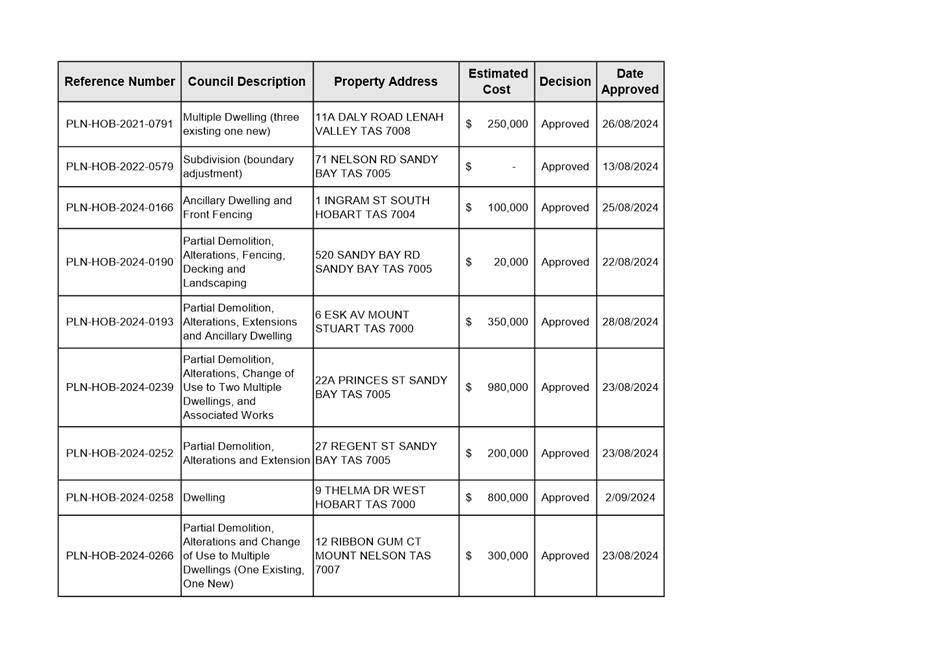
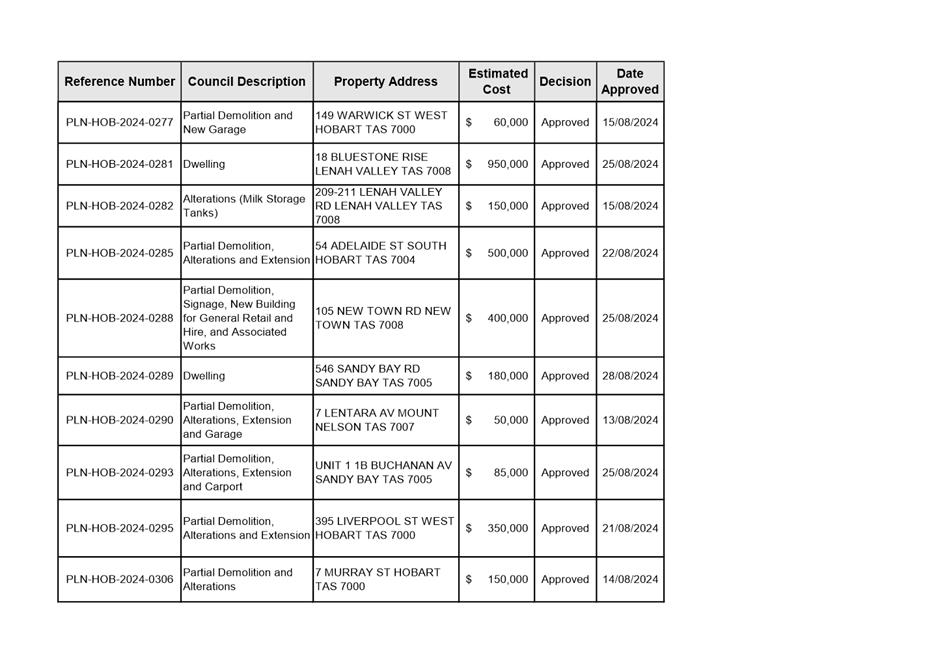
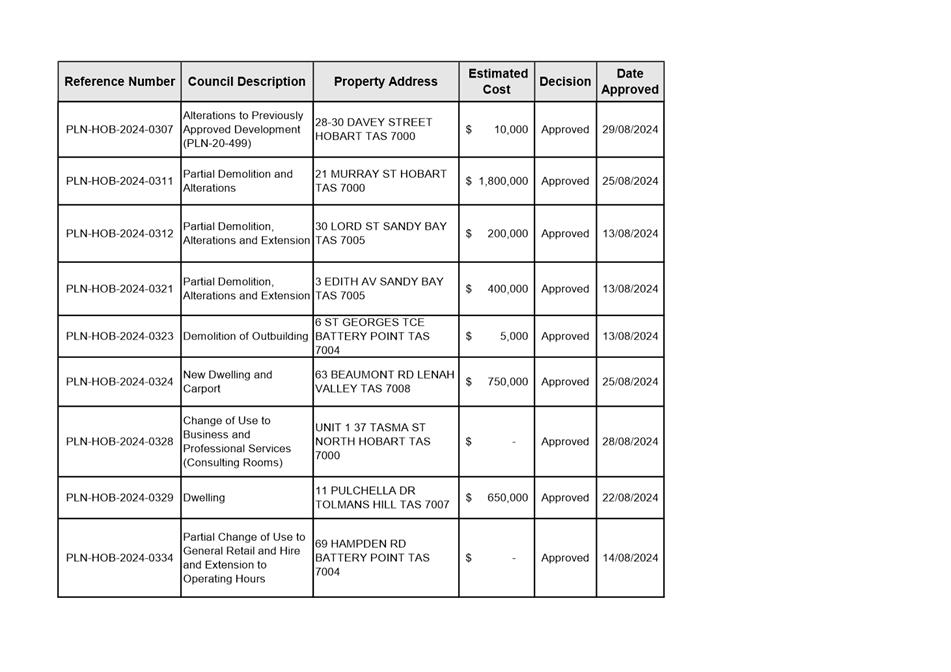
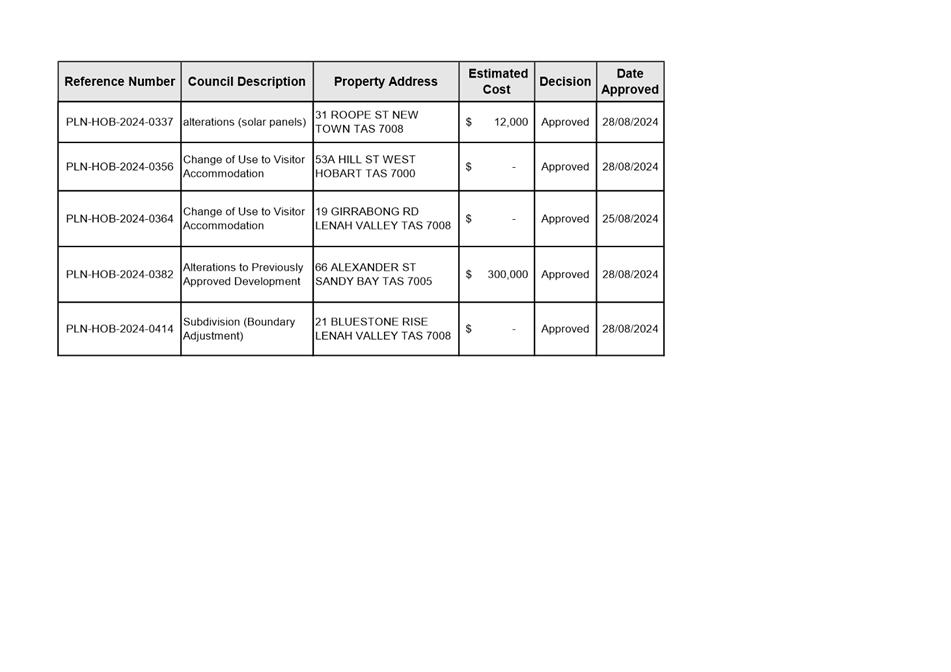
Attached is the delegated planning decisions report for the period 18 August 2024 to 4 September 2024.
|
That: 1. That the information contained in the Delegated Decision Report (Planning) be received and noted.
|
As signatory to this report, I certify that, pursuant to Section 55(1) of the Local Government Act 1993, I hold no interest, as referred to in Section 49 of the Local Government Act 1993, in matters contained in this report.
|
Karen Abey Acting Director City Life |
|
Date: 5 September 2024
File Reference: F24/80645
Attachment a: Delegated
Decision Report (Planning) ⇩ 
|
Agenda (Open Portion) Planning Committee Meeting |
Page 1 |
|
|
|
11/9/2024 |
|
7.3 Planning - Advertised Applications Report
Memorandum of the Acting Director City Life of 5 September 2024 and attachment.
Delegation: Committee
|
Item No. 7.3 |
Agenda (Open Portion) Planning Committee Meeting |
Page 1 |
|
|
11/9/2024 |
|

Memorandum: Planning Committee
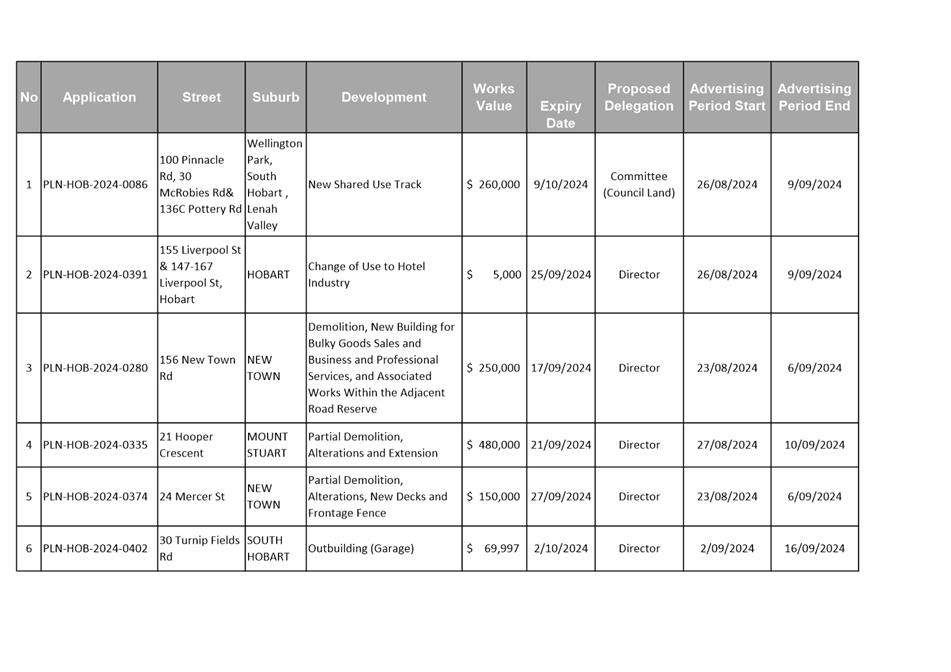
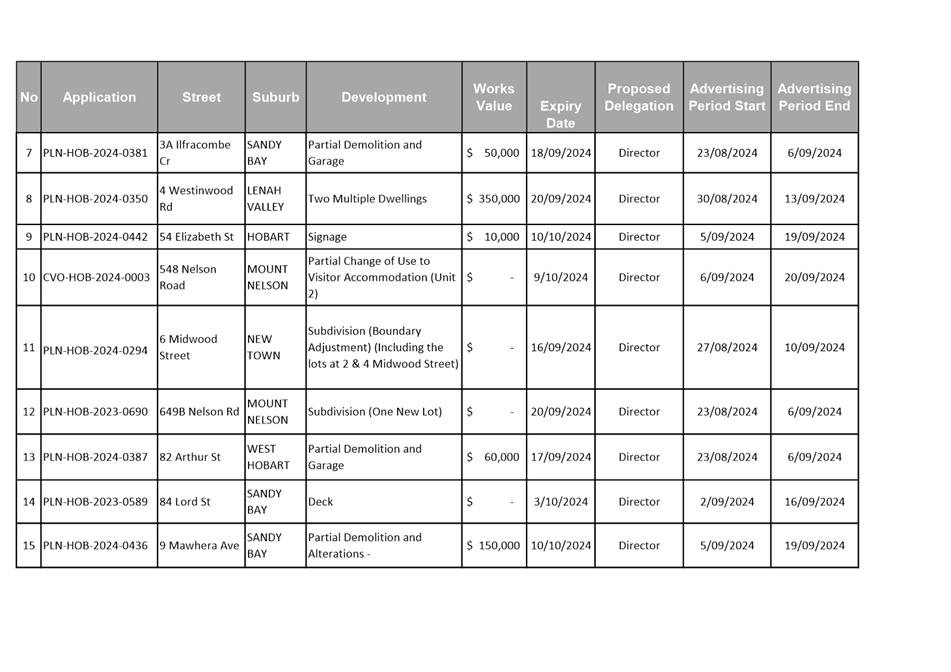
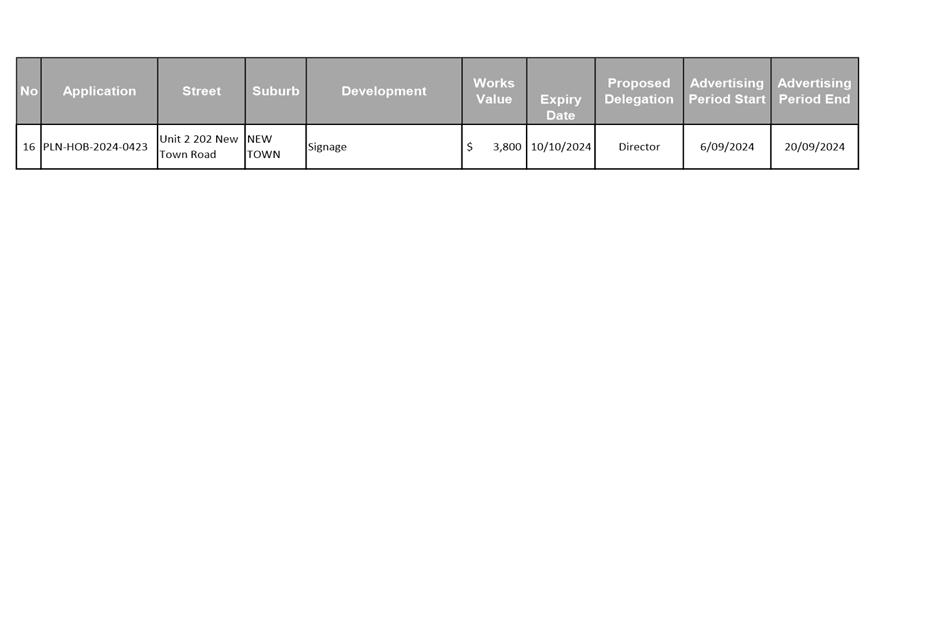
Planning - Advertised Applications Report
Attached is the advertised applications list for the period 16 August 2024 to 4 September 2024.
|
That: 1. That the information contained in the 'Planning - Advertised Applications Report' be received and noted.
|
As signatory to this report, I certify that, pursuant to Section 55(1) of the Local Government Act 1993, I hold no interest, as referred to in Section 49 of the Local Government Act 1993, in matters contained in this report.
|
Karen Abey Acting Director City Life |
|
Date: 5 September 2024
File Reference: F24/80733
Attachment a: Advertising
List - 16.08.2024 - 04.09.2024 ⇩
|
|
Agenda (Open Portion) Planning Committee Meeting |
Page 1 |
|
|
11/9/2024 |
|
Regulation 29 of the Local Government (Meeting Procedures) Regulations 2015. File Ref: 13-1-10
(1) A councillor at a meeting may ask a question without notice –
(a) of the chairperson; or
(b) through the chairperson, of –
(i) another councillor; or
(ii) the general manager.
(2) In putting a question without notice at a meeting, a councillor must not –
(a) offer an argument or opinion; or
(b) draw any inferences or make any imputations – except so far as may be necessary to explain the question.
(3) The chairperson of a meeting must not permit any debate of a question without notice or its answer.
(4) The chairperson, councillor or general manager who is asked a question without notice at a meeting may decline to answer the question.
(5) The chairperson of a meeting may refuse to accept a question without notice if it does not relate to the activities of the council.
(6) Questions without notice, and any answers to those questions, are not required to be recorded in the minutes of the meeting.
(7) The chairperson of a meeting may require a councillor to put a question without notice in writing.
|
|
Agenda (Open Portion) Planning Committee Meeting |
Page 1 |
|
|
11/9/2024 |
|