City
of hobart
AGENDA
The Hobart Workshop Committee Meeting
Open Portion
Monday, 19 January 2026
at 4.00pm
 |
Lady Osborne Room
City
of hobart
AGENDA
The Hobart Workshop Committee Meeting
Open Portion
Monday, 19 January 2026
at 4.00pm
|
Working together to make Hobart a better place for the community.
THE VALUES
The Council is:
|
People |
We care about people – our community, our customers and colleagues. |
|
Teamwork |
We collaborate both within the organisation and with external stakeholders drawing on skills and expertise for the benefit of our community. |
|
Focus and Direction |
We have clear goals and plans to achieve sustainable social, environmental and economic outcomes for the Hobart community. |
|
Creativity and Innovation |
We embrace new approaches and continuously improve to achieve better outcomes for our community. |
|
Accountability |
We are transparent, work to high ethical and professional standards and are accountable for delivering outcomes for our community. |
ELECTED MEMBER COMMITMENTS
|
Respectful and Cooperative Behaviour |
We will treat each other, staff, and stakeholders respectfully, fostering a collaborative environment. |
|
Conduct and media use |
We will advocate using transparent, evidence-based arguments, respect majority decisions, avoid public criticism of employees, and maintain workplace safety by refraining from harmful communication. |
|
Objective, evidence-based communication: |
Our discussions and advocacy are grounded in reliable, shared evidence, avoiding personal attacks and promoting respectful debate before public commentary. |
|
Roles and responsibilities: |
We recognise our duty to represent our community while being accountable, engaging in critical debate and holding others to account respectfully. |
|
|
Agenda (Open Portion) The Hobart Workshop Committee Meeting |
Page 3 |
|
|
19/1/2026 |
|
Business listed on the agenda is to be conducted in the order in which it is set out, unless the committee by simple majority determines otherwise.
APOLOGIES AND LEAVE OF ABSENCE
3. Consideration of Supplementary Items
4. Indications of Conflicts of Interest
6. Reports of Special Committees
6.1 Place and Wellbeing Committee
6.2 Climate, Sustainability and Biodiversity Committee
7.1 2025-26 Annual Plan Progress Report for the period ending 31 December 2025
8.2 Twelve Month Review - Argyle and Campbell St Bike Lanes
8.3 Stormwater and Waterways Briefing
9. Responses to Questions Without Notice
9.1 Statistical Information on number of International and Interstate Students in Southern Tasmania
11. Closed Portion Of The Meeting
|
|
Agenda (Open Portion) The Hobart Workshop Committee Meeting |
Page 4 |
|
|
19/1/2026 |
|
The Hobart Workshop Committee Meeting
(Open Portion) held
Monday,
19 January 2026 at 4.00pm
in the Lady Osborne Room.
The title Chief Executive Officer is a term of reference for the General Manager as appointed by Council pursuant s.61 of the Local Government Act 1993 (Tas).
|
COMMITTEE MEMBERS: Alderman M Zucco (Chairperson) Deputy Lord Mayor Councillor Dr Z E Sherlock Councillor J L Kelly Councillor L M Elliot Alderman L A Bloomfield Councillor R J Posselt Councillor B Lohberger Councillor G H Kitsos
NOMINEE MEMBERS: Lord Mayor Councillor A M Reynolds Councillor W F Harvey Councillor M S C Dutta Councillor W N S Coats
|
Apologies:
Leave of Absence: Nil.
|
|
The minutes of the Open Portion of the Hobart Workshop Committee meeting held on Monday, 8 December 2025, are submitted for confirming as an accurate record.
|
Ref: Part 2, Regulation 10(7) of the Local Government (Meeting Procedures) Regulations 2025.
|
That the Committee resolve to deal with any supplementary items not appearing on the agenda, as reported by the Chief Executive Officer.
|
Ref: Part 2, Regulation 10(8) of the Local Government (Meeting Procedures) Regulations 2025.
Members of the Committee are requested to indicate where they may have, or are likely to have, interest in the agenda.
Regulation 17 of the Local Government (Meeting Procedures) Regulations 2025.
A Committee may close a part of a meeting to the public where a matter to be discussed falls within 17(2) of the above regulations.
In the event that the Committee transfers an item to the closed portion, the reasons for doing so should be stated.
Are there any items which should be transferred from this agenda to the closed portion of the agenda, or from the closed to the open portion of the agenda?
|
Agenda (Open Portion) The Hobart Workshop Committee Meeting |
Page 1 |
|
|
|
19/1/2026 |
|
6.1 Place and Wellbeing Committee
Report of the Head of Executive Services of 5 January 2026 and attachments.
Delegation: Committee
|
Item No. 6.1 |
Agenda (Open Portion) The Hobart Workshop Committee Meeting |
Page 1 |
|
|
19/1/2026 |
|

Memorandum: Hobart Workshop Committee
Place and Wellbeing Committee
The purpose of this report is to inform the committee of the outcomes of the meeting of the Place and Wellbeing Committee that was held on 25 November 2025.
The following was discussed:
· Creative City Strategy – the Committee provided feedback on the Creative City Strategy, noting the importance of including maritime events, more satellite events, and writer’s events. The Committee also discussed the need to manage the community’s expectations in relation to securing car parking spaces close to events. The Committee suggested that the City could have ‘hero’s’ that bring people into the City, they also suggested creating maps, such as a ‘graffiti map’, market maps, writer’s maps or ‘Science / Antarctic map’ for people who visit the city and are interested in seeing what the City offers in each of those areas. The committee also suggested creating an indigenous plants and ecological park, reinvigorating Adult Education classes, and activating more creative spaces (through engagement with developers).
· Greater Hobart Sport and Recreation Infrastructure Strategy – the Committee provided feedback on Ross Planning’s initial observations obtained from information collected on ‘supply’ of recreation, open space and sports fields. The Committee noted that the analysis to date is quantitative and had quite a few questions about to whom Greater Hobart was being bench marked against. The Committee discussed the balancing act between providing a reasonable number of facilities that can be managed and maintained versus new ones that have no ongoing maintenance funding budgeted and the effect that building new facilities can have on existing facilities.
That the Hobart Workshop Committee receive and note the minutes of the Place and Wellbeing Committee of 25 November 2025, marked as Attachment A.
As signatory to this report, I certify that, pursuant to Section 55(1) of the Local Government Act 1993, I hold no interest, as referred to in Section 49 of the Local Government Act 1993, in matters contained in this report.
|
Laura Eaton Head of Executive Services |
|
Date: 5 January 2026
File Reference: F25/92810
Attachment a: Place
and Wellbeing Committee - Minutes - 25 November 2025 (Supporting information) 
|
Agenda (Open Portion) The Hobart Workshop Committee Meeting |
Page 1 |
|
|
|
19/1/2026 |
|
6.2 Climate, Sustainability and Biodiversity Committee
Report of the Director Infrastructure and Assets of 13 January 2026 and attachments.
Delegation: Committee
|
Item No. 6.2 |
Agenda (Open Portion) The Hobart Workshop Committee Meeting |
Page 1 |
|
|
19/1/2026 |
|

Memorandum: Hobart Workshop Committee
Climate, Sustainability and Biodiversity Committee
The purpose of this report is to inform the committee of the outcomes of the meeting of the Climate, Sustainability and Biodiversity Committee that was held on 11 November 2025.
The following was discussed:
· Climate Ready Hobart Forum – the Committee expressed a desire for further involvement in the next Forum, as well as ways to optimise engagement with the wider community. The Committee noted aims for the next Forum including a focus around reducing carbon footprint and potential stakeholder partnerships.
· Haldane Reserve – the Committee noted the land is a unique parcel of land, its biggest issue is weeds coming from neighbouring properties (requiring selective weed spraying). Council is looking to establish a walking track utilising the ‘Old Winter Road’ once assessed and costed, it will need to be approved by Council. The Committee discussed concerns regarding funding and assessments for the walking track and acknowledged the importance of having green space that aligns with the Open Space Strategy.
That the Hobart Workshop Committee receive and note the minutes of the Climate, Sustainability and Biodiversity Committee of 11 November 2025, marked as Attachment A.
As signatory to this report, I certify that, pursuant to Section 55(1) of the Local Government Act 1993, I hold no interest, as referred to in Section 49 of the Local Government Act 1993, in matters contained in this report.
|
David Reeve Director Infrastructure and Assets |
|
Date: 13 January 2026
File Reference: F25/92817
Attachment a: Climate,
Sustainability and Biodiversity Committee - Minutes - 11 November 2025
(Supporting information)
|
Agenda (Open Portion) The Hobart Workshop Committee Meeting |
Page 1 |
|
|
|
19/1/2026 |
|
7.1 2025-26 Annual Plan Progress Report for the period ending 31 December 2025
Report of the Manager Strategy, Planning and Performance, Senior Advisor - Strategic Planning and Chief Financial Officer of 6 January 2026 and attachments.
Delegation: Committee
|
Item No. 7.1 |
Agenda (Open Portion) The Hobart Workshop Committee Meeting |
Page 1 |
|
|
19/1/2026 |
|
REPORT TITLE: 2025-26 Annual Plan Progress Report for the period ending 31 December 2025
REPORT PROVIDED BY: Manager Strategy, Planning and Performance
Senior Advisor - Strategic Planning
Chief Financial Officer
1. Report Summary and Key Issue
1.1. The purpose of this report is to present the 2025-26 Annual Plan quarterly progress report for the period ending 31 December 2025 (refer Attachment A).
1.2. The Annual Plan is developed as part of the annual budget and sets out the major actions and initiatives for 2025-26. Actions in the Annual Plan must be aligned with the City’s Strategic Plan.
1.2.1. Reports on the progress of the annual plan are provided each quarter to the Council for noting.
1.3. There are 43 major actions and initiatives included in the 2025-26 Annual Plan. The status of actions and initiatives as of 31 December 2025 is as follows:
|
Complete |
2 |
|
In progress – on track |
36 |
|
In progress delayed |
2 |
|
On hold |
- |
|
Not started |
3 |
2. Recommendation
That the Committee receive and note the City of Hobart 2025-26 Annual Plan Progress Report for the period ending 31 December 2025 and endorse its release for publication on the City of Hobart website.
3. Discussion and Background
3.1. The Annual Plan is developed as part of the annual budget and sets out the major actions and initiatives for the 2025-26 financial year. Actions in the Annual Plan must be aligned with the City’s Strategic Plan.
3.2. The Annual Plan is required pursuant to Section 71 of the Local Government Act 1993. It is adopted by Council with the annual budget estimates. The Annual Plan sets out the Strategic Directions, major actions and initiatives that will guide the priorities of the organisation over the 12 months and must include a summary of the budget estimates.
3.2.1. The 2025-26 Annual Plan was developed with a focus on delivering value and benefit to the community while ensuring ongoing financial viability. This balanced approach allows for the implementation of forward-thinking and innovative initiatives while maintaining the fiscal sustainability of the City.
3.3. There are 43 major actions and initiatives included in the 2025-26 Annual Plan. The status of actions and initiatives as of 31 December 2025 is as follows:
|
Complete |
2 |
|
In progress – on track |
36 |
|
In progress delayed |
2 |
|
On hold |
- |
|
Not started |
3 |
4. Legal, Risk and Legislative Considerations
4.1. The Annual Plan is prepared in accordance with section 71 of the Local Government Act 1993 and must be summarised in the Annual Report (section 72(1)(a) of the Act).
5. Strategic Planning and Policy Considerations
5.1. The Annual Plan progress report provides a summary of the progress of the major actions and initiatives in the Annual Plan and aligns with various strategies in the Capital City Strategic Plan 2023 including best practice, transparency and accountability to the community.
Pillar 8: Governance and civic involvement
Outcome 8.1: Hobart is a city of best
practice, ethical governance and transparent decision-making.
8.1.2 Practice and communicate good city governance and decision-making.
8.1.3 Ensure systematic and useful measurement of community outcomes and the City’s performance.
6. Financial Viability
6.1. Financial Considerations:
|
|
2025-26 |
2026-27 |
2027-28 |
2028-29 |
|
|
$’000 |
$’000 |
$’000 |
$’000 |
|
|
|
|
|
|
|
Revenue |
N/A |
N/A |
N/A |
N/A |
|
Existing Revenue |
|
|
|
|
|
Additional Revenue |
|
|
|
|
|
Total Revenue |
|
|
|
|
|
|
|
|
|
|
|
Expenditure |
N/A |
N/A |
N/A |
N/A |
|
Operating |
|
|
|
|
|
Capital |
|
|
|
|
|
Total Expenditure |
|
|
|
|
|
|
|
|
|
|
|
Net Cost |
|
|
|
|
|
|
|
|
|
|
FTE Impact
|
|
2025-26 |
2026-27 |
2027-28 |
2028-29 |
|
|
|
|
|
|
|
Change in FTE |
N/A |
N/A |
N/A |
N/A |
|
|
|
|
|
|
Detail the change in the level of full-time equivalents within the group should the requested level of additional funding be required.
6.1.1. There are no financial implications arising from this report.
6.1.2. There are no FTE or asset implications arising from this report.
7. Community and Business Engagement and Collaboration
7.1. Not applicable.
8. Innovation and Continuous Improvement
8.1. Quarterly progress reports will continue to be provided on the annual plan and published on the City of Hobart website.
As signatory to this report, I certify that, pursuant to Section 55(1) of the Local Government Act 1993, I hold no interest, as referred to in Section 49 of the Local Government Act 1993, in matters contained in this report.
|
Janine Arnold Manager Strategy, Planning and Performance |
Paula Gudgeon Senior Advisor - Strategic Planning |
|
Michelle Wickham Chief Financial Officer |
|
Date: 6 January 2026
File Reference: F25/91835
Attachment a: Annual
Plan 2025-26 progress report for the period ending 31 December 2025 (Supporting
information)
|
Agenda (Open Portion) The Hobart Workshop Committee Meeting |
Page 1 |
|
|
|
19/1/2026 |
|
The City of Hobart utilises the workshop forum as allowed under the Local Government (Meeting Procedures) Regulations 2025 as a mechanism to receive information in relation to specific matters.
In accordance with the Terms of Reference of the Committee, any matter that is listed on the agenda for workshopping may not be the subject of a Committee decision, other than a resolution that the item be noted.
8.1 Augusta Road / Elizabeth Street - Pedestrian, Bicycle, Public Transport and Urban Enhancement Planning Project
Report of the Manager City Transport and Director Strategic and Regulatory Services of 14 January 2026.
|
Item No. 8.1 |
Agenda (Open Portion) The Hobart Workshop Committee Meeting |
Page 1 |
|
|
19/1/2026 |
|
REPORT TITLE: Augusta Road / Elizabeth Street - Pedestrian, Bicycle, Public Transport and Urban Enhancement Planning Project
REPORT PROVIDED BY: Manager City Transport
Director Strategic and Regulatory Services
1. Report Summary and Key Issue
1.1. The development of a plan for and implementation of a project to install improved bicycle, pedestrian and public transport facilities on Augusta Road / Elizabeth Street has been endorsed in a number of Council strategies, documents and plans, including the Hobart Transport Strategy 2024 (A.39).
1.2. The next step in the project is to engage with stakeholders, ahead of developing design solutions. Previous engagement has shown significant community, stakeholder, and Council support to undertake this project.
1.3. Initial major stakeholder pre-engagement with Calvery Hospital has identified some additional opportunities for Council to work collaboratively together to further both transport and strategic planning objectives.
1.4. Once a design has been prepared, further engagement is proposed to be carried out to give the community an opportunity to raise any issues with the proposal.
1.5. This report provides an update to Elected Members on the project, particularly the proposed approach for stakeholder engagement and community engagement.
2.1 To provide Council with an update and seek feedback to inform the development of this project.
3. Discussion and Background
3.1. Successive transport strategies for Hobart have identified the need for creating bicycle and pedestrian facilities on key corridors (arterial routes) for the development of transport networks (with an emphasis on active travel facilitation).
3.2. The development of a plan for, and implementation of, a project to install improved bicycle, pedestrian and public transport facilities on Augusta Road / Elizabeth Street is a key strategic project for Council – called for in numerous previously endorsed Council strategies, documents and plans. (Northern Suburbs LAMP (Endorsed – 27/11/2023) , North Hobart Neighbourhood Plan (Endorsed - 265-2025), Principal Bicycle Network – Adopted 2007, Greater Hobart Cycling Plan etc)
3.3. Additionally, the currently endorsed Hobart Transport Strategy 2024 (A.39) requires:
Progressively connect and protect the bicycle network as identified in the Greater Hobart Cycling Plan for All Ages and Abilities, with projects for Collins Street and Augusta Road as priority.
3.4. The next phase in the project is to engage with stakeholders ahead of developing design solutions for pedestrian, bicycle, public transport and public realm improvements on Augusta Road / Elizabeth Street.
3.5. Previous engagement has shown significant community, stakeholder, and Council support to undertake this project.
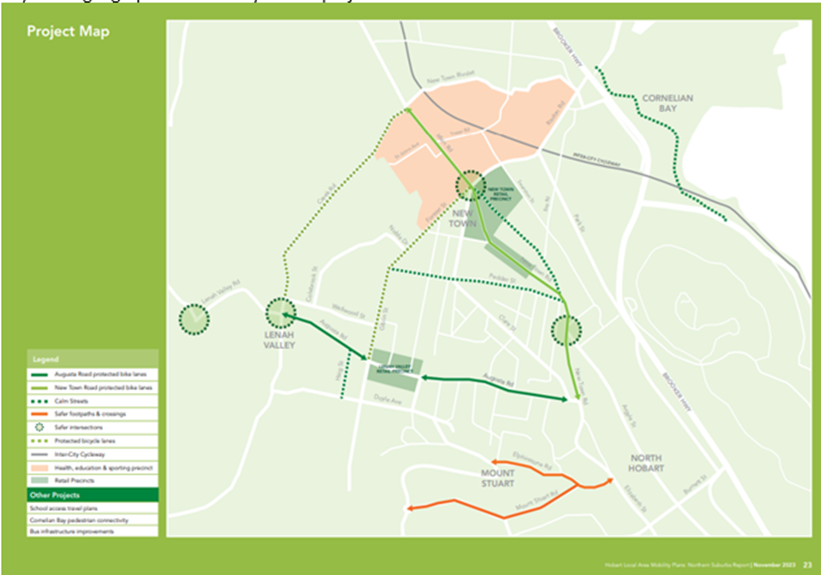
3.6. The extent of the project area is defined in the documents mentioned in section 3.2. From a perspective of balancing a connected network improvement, a manageable project extent (with limited resources) and a packageable set of improvement projects which might receive future grant funding support, the project corridor has been defined as:
Elizabeth Street – Federal Street junction to Augusta Road junction
Commercial Road – between both Elizabeth Street junctions
Augusta Road – Elizabeth Street junction to Greenway Ave.
Northern Suburbs LAMP (extract – pg. 23)

North Hobart Neighbourhood Plan (pg. 127)
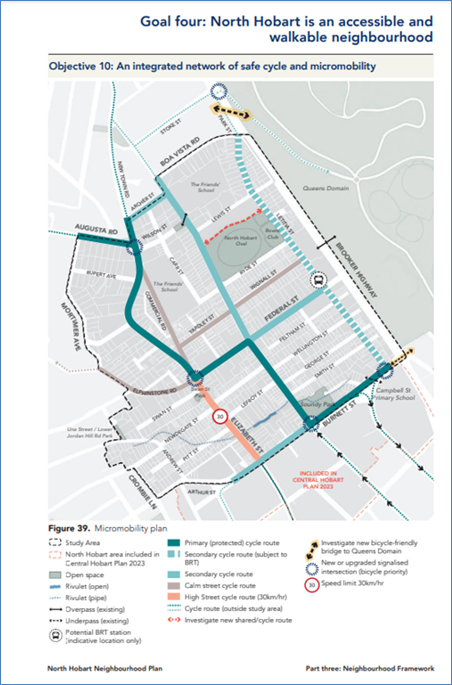
Planning corridor
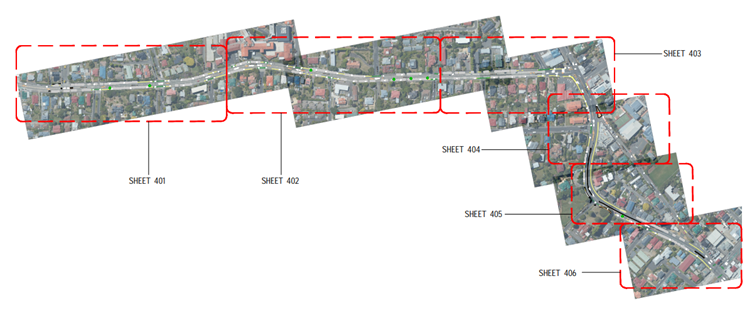
3.7. The engagement process will commence in the first half of 2026. The purpose of this engagement is to:
3.7.1. Position the project within the City’s broader strategic work.
3.7.2. Share the story of past improvements and future aspirations.
3.7.3. Understand and share community attitudes toward active transport, street greening, and parking reallocation that have been gathered as part of the Transport Strategy work.
3.8. The key messages for this engagement will focus on the following.
3.8.1. This work is a result of the community feedback received as part of a range of transport and precinct engagement conducted over the last ten years.
3.8.2. The City of Hobart continuously undertakes works to maintain and improve the liveability and attractiveness of our suburban areas.
3.8.3. Over the past 10 years the City of Hobart has, in the New Town / Lenah Valley area, worked with the community and upgraded both retail precinct areas, upgraded John Turnbull Park, Ancanthe Park, Swan Street Park, the Clare Street Oval, Cornelian Bay, the New Town Rivulet outfall and Linear Park, renewed numerous roads, footpaths and other City of Hobart facilities.
3.8.4. The City of Hobart is now embarking on a planning project to improve walking, cycling, public transport facilities and city greening on Elizabeth Street between Federal Street and Augusta Road and on Augusta Road between Elizabeth Street and Greenway Avenue.
3.8.5. Ensure this project is continuously described as an action from the endorsed Transport Strategy.
3.9. Early initial major stakeholder pre-engagement with Calvery Hospital (Lenah Valley) has identified some additional opportunities for Council to work collaboratively together to further both transport and strategic planning objectives.
3.9.1. Calvary Hospital provides a large parking supply on site, however there are parking pressures, and both staff and visitors do use adjacent on street parking.
3.9.2. Calvery Hospital has indicated they are engaging a private parking provider to look at options to improve management of their on-site parking supply. Changes to on-site parking allocation could have impacts on street parking use.
3.9.3. A meeting is planned between Council officers and Calvary staff to discuss future collaborations in February 2026.
4. Legal, Risk and Legislative Considerations
4.1. No legal or legislative considerations have been identified at this stage, noting the potential for such to be identified during future planning work.
5. Strategic Planning and Policy Considerations
5.1. The planning for and implementation of improved pedestrian, bicycle and public transport facilities is core business for Council exercising its role as a road manager.
5.2. The project has been identified in key City of Hobart Strategic documents:
5.2.1. Northern Suburbs LAMP (endorsed – 27/11/2023);
5.2.2. North Hobart Neighbourhood Plan (endorsed – 26/5/2025);
5.2.3. Principal Bicycle Network (adopted 2007);
5.2.4. Greater Hobart Cycling Plan; and
5.2.5. Hobart Transport Strategy 2024 (endorsed July 2024)
5.3. Other strategic planning alignment exists with the City of Hobart Urban Tree Strategy and Climate Ready Hobart Strategy.
6. Financial Viability
6.1. Financial Considerations:
As an early-stage planning project, with significant variables yet to be worked through, a realistic project capital cost is still being evaluated.
Undertaking the planning work will position the project well for opportunities which may present themselves as part of any grant funding or Australian Government election opportunities (to be held in early 2028)
6.1.1. A funding strategy needs to be developed given the increasingly common requirement of grant funding to require substantial co-funding contributions from Local Government.
6.1.2. Future asset renewal funding has been identified in the corridor, and this could provide an initial funding stream. Other city programs (IE Street tree funding) might also be useful to provide additional contributions to leverage funding.
City Economy Strategy:
6.1.3. This proposal aligns to the following strategic priorities listed in the City of Hobart City Economy Strategy 2023 – 2028:
Strategic Priorities
1. Plan for our collective social, economic and environmental prosperity.
(Inter alia)
1.7 Partner on projects that support local businesses to transform to a zero emissions economy and to implement locally relevant UN 2030 sustainability goals
1.8 Advocate for additional infrastructure that supports our precinct plans and promotes increased public transport use and micro-mobility
1.9 Deliver neighbourhood, vision and structure plans across the city that accommodate population growth and support businesses.
6.2. Consultants
The project currently has engaged local consultants Pitt and Sherry through a competitive tender to undertake traffic modelling of an early proof of concept design. Additional consultancies will be required during the life of the project from other engineering and quantity surveyor consultants.
7. Climate and Sustainability Considerations
7.1. Transport related emissions are considered to be Tasmania’s most problematic segment. Providing active and public transport alternatives to private motor vehicle use is a key strategy to respond to climate change related emissions and improve the sustainability and resilience of the transport sector.
8. Community and Business Engagement and Collaboration
8.1. A comprehensive stakeholder, community and business engagement plan is being finalised through the City’s Communications, Engagement and Marketing Group.
8.2. Pre-engagement with internal City of Hobart stakeholders has commenced.
8.3. Initial contact has occurred with Calvary (Lenah Valley) Hospital executive team to brief them on the project and discuss any relevant issues which may need to be managed.
9. Innovation and Continuous Improvement
9.1. This project has the potential to innovate and bring learnings from more recent Hobart, Tasmanian and Australian active transport engagement and design projects.
9.1.1. Engagement learnings from Collins Street, Sandy Bay Road and other engagements have been incorporated into the draft Engagement Plan approach.
As signatory to this report, I certify that, pursuant to Section 55(1) of the Local Government Act 1993, I hold no interest, as referred to in Section 49 of the Local Government Act 1993, in matters contained in this report.
|
Daniel Verdouw Manager City Transport |
Karen Abey Director Strategic and Regulatory Services |
Date: 14 January 2026
File Reference: F26/669
|
Agenda (Open Portion) The Hobart Workshop Committee Meeting |
Page 1 |
|
|
|
19/1/2026 |
|
8.2 Twelve Month Review - Argyle and Campbell St Bike Lanes
Report of the Manager City Transport and Director Strategic and Regulatory Services of 14 January 2026 and attachments.
|
Item No. 8.2 |
Agenda (Open Portion) The Hobart Workshop Committee Meeting |
Page 1 |
|
|
19/1/2026 |
|

Memorandum: Hobart Workshop Committee
Twelve Month Review - Argyle and Campbell St Bike Lanes
The Argyle Street and Campbell Street bicycle lane project has nearly completed the “North-South” bicycle and micro-mobility corridor which has featured in key City of Hobart strategic planning documents, plans and strategies for over 25 years.
The project has demonstrated that higher quality facilities, approaching an AAA (All Ages and Abilities) quality can be built in Hobart to improve the safety of vulnerable road users and support more people to ride more often.
The project was designed and built, with full project funding from the Tasmanian Government. The final cost was less than the cost estimate upon which the funding grant was based.
It should be noted that, unlike the Collins Street Transformation project, this project had no Council endorsed methodology for measuring the success of this project. As such, officers have collected a range of information to provide to Elected Members to make a decision on the success of this project.
Data collected and provided in the report (Attachment A) shows the project.
- Currently supports approximately 250 bicycle trips each weekday and more than 6,000 bicycle trips per month.
- Has not seen any easily identifiable increase in vehicle crashes and no recorded bicycle crashes.
- Following initial complaints about illegal parking in clearways, has had very little public feedback.
- Does not appear to have produced any additional traffic congestion (over and above what occurs normally at peak hour).
- Has highlighted a challenge in sourcing a local vehicle towing contractor to provide clearway towing services to Council.
Observations suggest that road users have adapted to the road changes (except for Clearway parking restriction compliance). Parking bay occupation observations shows good compliance by drivers with parking in marked bays in a tidy manner.
Traffic signal changes have been well accepted, especially in respect of the Campbell Street and Liverpool Street junction.
The use of flexible bollards to encourage separation has been assessed as working well. Damage and vandalism of this road furniture appears to minimal to nil across the project. No concerning issues have been identified.
Also, unlike the Collins Street Transformation project, the infrastructure treatments were more permanent in nature. This included significant traffic signal electrical infrastructure upgrades as well as kerb line changes.
For the Council to provide feedback on the high-level review of the Argyle Street and Campbell Street bicycle lane project (provided as Attachment A).
As signatory to this report, I certify that, pursuant to Section 55(1) of the Local Government Act 1993, I hold no interest, as referred to in Section 49 of the Local Government Act 1993, in matters contained in this report.
|
Daniel Verdouw Manager City Transport |
Karen Abey Director Strategic and Regulatory Services |
Date: 14 January 2026
File Reference: F25/91030
Attachment a: Argyle
Street and Campbell Street Bike Lanes - Twelve Month Review - Final Report -
January 2026 (Supporting information)
|
Agenda (Open Portion) The Hobart Workshop Committee Meeting |
Page 1 |
|
|
|
19/1/2026 |
|
8.3 Stormwater and Waterways Briefing
Report of the Manager Stormwater and Waterways and Director Infrastructure and Assets of 6 January 2026.
|
|
Agenda (Open Portion) The Hobart Workshop Committee Meeting |
Page 1 |
|
|
19/1/2026 |
|

Memorandum: Hobart Workshop Committee
Stormwater and Waterways Briefing
1. Report Summary
The purpose of this briefing is to increase understanding of key issues which are likely to require changes in the City’s approach to stormwater and waterways practices over the next few years.
Increased understanding will enable the City to make informed decisions that integrate with other asset classes, risk management approaches and exposure and financial implications.
This briefing will provide information on the following topics:
· Nuisance versus flood management
· Hobart Rivulet
· Climate change implications
· General stormwater update
2. Nuisance versus Flood Management
The standard approach to managing stormwater should be through a combination of minor and major stormwater systems that interact to move water downstream; most of the piped network is part of the minor system and some trunk mains and overland flow paths make up the major system.
The below definition is from Australian Rainfall and Runoff Guideline 2019.
A Major and Minor Stormwater Management System Has Two Parts:
· The minor system manages nuisance. This runoff is conveyed in a
manner that maintains safety, minimises nuisance and damage to property. The
infrastructure is also provided to avoid potential maintenance problems for
example, ponding and saturation of designated areas. Importantly, the minor
system also includes volume management measures that aim to hold water within
urban landscapes and sub-catchments (refer to Book 9, Chapter 4) – these
solutions may include ponding of stormwater within a defined area. The minor
system must withstand the effects of regular stormwater inundation.
· A major system is primarily intended to mitigate disaster. The major system typically includes overland flow paths on roads and through open space, and trunk conveyance infrastructure. This system conveys additional stormwater runoff produced during larger less probable and rarer storm events with the intent of managing the potential for flood disaster. Overland conveyance of stormwater from large events is potentially hazardous due to the velocity and depth of flows, and must be safely contained within a defined corridor of major system flows. (Coombes, et al., 2019)
This conflicts with many people’s ideas of how the
stormwater system works, there is a common misconception that floods are
mitigated by underground piped networks and for several reasons this is rarely
the case.
The current pipe network design intent is to drain a 5 per cent Annual Exceedance Probability (AEP) (or 1 in 20 Average Recurrence Interval) rainfall event. This has meant that flow rarely emerges from the piped networks and a consequence is that development has overlaid many of our overland flow paths whilst increasing stormwater volumes by introducing large impervious surfaces into our urban areas.
Future strategic management of the City’s overland flow paths will be investigated and will involve a change in management and approach to our overland flow paths.
The success of the Hobart Rivulet trail in mitigating flood risk to communities whilst providing significant community benefit should be noted.
3. Climate Change Implications
Stormwater and flood
modelling are particularly impacted by climate change. Any increase in
temperature corresponds to associated increases in rainfall intensity.
Practitioners in Tasmania have been utilising climate change factors for over 10 years in flood modelling and to size the piped network. The City uses these factors for decision making and consultants and developers have been required to apply them to development decisions.
The brief history of climate change factors has been:
· 2010- initial factors put out by the Climate futures for Tasmania project group indicated +30% for extreme rainfall.
· 2019 – update national factors moved Hobart Council area to +16 to 18% (Australian Rainfall and Runoff (ARR) and Bureau of Meteorology (BOM)).
· 2024 – updated national factors array released by ARR and BOM.
The most recent updates differ from previous updates as instead of supplying a single number increase, they have moved to a risk management approach in which an array of figures have been made available and individual jurisdictions have been advised to select an appropriate approach.
The arrays are based on possible climate scenario, duration of rainfall event and time outlook. For example, if pipes are installed with a design life past 2100, in an area of Hobart where the critical rainfall duration is 1 hour we may choose the 2100 – 1 hour factor, and would then need to choose from 4 possible future climate scenarios. Noting that all but the most optimistic scenarios involve increasing the climate change factors between 41% and 86% for short duration events.
This approach pushes the risk determination onto users or jurisdictions to come up with an appropriate approach. The advice is to base the decision on risk and the Department of Climate Change, Energy, the Environment and Water (DCEEW) has started to put out guidance on this approach. Ideally, we will analyse the impacts and risks of the different scenarios and produce a thorough report with clear guidance. This will take time and interim guidance on which climate factors need to be applied should be provided by the City to guide development and provide certainty to developers and consultants whilst this is underway. A discussion of the options and possible interim outcomes will be included in the presentation.
4. General Stormwater Update
4.1 Ageing
Infrastructure
Stormwater
assets are, for the first time in our history, getting close to the stage of
requiring large scale renewal. We can extend the life of many mains by relining,
however, future management of these assets will increase.
4.2 Unserviced Areas / “Shared
Private Infrastructure”
Hobart, due
to the era it was developed, has areas where the associated stormwater
infrastructure is unmapped or does not exist in appropriate locations. We are
investigating the implications of this.
4.3 Water Quality
We have an
opportunity to impact water quality outcomes for our Rivulets and the receiving
bays in the Derwent River. Communities value and are invested in their local
waterways, improving our water quality management practices and funding further
water quality installations and blue green infrastructure will help us achieve
water quality targets.
4.4 Strategic Plan
A two-year timeframe is required
to create a strategic plan that pulls together information from:
· Asset Management Plans and Stormwater and Waterways Asset Management Plans
· Risk and Disaster modelling
· Water quality opportunity analysis
· Cultural connections
4.5 Flood Modelling Update
GIS has been
audited and updated and the team are currently building the Hobart and New Town
models. Models should be built in six months after which scenario analysis of
possible outcomes and solutions can be undertaken.
4.6 New Town Rivulet Update
Photos of the New Town Rivulet project will be shared if time permits.
To increase understanding of key issues which are likely to require changes in the City’s approach to stormwater and waterways practices over the next few years.
As signatory to this report, I certify that, pursuant to Section 55(1) of the Local Government Act 1993, I hold no interest, as referred to in Section 49 of the Local Government Act 1993, in matters contained in this report.
|
Anna Wilson Manager Stormwater and Waterways |
David Reeve Director Infrastructure and Assets |
Date: 6 January 2026
File Reference: F25/50332
|
Agenda (Open Portion) The Hobart Workshop Committee Meeting |
Page 1 |
|
|
|
19/1/2026 |
|
Regulation 34 Local Government (Meeting
Procedures) Regulations 2025.
File Ref: 13-1-10
The Chief Executive Officer reports:-
“In accordance with the procedures approved in respect to Questions Without Notice, the following responses to questions taken on notice are provided to the Committee for information.
The Committee is reminded that in accordance with Regulation 34(3) of the Local Government (Meeting Procedures) Regulations 2025, the Chairperson is not to allow discussion or debate on either the question or the response.”
|
That the following response to a question without notice be received and noted.
|
9.1 Statistical Information on number of International and Interstate Students in Southern Tasmania
Memorandum of the Director
Strategic and Regulatory Services of
6 January 2026.
|
Item No. 9.1 |
Agenda (Open Portion) The Hobart Workshop Committee Meeting |
Page 1 |
|
|
19/1/2026 |
|
memorandum: Lord
Mayor
Deputy lord Mayor
Elected members
Statistical Information on number of International and Interstate Students in Southern Tasmania
|
Meeting: Hobart Workshop Committee
|
Meeting date: 17 November 2025
|
|
Raised by: Alderman Bloomfield |
|
Question:
How many students are actually engaging with the Hobart university Campus?
A break down in the number of students in Southern Tasmania that are: international students and interstate students?
How many students from interstate and overseas in southern Tasmania who are in university provided accommodations versus private accommodation?
Response:
Officers have contacted the University of Tasmania and have been advised the following:
The number of students currently engaging with the Hobart university campus.
There are nearly 10,000 students studying with the University of
Tasmania across Southern Tasmania in 2025.
In 2025, there were approximately 4,300 on-campus or mixed mode
attendance students engaging with the Hobart City Campus. This includes
students studying at The Hedberg, the Medical Sciences Precinct, the Centre for
Creative and Performing Arts, IMAS, our Domain facilities, and our previous
business school location at KPMG.
When The Forest opens for students in early February 2026, 70% of
all students in Southern Tasmania will interact with one or more of the
University's city campus facilities for classes and activities.
A breakdown of the number of students in
Southern Tasmania, distinguishing between international students and interstate
students
Of the almost 10,000 students studying in Southern Tasmania, 76% are
domestic students - 63% from Tasmania and 13% from interstate - and 24%
international.
Within this Tasmanian cohort of students, 85% are originally from
Southern Tasmania.
The number of interstate and overseas
students in Southern Tasmania who are residing in university-provided
accommodations versus private accommodations.
The University of Tasmania currently operates 2,469 beds across 15 sites statewide, including overflow accommodation. These are located in Hobart, Launceston, Burnie, and Sandy Bay, with a mix of residential Colleges, studio and shared apartment-style accommodation.
As of June 2025, accommodation occupancy sits at 83%, with availability at Hytten Hall (Hobart) and Christ College (Sandy Bay).
In 2025, there were 315 Tasmanian, 359 interstate and 681 international students residing in university accommodation in Southern Tasmania.
As signatory to this report, I certify that, pursuant to Section 55(1) of the Local Government Act 1993, I hold no interest, as referred to in Section 49 of the Local Government Act 1993, in matters contained in this report.
|
Karen Abey Director Strategic and Regulatory Services |
|
Date: 6 January 2026
File Reference: F25/87824
|
|
Agenda (Open Portion) The Hobart Workshop Committee Meeting |
Page 1 |
|
|
19/1/2026 |
|
Regulations 33 and 34 of the Local Government (Meeting Procedures) Regulations 2025.
File Ref: 13-1-10
33. (2) A question asked at a meeting is to, as far as is practicable -
(a) be concise; and
(b) be clear; and
(c) not be a statement; and
(d) have minimal pre-amble
34. Questions without notice by a Councillor
(1) A councillor at a meeting may ask a question without notice –
(a) of the chairperson; or
(b) through the chairperson, of –
(i) another councillor; or
(ii) the Chief Executive Officer.
(2) In asking a question without notice at a meeting, a councillor must not –
(a) offer an argument or opinion; or
(b) draw any inferences or make any imputations –
except so far as may be necessary to explain the question.
(3) The chairperson of a meeting must not permit any debate of a question without notice or its answer.
(4) The chairperson, councillor or Chief Executive Officer who is asked a question without notice at a meeting may decline to answer the question.
(5) The chairperson of a meeting may require a councillor to put a question without notice in writing.
|
|
Agenda (Open Portion) The Hobart Workshop Committee Meeting |
Page 1 |
|
|
19/1/2026 |
|
|
That the Committee resolve by majority that the meeting be closed to the public pursuant to regulation 17(1) of the Local Government (Meeting Procedures) Regulations 2025 because the items included on the closed agenda contain the following matters:
· Minutes of a Closed Committee Meeting · Confidential Information · Closed Questions Without Notice
The following items are listed for discussion:-
Item No. 1 Minutes of the last meeting of the Closed Portion of the Committee Meeting Item No. 2 Consideration of supplementary items to the agenda Item No. 3 Indications of conflicts of interest Item No. 4 Items For Workshopping Item No. 4.1 Future State of Car Parking in Hobart LG(MP)R 17(2)(c) and (h)(ii) Item No. 5 Questions Without Notice
|