

|
AGENDA OPEN PORTION OF THE Council Meeting Monday, 28 AUGUST 2023 AT 5.00 pm
|

|
AGENDA OPEN PORTION OF THE Council Meeting Monday, 28 AUGUST 2023 AT 5.00 pm
|
|
|
Agenda (Open Portion) Council Meeting |
Page 5 |
|
|
28/8/2023 |
|
APOLOGIES AND LEAVE OF ABSENCE
4. Communication from the ChairPERSON
5. Notification of Council WorKshops
8. Consideration of Supplementary Items
9. Indications of Pecuniary and Conflicts Of Interest
10. North Hobart Neighbourhood Plan Discussion Paper
11. Lease - Part of 1 Bell Street, New Town in Tasmania
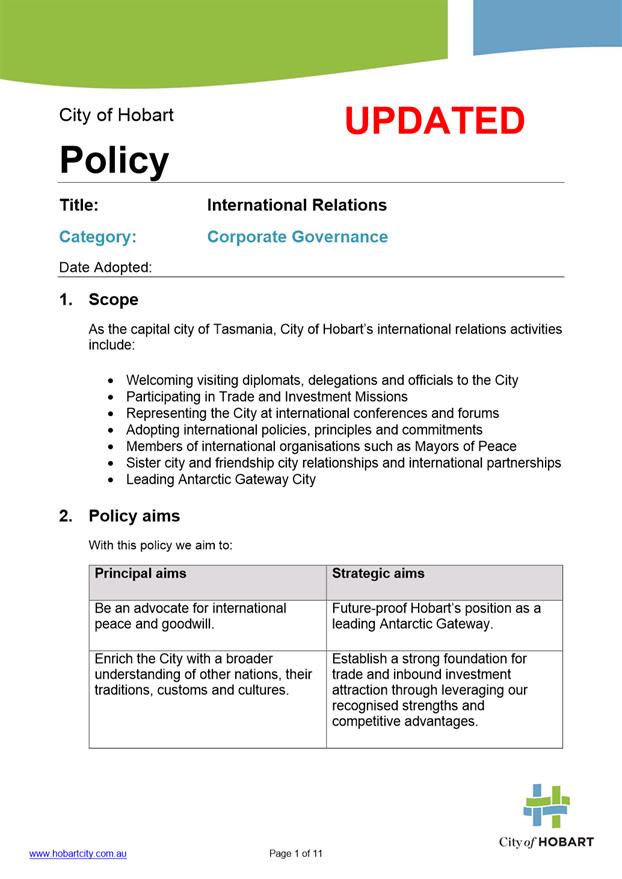
12. International Relations Policy
13. Status of the Urban Canopy on Public and Private Land
14. Response to Petition - TasNetworks Transformer Relocation - Harbroe Avenue, New Town
15. Response to Petition - Salamanca Stallholder Association Negotiation on draft Licence Agreement
16. Independent Review of Commonwealth Disaster Funding submission
17. Procurement - Quotation Exemption Report
Report of the ACTING Chief Executive Officer
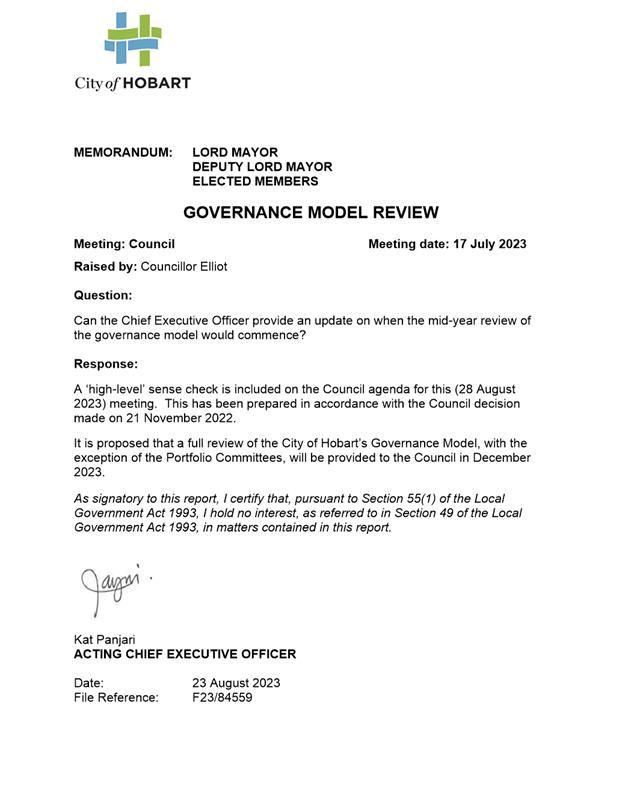
18. Governing Hobart - Sense Check
20. Tasmanian AFL Package - High Performance Centre
21. Code of Conduct Determination Report Ms Anna Sharman v Councillor Ben Lohberger
Motions of which notice has been given
22. Climate Change Leadership: Transport Emissions
23. Talent Acquisition Policy Update
24. Public Interests Register Policy Update
25. RESPONSES TO QUESTIONS WITHOUT NOTICE
27. Closed Portion Of The Meeting
|
|
Agenda (Open Portion) Council Meeting |
Page 8 |
|
|
28/8/2023 |
|
A meeting of the Open Portion of the Council will be held in the Council Chamber, Town Hall on Monday, 28 August 2023 at 5.00 pm.
Kat Panjari
Acting Chief Executive Officer
The title Chief Executive Officer is a term of reference for the General Manager as appointed by Council pursuant s.61 of the Local Government Act 1993 (Tas).
|
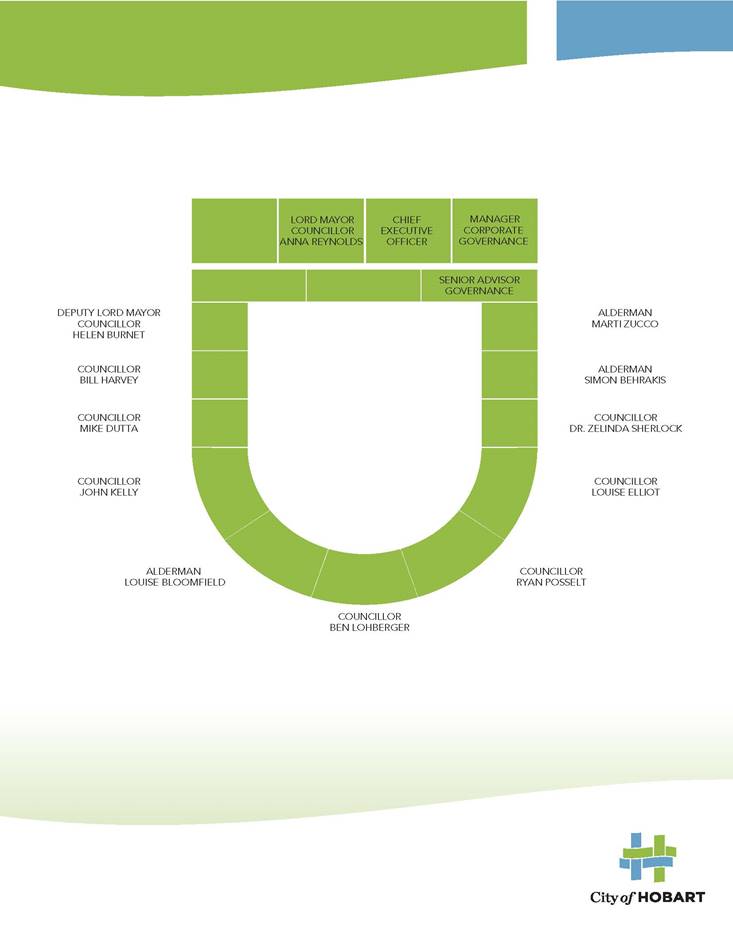
ELECTED MEMBERS: Lord Mayor A M Reynolds Deputy Lord Mayor H Burnet Alderman M Zucco Councillor W F Harvey Alderman S Behrakis Councillor M S C Dutta Councillor Dr Z E Sherlock Councillor J L Kelly Councillor L M Elliot Alderman L A Bloomfield Councillor R J Posselt Councillor B Lohberger |
APOLOGIES:
LEAVE OF ABSENCE: Alderman M Zucco
|
|
The Chairperson reports that she has perused the minutes of the Open Portion of the Council meeting held on Monday, 17 July 2023, finds them to be a true record and recommends that they be taken as read and signed as a correct record.
|
Are there any items, which the meeting believes, should be transferred from this agenda to the closed agenda or from the closed agenda to the open agenda, in accordance with the procedures allowed under Section 15 of the Local Government (Meeting Procedures) Regulations 2015?
In accordance with the requirements of the Local Government (Meeting Procedures) Regulations 2015, the General Manager reports that the following workshops have been conducted since the last ordinary meeting of the Council.
Date: Monday 31 July 2023
Purpose: Rating and Valuation Strategy Review
Attendance:
The Lord Mayor Councillor A Reynolds, Deputy Lord Mayor Councillor H Burnet, Councillors B Harvey, M Dutta, J Kelly, L Elliot, Alderman L Bloomfield, Councillors R Posselt, B Lohberger
Apologies:
Councillor Dr Z Sherlock
Date: Thursday 3 August 2023
Purpose: Global Approaches to Placemaking for Elizabeth Street Plan
Attendance:
The Lord Mayor Councillor A Reynolds, Deputy Lord Mayor Councillor H Burnet, Councillors B Harvey, M Dutta, J Kelly, Alderman L Bloomfield, Councillor B Lohberger
Apologies:
Councillors Dr Z Sherlock, R Posselt
Date: Monday 7 August 2023
Purpose: Capital City Strategic Plan
Attendance:
The Lord Mayor Councillor A Reynolds, Councillors B Harvey, M Dutta, J Kelly, L Elliot, Alderman L Bloomfield, Councillors R Posselt and B Lohberger
Apologies:
The Deputy Lord Mayor Councillor Burnet, Councillor Dr Z Sherlock
Date: Monday 21 August 2023
Purpose: North Hobart Neighbourhood Plan | Annual Plan Quarterly Report | International Relations Policy
Attendance:
The Lord Mayor Councillor A Reynolds, Deputy Lord Mayor Councillor H Burnet, Councillor B Harvey, Alderman S Behrakis, Councillors M Dutta, J Kelly, L Elliot, Alderman L Bloomfield, Councillors R Posselt and B Lohberger
Leave of Absence:
Alderman M Zucco and Councillor M Dutta
Apologies:
Councillor Dr Z Sherlock
Regulation 31 Local Government (Meeting
Procedures) Regulations 2015.
File Ref: 16/119-001
6.1 Public Questions
Ref: Part 2, Regulation 8(6) of the Local Government (Meeting Procedures) Regulations 2015.
|
That the Council resolve to deal with any supplementary items not appearing on the agenda, as reported by the Acting Chief Executive Officer in accordance with the provisions of the Local Government (Meeting Procedures) Regulations 2015.
|
Ref: Part 2, Regulation 8(7) of the Local Government (Meeting Procedures) Regulations 2015.
Elected Members are requested to indicate where they may have any pecuniary or conflict of interest in respect to any matter appearing on the agenda, or any supplementary item to the agenda.
|
Agenda (Open Portion) Council Meeting |
Page 9 |
|
|
|
28/8/2023 |
|
10. North Hobart Neighbourhood Plan Discussion Paper
File Ref: F23/75074; 22/65
Report of the
Program Leader City Futures and the Director City Futures of
15 August 2023 and attachments.
Delegation: Council
|
Item No. 10 |
Agenda (Open Portion) Council Meeting |
Page 12 |
|
|
28/8/2023 |
|
REPORT TITLE: North Hobart Neighbourhood Plan Discussion Paper
REPORT PROVIDED BY: Program Leader City Futures
Director City Futures
1. Report Summary
1.1. The purpose of this report is for Council to consider endorsing the release of the North Hobart Neighbourhood Plan Discussion Paper (Discussion Paper) (Attachment A) for consultation with key stakeholders and the community.
1.2. The North Hobart Neighbourhood Plan (Neighbourhood Plan) project benefits the community by providing an appropriate Structure Plan framework to help guide strategic land use and development decision making and public infrastructure investment in North Hobart.
2. Key Issues
2.1. The Neighbourhood Plan will include recommendations and guidance for planning policies, and planning scheme amendments, and projects, such as public infrastructure provision funding and public realm improvements, which support sustainable growth in North Hobart over the next twenty years.
2.2. The purpose of the Discussion Paper is to communicate the relevant information relating to the future Neighbourhood Plan to the public in order to get their feedback. This includes:
2.2.1. Background information from the North Hobart Retail and Entertainment Precinct: Part A - Place Vision Framework; Part B – Access & Parking Plan; and additional information; and
2.2.2. Analysis undertaken during the preparation of the Discussion Paper including: Aboriginal culture and heritage; Economic analysis; Built Form and Public Realm; Blue and Green Network; Transport Network and Strategic and Statutory Planning and Policy.
2.2.3. The Economic Assessment prepared by Hill PDA, is intended to be released to the public at the same time as the Discussion Paper.
2.3. The Discussion Paper addresses a wide range of issues, including land use, built form, transport integration, the public realm, open space provision, greening and infrastructure.
2.4. The Discussion Paper includes a Plan Vision, Directions, and Ideas, which the community will be invited to provide feedback on during the community consultation period, this feedback will be used to help inform the future Neighbourhood Plan.
2.5. A Stakeholder Engagement Plan has been prepared to outline the next stages of the process, which introduces a strategic framework for the purpose of seeking feedback from stakeholders and the community on potential future directions for the Neighbourhood Plan. Stakeholder Engagement is planned for the month of September 2023.
|
That the Council endorse the release of both the North Hobart Neighbourhood Plan Discussion Paper (Attachment A) and the North Hobart Neighbourhood Plan Economic Assessment (Attachment B) for use during consultation with the community.
|
4. Background
4.1. In February 2020, the City of Hobart invited North Hobart residents, traders and visitors to share their thoughts on the future of the Elizabeth Street North Hobart retail and restaurant strip.
The Council received more than 735 responses from people sharing their ideas and opinions through surveys and face-to-face workshops facilitated by place making and transport consultants Village Well and MRCagney. These contributions helped the consultants develop the following reports:
4.1.1. The North Hobart Place Vision Framework developed by Village Well, which offers an aspirational vision for North Hobart.
4.1.2. The Access and Parking Plan developed by MRCagney, which offers a series of recommendations to guide future place making, amenity, transport and parking improvements in the precinct.
Council resolved that a Precinct Plan (Neighbourhood Plan) for North Hobart be developed in consultation with key agencies and stakeholders including North Hobart traders, landowners and residents on 20 September 2021.
4.2. The 30-year Greater Hobart Plan for Growth and Change was jointly endorsed in 2022 by the State Government, City of Hobart, City of Glenorchy, City of Clarence and Kingborough Councils.
The Greater Hobart Plan has identified that there will be strong population growth in Greater Hobart over the next 30 years. This growth is best placed in areas with high amenity and good services, in a way that maintains the key attributes that make these areas liveable and attractive. The timely upgrading of infrastructure, utilities and services, including public transport, open space and community facilities, will be critical to support the growth. The Greater Hobart Plan found that the city of Hobart can accommodate 10,300 additional dwellings over the next 30 years.
5. Legal, Risk and Legislative Considerations
5.1. Other than reputational and normal project management risk considerations, no specific legal, risk and legislative issues are seen to apply to the proposed next engagement stage of the project.
5.2. The Neighbourhood Plan is likely to require implementation in part through amendments to the planning scheme. This will be subject to a further consideration by Council once the draft Neighbourhood Plan is prepared and implementation has begun.
5.3. The Neighbourhood Plan will address risks to the Council, such as resilience and adaptation required due to Climate Change.
6. Discussion
6.1. The Discussion Paper includes a Plan Vision, four Directions, and fifteen Ideas, which the community will be invited to provide feedback on during the community consultation period, this feedback will be used to help inform the future Neighbourhood Plan.
6.1.1. Direction one: North Hobart is a welcoming and inclusive neighbourhood to live and work, offering a diversity of housing and employment spaces and everyday convenience for a growing community.
Idea one identifies opportunities to facilitate a range of housing, including social, affordable, and key worker housing.
Idea two explores how the study area can provide jobs, services, and everyday convenience within walking distance to support good growth and meet community needs.
Idea three investigates how we can establish a clear built form guidance to promote well-designed and sustainable buildings that respond to North Hobart’s heritage.
Idea four considers how we can create a sustainable balance between accommodation offerings within North Hobart, while providing housing for residents.
6.1.2. Direction two: North Hobart is a creative and cultural neighbourhood on palawa Country, a destination that celebrates the arts, culture, food, creativity, heritage, and diversity.
Idea five identifies opportunities for cultural expression, including connection to Country throughout North Hobart and the Providence Valley Rivulet.
Idea six explores how we can cultivate North Hobart’s creative heart and provide welcoming spaces and places to innovate, experiment and connect with others.
Idea seven considers how we can strengthen Elizabeth Street and nearby areas as a vibrant day and night-time destination, attracting locals, workers and visitors to its bustling live music, food, arts, entertainment scene.
6.1.3. Direction three: North Hobart is a resilient and sustainable neighbourhood with views to kunanyi/Mount Wellington and the Queens Domain with access to more greenery and open spaces.
Idea eight defines a green street network to increase urban cooling in summer and to provide attractive streetscapes for everyday movement and life.
Idea nine identifies locations that need overland flooding mitigation through water sensitive urban design and potential locations for flood water retention.
Idea ten identifies opportunities for new open spaces, including pocket parks, plazas and forecourts, as well as improving links to existing spaces and the Domain.
Idea eleven investigates the future role of North Hobart Oval and Bowls Club to meet future demand for open space and community facilities.
6.1.4. Direction four: North Hobart is an accessible and pedestrian-friendly neighbourhood with a variety of transport solutions to easily connect residents and visitors to Hobart and beyond.
Idea twelve defines how a safe network of high-quality walkways, footpaths, lanes, and streets, including new links can achieve better connectivity.
Idea thirteen explores how we can encourage more people to cycle or use micro-mobility options by providing a network of safe cycle lanes and facilities.
Idea fourteen how we can support Elizabeth Street’s role as a pedestrian-friendly ‘High Street’ and manage vehicles and car parking to ensure that it is safe and available for those who need it.
Idea fifteen advocates for change to the public transport network that will connect North Hobart’s growing community to everyday destinations and support North Hobart as a regional destination.
6.1.5. HillPDA was commissioned to undertake an Economic Assessment, which included forecasting the demand for employment floorspace within the study area. The purpose of this, is to allow enough capacity in the proposed planning framework, for the development and provision of future employment uses. Ensuring the local community remains appropriately serviced, and economically sustainable.
6.1.6. The study area is estimated to contain 74,710sqm of occupied employment space. 16,270sqm or 22% attributed to retail uses, 11,135qm or 15% was commercial, 21,695sqm or 29% was industrial/urban services uses and the remaining 12,615sqm or 34% was occupied by other uses.
6.1.7. The study area is a key dining and entertainment locality in Greater Hobart. This was evident in:
6.1.7.1. 48% of the study area's retail space being attributed to speciality food space, 32% was café and restaurant space;
6.1.7.2. 66% of the $80.6 million in retail spend in North Hobart suburb was captured by dining and entertainment uses;
6.1.7.3. 9% or $17.2 million of the $195 million in dining and entertainment spend generated by Hobart LGA residents is captured by retailers in North Hobart suburb; and
6.1.7.4. There is a high concentration of hospitality occupations in the study area, when compared to Hobart LGA and Greater Hobart.
6.1.8. Around 80% of the retail expenditure generated by North Hobart residents escapes the suburb. An increase in the retail offer with an appropriate mixture and type, would retain expenditure. Providing a key anchor tenant, such as a supermarket, would increase the amount of spend that is retained in the suburb.
6.1.9. The study area provides a supportive industrial and urban service role to the surrounding community.
6.1.10. There is a current demand for 16,335sqm of retail floorspace in the study area, with 16,270sqm currently provided. However, a deficit of 6,110sqm by 2041 is forecast. Most of this net demand (50%) is in speciality food space and food services.
An additional 24,158sqm of non-retail employment floorspace is required to support an increase of 612 jobs in the study area over the period to 2041. 5,672sqm is commercial/knowledge intensive space, 3,920sqm is industrial/urban service related, and 14,566sqm is other employment space.
7. Capital City Strategic Plan
7.1. The Neighbourhood Plan project will assist in the achievement of the strategic outcomes of the Capital City Strategic Plan 2019-2029.
The Capital City Strategic Plan 2019-29 elaborates on how the Pillars set out in Hobart: A community vision for our island capital can be achieved. While a neighbourhood plan will have many “touchpoints” with the strategic outcomes within the Plan the key strategic outcomes that have particular relevance include:
7.1.1. Pillar 1. Sense of Place
Outcome: 1.1 Hobart keeps a strong sense of place and identity, even as the city changes.
Outcome: 1.2 Hobart's cityscape reflects the heritage, culture and natural environment that make it special.
Outcome: 1.3 In City decision-making, we consider how different aspects of Hobart life connect and contribute to sense of place.
7.1.2. Pillar 2. Community Inclusion, Participation and Belonging
Outcome: 2.1 Hobart is a place that recognises and celebrates Tasmanian Aboriginal people, history and culture, working together towards shared goals.
Outcome: 2.3 Hobart communities are active, healthy and engaged in lifelong learning.
Outcome: 2.4 Hobart communities are safe and resilient, ensuring people can support one another and flourish in times of hardship.
7.1.3. Pillar 3. Creativity and Culture
Outcome: 3.1 Hobart is a creative and cultural capital where creativity is a way of life.
Outcome: 3.4 Civic and heritage spaces support creativity, resulting in a vibrant public realm.
7.1.4. Pillar 4. City Economies
Outcome: 4.1 Hobart's economy reflects its unique environment, culture and identity.
Outcome: 4.5 Hobart's economy is strong, diverse and resilient.
7.1.5. Pillar 5. Movement and Connectivity
Outcome: 5.1 An accessible and connected city environment helps maintain Hobart's pace of life.
Outcome: 5.2 Hobart has effective and environmentally sustainable transport systems.
Outcome: 5.4 Data informs decision-making.
7.1.6. Pillar 6. Natural Environment
Outcome: 6.1 The natural environment is part of the city and biodiversity is preserved, secure and flourishing.
Outcome: 6.3 Hobart is a city with renewable and ecologically sustainable energy, waste and water systems.
Outcome: 6.4 Hobart is responsive and resilient to climate change and natural disasters.
Outcome: 6.5 Hobart's bushland, parks and reserves are places for sport, recreation and play.
7.1.7. Pillar 7. Built Environment
Outcome: 7.1 Hobart has a diverse supply of housing and affordable homes
Outcome: 7.2 Development enhances Hobart's unique identity, human scale and built heritage.
Outcome: 7.3 Infrastructure and services are planned, managed and maintained to provide for community wellbeing.
Outcome: 7.4 Community involvement and an understanding of future needs help guide changes to Hobart's built environment.
7.1.8. Pillar 8. Governance and Civic Involvement
Outcome: 8.1 Hobart is a city of best practice, ethical governance and transparent decision-making.
Outcome: 8.4 People are involved in civic life, and the City's communication and engagement with Hobart communities are proactive and inclusive.
Outcome: 8.5 Quality services are delivered efficiently, effectively and safely.
8. Regional, State and National Plans and Policies
8.1. The following plans and policies are reference within the discussion paper:
8.1.1. The Discussion Paper references the State Government's 30-Year Greater Hobart Plan 2022 and 30-Year Greater Hobart Plan: Strategy for Growth and Change 2022.
8.1.2. The Discussion Paper references the Southern Tasmanian Regional Land Use Strategy.
8.1.3. The Discussion Paper references the Southern Tasmanian Industrial Land Strategy 2012
8.1.4. The Discussion Paper references the Hobart City Deal and Implementation Plan 2019
8.1.5. . State Policy on Water Quality Management 1997
9. Financial Viability
9.1. Funding Source and Impact on Current Year Operating Result
9.1.1. Funding for this project has been allocated within the 23/24 budget for the City Futures Divisional.
9.2. Impact on Future Years’ Financial Result
9.2.1. The Neighbourhood Plan will outline a strategic approach to future requirements that may require funding in future years.
9.3. Asset Related Implications
9.3.1. The financial implications for assets will be addressed in the implementation plan phase of the project for consideration in future years.
10. Sustainability Considerations
10.1. Climate change, Resilience and Sustainability are key drivers for the Neighbourhood Plan project.
10.1.1. Adapting to a changing climate presents both risks and transformative opportunities for North Hobart. To reduce risks, we need to prepare for natural disasters and climate-related shocks. To leverage opportunities, we need to consider how to move towards zero emissions.
10.1.2. The future growth and investment in North Hobart must respond to the challenges of climate change to create a more resilient and sustainable neighbourhood including outcomes that will foster active transport, mitigate flooding risks and provide quality parks and places for community resilience and wellbeing.
10.1.3. Environmental impacts are discussed in the Discussion Paper and will further be considered when drafting the Neighbourhood Plan.
11. Community Engagement
11.1. A detailed Stakeholder Engagement Plan has been developed by Council staff and the consultant MGS with subconsultants Mosaic Lab. Mosaic Lab are industry leaders in deliberative and high influence community and stakeholder engagement.
11.2. The stakeholder engagement plan aims to ensure that the concerns and aspirations of the community are directly incorporated into the Neighbourhood Plan.
This engagement will produce:
11.2.1. A transparent process to hear about the gaps or needs not met through the scope of the Neighbourhood Plan. This process will clearly manage expectations of the community. This includes explaining why suggestions are not adopted and closing the loop at every stage of the project.
11.2.2. Broad, diverse and accessible engagement to hear from different voices and gather a range of opinions from traditional owners, residents, businesses and visitors.
11.2.3. A considered and clear Neighbourhood Plan that builds on an understanding of the needs of residents, visitors and workers and honours the history and 'essence' of North Hobart.
11.3. This project consists of four separate engagement processes:
11.3.1. Traditional owners
11.3.2. Community engagement
11.3.3. Targeted precinct stakeholders
11.3.4. Council stakeholders
11.4. Subject to Council’s endorsement, the Discussion Paper will be released for public exhibition for the month of September.
The following engagement activities have been planned:
11.4.1. Two face to face community consultation workshops facilitated by Mosaic Lab.
11.4.2. Pop up stall.
11.4.3. Online survey on the City of Hobart Your Say webpage.
11.4.4. School student engagement exercise including a possible design competition.
12. Communications Strategy
12.1. Council’s Strategic Communications and Marketing team have developed a Communications Plan for the Neighbourhood Plan project.
As signatory to this report, I certify that, pursuant to Section 55(1) of the Local Government Act 1993, I hold no interest, as referred to in Section 49 of the Local Government Act 1993, in matters contained in this report.
|
Jennifer Lawley Program Leader City Futures |
Neil Noye Director City Futures |
Date: 15 August 2023
File Reference: F23/75074; 22/65
Attachment a: North
Hobart Neighbourhood Plan Discussion Paper (Supporting information) 
|
Item No. 11 |
Agenda (Open Portion) Council Meeting |
Page 1 |
|
|
28/8/2023 |
|
11. Lease - Part of 1 Bell Street, New Town in Tasmania
File Ref: F23/86330
Report of the Principal Advisor Legal & Property and Director of City Futures of 17 August 2023 and attachments.
Delegation: Council
|
Item No. 11 |
Agenda (Open Portion) Council Meeting |
Page 1 |
|
|
28/8/2023 |
|
REPORT TITLE: Lease - Part of 1 Bell Street, New Town in Tasmania
REPORT PROVIDED BY: Principal Advisor Legal & Property
Director City Futures
1. Report Summary
1.1. The purpose of this report is to consider a proposal from the Hobart Community Shed Ltd (the “Community Shed”) to grant them a lease for that vacant parcel of land situated at 1 Bell Street, New Town in Tasmania (“Land”) indicated in Attachment A for the purposes of constructing a community shed to service the Hobart Municipal Area.
1.2. The full details of the proposal from the Community Shed are contained in the application enclosed as Attachment B.
1.3. The proposal aligns with the Council’s Policy: Leases to Non-profit Organisations and represents a good opportunity to use the space for a community purpose.
1.4. Notwithstanding this request it is open to Council to seek a broader public expression of interest process for the opportunity to lease the Land for a community purpose and encourage the Hobart Community Shed Ltd to make a submission to that process thereby allowing wider interest to be considered.
2. Key Issues
2.1. Whether the proposed lease arrangement represents the best use of the Land and the proposed terms deliver sufficient value for the ratepayers of Hobart.
|
That: 1. The Council either: (i) Resolve by absolute majority to grant a lease to the Hobart Community Shed Ltd of that part if 1 Bell St, New Town in Tasmania indicated on the plan contained in Attachment A for a period of ten (10) years with the option for a further ten (10) year term at the nominal rental of $100.00 plus GST per annum; or (ii) Resolve to refuse the proposal from the Hobart Community Shed Ltd contained in Attachment B; or
(iii) Resolve to undertake a public expression of interest process for the opportunity to lease the Land for a community purpose and encourage the Hobart Community Shed Ltd to make a submission to that process; 2. Should Council elect to proceed with option 1(i), it further resolve: (i) To undertake the statutory consultation process prescribed by section 178 of the Local Government Act 1993 (Tas)(“Act”), being: (a) to publish its intention to grant a lease on at least 2 separate occasions in a daily newspaper circulating in the municipal area; and (b) display a copy of the notice on any boundary of the public land that abuts a highway; and (c) notify the public that an objection to the proposed sale, lease, donation, exchange or disposal may be made to the Chief Executive Officer (“CEO”) within 21 days of the date of the first publication. (ii) That the granting of the lease be conditional on the Council not receiving any objection under section 178(4) of the Act or an appeal of the decision to grant a lease of the Land under section 178 of the Act; (iii) To delegate to the Chief Executive Officer the authority to settle the terms of the proposed lease and to respond to any objections or appeals of the Council’s decision to grant a lease of the Land; and (iv) The discounted rental be reported in the Council’s Annual Report in accordance with the Council’s Policy: Leases to Non-Profit Organisations. |
4. Background
4.1. The Council owns the property known as 1 Bell Street, New Town in Tasmania (“Property”).
4.2. The subject property is a parcel of land situated within the northern boundaries of the Property shown on the plan in Attachment A (“Land”).
4.3. The Land is currently vacant and is not subject to any leasehold interest (Attachment C).
4.4. The Council has been approached by the Community Shed seeking a long-term lease over the Land to construct a community shed.
4.5. The attached proposal (Attachment B) outlines the Community Shed’s intent in respect to the property, noting the specifications of the proposed development are prescribed on page 2.
4.6. It is considered the proposal aligns with the Council’s Policy: Leases to Non-profit Organisations and represents a good opportunity to use the space for a community purpose.
4.7. Whilst it is open to Council to call for expressions of interest for the use of this property, recognising the suitability of the Community Shed’s use of the property and magnitude of the proposed investment, the direct approach could be a justified outcome for the City.
4.8. The Council’s Leases to Non-Profit Organisations policy sets out a number of criteria against which any proposals seeking a reduced rental are to be assessed. The table below provides commentary regarding the proposal by the Community Shed against the criteria in that policy:
|
Criteria |
Comments |
|
Use, or proposed use of the property |
The Land will be used by the Community Shed to build and fit out a Hobart Community Shed which will provide workshop facilities (woodworking, metalwork, electronics etc), arts and craft activity space, kitchen and meeting rooms |
|
Alignment with the Council’s Strategic Plan and other relevant Council strategic documents |
Aligns strongly with Pillar 2 of the Capital City Strategic Plan 2019-29. The Community Shed has particularised these synergies in greater detail on pages 2-3 of its application (Annexure B) |
|
Level of community benefit – proposed or provided |
The Community Shed’s mission can be generally summarised as aiming for the:
· improvement of the health and wellbeing of all Community Shed members; · alleviation of any physical, mental, emotional or social difficulties experienced by members, guests and their families; · development of a culture where all community members or interested persons are welcome and where mutual support, respect and trust are paramount; and · providing an environment where members can further develop and pass on their skills and where others can learn and participate in a variety of rewarding activities
The Community Shed proposes to further its mission by: · raising awareness, provide advice and promote the benefits of the early intervention and prevention of all forms of physical or mental illness to community members -including facilitating links with health-related agencies, family support organisations and specialist health professionals; · provide the opportunities for increased social interaction and support for members where this can alleviate any issues of loneliness, isolation, depression or dealing with a transitional period in their life ( e.g. separation, redundancy, bereavement, retirement, ill health, relocation); |
|
Value of land and buildings |
The property has been appraised as having a market rental of $12,000.00 per annum (excluding GST) |
|
Potential for alternative use |
The parcel is held by the Council as Public Land for the purposes of section 177A of the Local Government Act 1993 (Tas). |
|
Viability and capability of the organisation |
The Community Shed was established in December 2021 and is an Australian Public Company regulated by the Australian Charities and Not-for-profits Commission |
|
Capacity to pay, after all income and expenditure is taken into account |
This information has not been provided by the Community Shed . |
|
Capacity to invest in and maintain the asset, or degree of capital investment undertaken |
The Community Shed will have internal maintenance obligations imposed as part of the lease. The Council will be responsible for insuring the building for its full replacement value |
|
Type of facility |
Community shed |
|
Capacity to invest in the community, or level of community investment provided, through disbursement of surplus funds to local community groups, organisations or activities |
High |
|
Length of tenure sought |
Ten years (10) with two options for further terms of ten (10) years each. |
|
For lease renewals only, the level of compliance with existing lease terms and conditions |
Not applicable |
4.9. In accordance with the desire for improved due diligence relating to leasing to not for profit organisations, and in line with external accounting advice, additional information relating to the operations of Community Shed has been obtained and assessed. This information is included as part of Attachment B and includes:
(a) evidence of ACNC registration;
(b) a list of all past and present committee members;
(c) disclosure of existing relationships, transactions and arrangements in place;
(d) confirmation that there are no conflicts of interest within the governance of the organisation (including the provision of services); and
(e) a written undertaking from the committee members of the organisation warranting they are a not-for-profit organisation, they comply with the policy, the completeness of the information provided and the accuracy of that information.
4.10. Based on the consideration of the proposal against the requirements of the Policy it is considered that the grant of a lease of the property to the Community Shed would be appropriate should the Council elect to do so.
4.11. Notwithstanding this request, it is open to Council to seek a broader public expression of interest process for the opportunity to lease the Land for a community purpose and encourage the Hobart Community Shed Ltd to make a submission to that process thereby allowing wider interest to be considered.
5. Legal, Risk and Legislative Considerations
5.1. Should Council endorse the approach to support the Hobart Community Shed Ltd, a draft lease will be prepared and finalised with the Community Shed.
5.2. It is also proposed that the benefit provided by Council be reported in the Council’s Annual Report in accordance with the Council’s Policy: Leases to Non-Profit Organisations.
5.3. Alternatively the Council could seek a broader public expression of interest process for the opportunity to lease the Land for a community purpose.
6. Discussion
6.1. Whilst the Community Shed has sought a lease term of ten years (10) with two options for further terms of ten (10) years each, it is proposed that one option for a further term of ten (10) years with a further five (5) year option term be offered to provide the total potential lettable period of twenty five (25) years rather than thirty (30) years.
6.2. The reduced period of time would align the lease terms provided to similar tenants situated on the Property.
6.3. It is noted that similar tenants in the area have conditions in their lease allowing for the Council to resume the land for a community need from 2030 (at earliest). It is understood that the inclusion of this condition was to allow for flexibility with future planning of the Property. A similar condition may be appropriate to include in this lease agreement.
6.4. The site is somewhat spatially isolated and the size and terrain does not lend itself to be incorporated within adjacent sporting facilities. Furthermore the proposal by the Hobart Community Shed Ltd is considered to comply with the Council’s Leases to Non-Profit Organisations policy. However, there could be other community groups that would meet the Council’s policy requirements that may also have an interest to lease this land and it is open for the Council to seek submissions more broadly for this site.
7. Financial Viability
7.1. Funding Source and Impact on Current Year Operating Result
7.1.1. There are some once-off transaction related costs that will be incurred by the Council associated with the preparation of the lease agreement and obtaining a market valuation. There will also be some significant non-financial costs associated with officer time to manage the agreement with the tenant.
7.2. Impact on Future Years’ Financial Result
7.2.1. There would be no material change in the Council’s financial position. The lease agreement will seek to impose the insurance premiums associated with the building be recovered from the proposed tenant.
7.3. Asset Related Implications
7.3.1. It is proposed that Council own the building once it has been constructed by the prospective tenant.
8. Community Engagement
8.1. Any decision to provide the Hobart Community Shed Ltd or any other community group with a lease would mandate a statutory notification period under the terms of the Local Government Act 1993 (Tas).
As signatory to this report, I certify that, pursuant to Section 55(1) of the Local Government Act 1993, I hold no interest, as referred to in Section 49 of the Local Government Act 1993, in matters contained in this report.
|
Adrian Hutchinson Principal Advisor Legal & Property |
Neil Noye Director City Futures |
Date: 17 August 2023
File Reference: F23/86330
Attachment a: Survey
Plan of the Land (Supporting information) 
Attachment
b: Representation
Letter (Supporting information)
Attachment
c: Plan
of Surrounding Leashold Interests (Supporting information) 
|
Item No. 12 |
Agenda (Open Portion) Council Meeting |
Page 1 |
|
|
28/8/2023 |
|
12. International Relations Policy
File Ref: F23/57310
Report of the
Manager Smart Economy and Director Connected City of
23 August 2023 and attachments.
Delegation: Council
|
Item No. 12 |
Agenda (Open Portion) Council Meeting |
Page 1 |
|
|
28/8/2023 |
|
REPORT TITLE: International Relations Policy
REPORT PROVIDED BY: Manager Smart Economy
Director Connected City
1. Report Summary
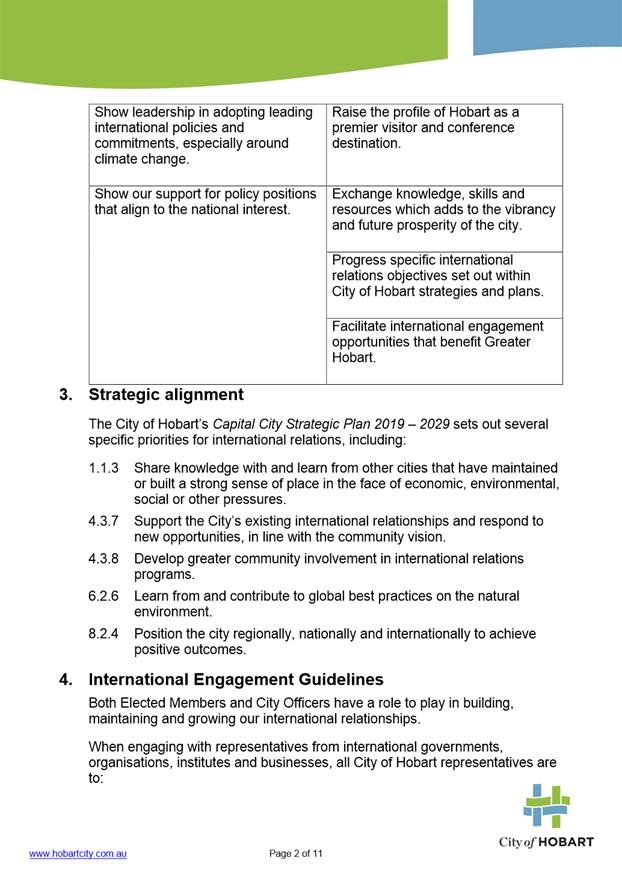
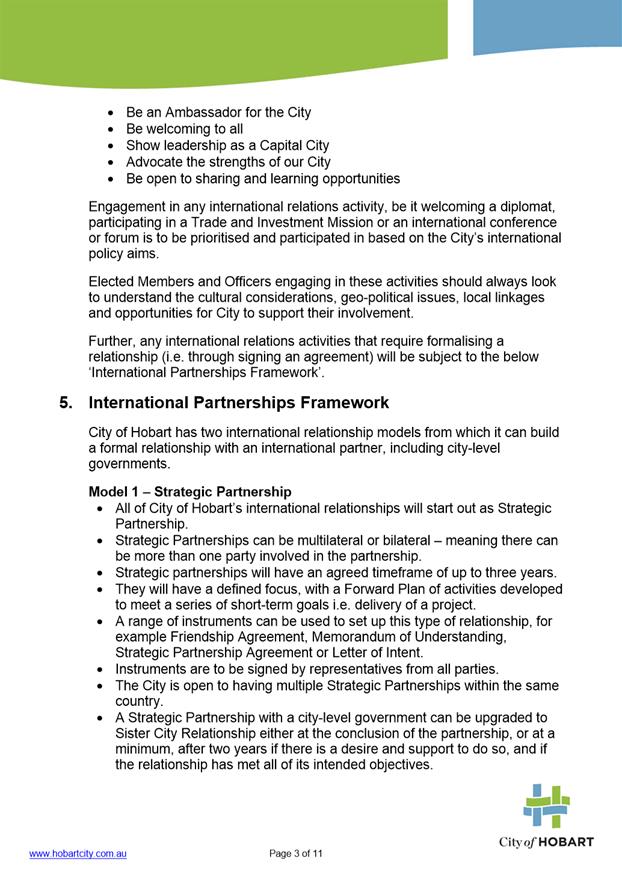
1.1. This report seeks approval of the implementation of a new International Relations Policy (Attachment B).
1.1.1. This requires the previous Guidelines for Future International Relationships Policy be rescinded (Attachment A).
1.2. This report also provides an overview of how this new Policy was developed.
2. Key Issues
2.1. Key updates to the Policy include:
2.1.1. Recognition and articulation of the scope of the City’s international relations activities.
2.1.2. Greater focus on achieving strategic alignment with our international relations activities, including through our formal partnerships.
2.1.3. Guidelines for engaging in international relations activities.
2.1.4. Framework for entering formal international partnerships.
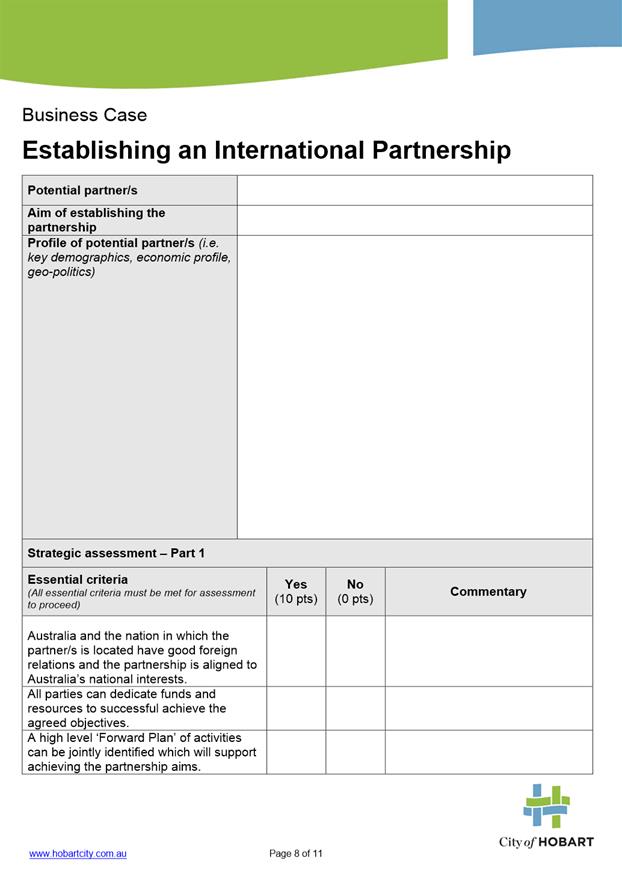
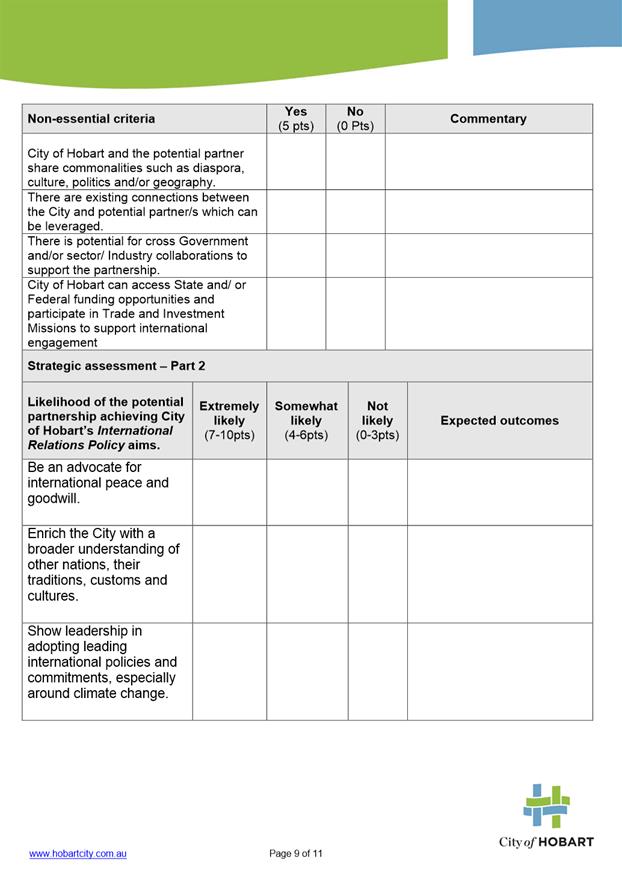
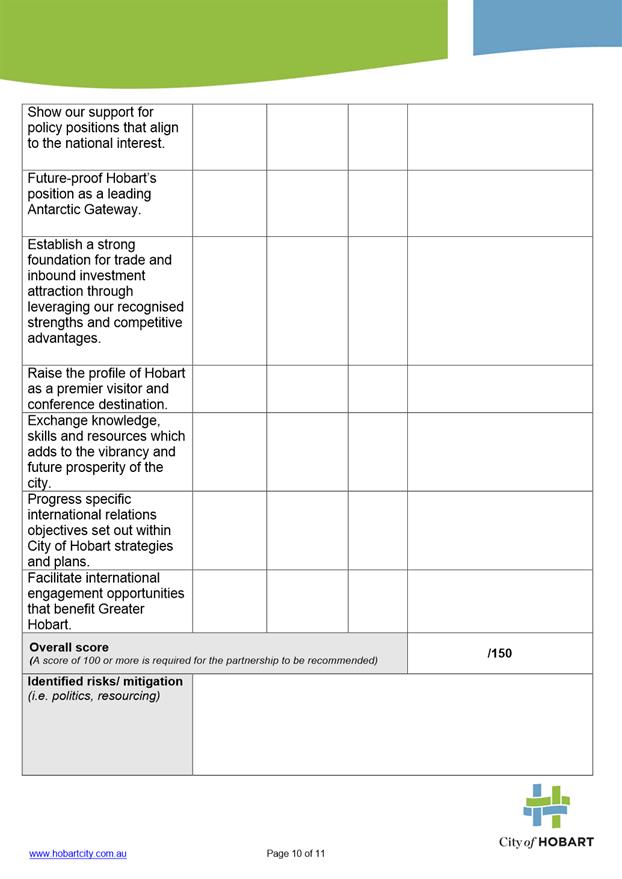
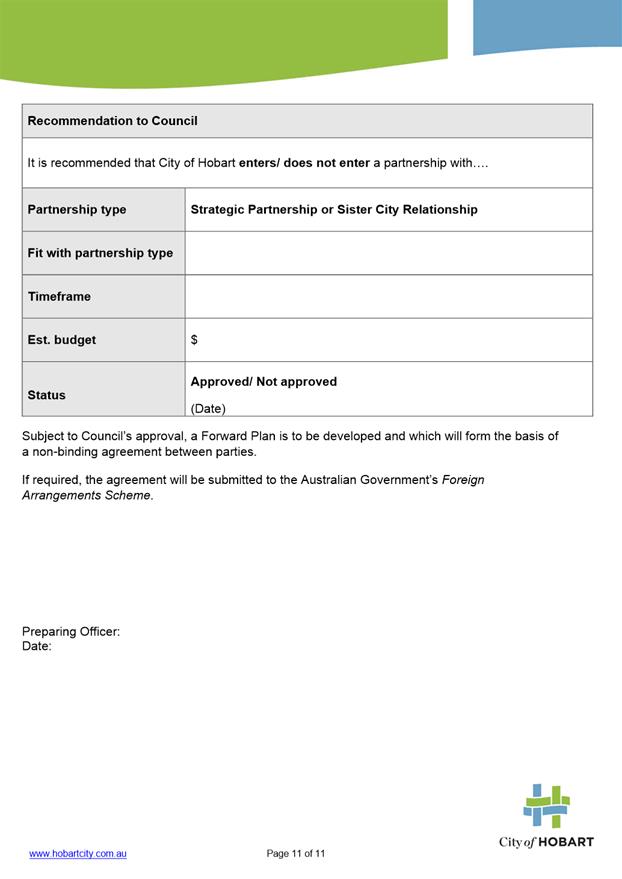
2.1.5. Business Case template to support informed, consistent and transparent decision making around international partnerships.
|
That: 1. The Council rescind the previous Guidelines for Future International Relationships Policy, marked as Attachment A to this report. 2. The Council approve the International Relations Policy, marked as Attachment B to this report. 3. The Council note that the City of Hobart’s existing international relationships will be managed within the framework of the new Policy going forward. 4. A discussion paper be prepared and provided to the Council to set the strategic direction for future international partnerships. |
4. Background
4.1. The Policy that the City of Hobart has previously followed for International Relationships has been rewritten based on significant changes to the geopolitical landscape in recent years and the desire for the City to grow its international profile, aligned to our strategic priorities.
4.2. Countries around the world have experienced and responded to the COVID pandemic in vastly different ways and tensions between world superpowers have rapidly increased, with open conflict resulting. These tensions, as well as an increasing uncertainty around resources, has affected trade relations between countries.
4.3. Australia is balancing its international relationships (including with important trading partners) very carefully and has introduced national legislation to ensure all levels of Government engaging with international Governments are doing so in line with Australian Foreign Policy and that the Australian Government is aware of any formal agreements involving foreign Governments.
4.4. As well as these considerations, the following inputs also informed the new Policy:
4.4.1. Formal and informal consultation with State and Federal Government agencies
4.4.2. Review of Council strategies and priorities
4.4.3. Review of other cities international relations policies
4.4.4. Consultation with Council’s Policy Lab
4.5. An Elected Member workshop on the draft new Policy was held on Tuesday 13 June 2023.
4.5.1. Subsequent to that workshop, in the EM Bulletin edition of Friday 30 June 2023, Elected Members were provided with links to the papers and given the opportunity to provide their feedback.
4.6. City of Hobart has two sister-city relationships:
4.6.1. Yaizu, Japan (since 1977)
4.6.2. L’Aquila, Italy (since 1998)
4.7. City of Hobart previously had friendship agreements with Fuzhou and Xi’an in China but these agreements have both now expired.
5. Legal, Risk and Legislative Considerations
5.1. International partnerships are subject to the Australian Government Foreign Relations Scheme introduced in 2020.
5.2. The new Policy ensures the City aligns with this scheme.
6. Discussion
6.1. It is important that the City’s international relations activities align with the City’s role and policy aims, to ensure alignment with national policy and community expectations. The updated Policy has been designed to ensure this.
6.2. As actively pursuing new international relationships has been paused for the last three years due to COVID, a discussion paper will be developed for the Council to consider at a further workshop. This will input into the development of a two-year strategic approach to our international partnerships.
6.3. It’s important to note that reaching the stage of entering a formal partnership will take time.
6.4. Council will be provided a Business Case which will support the final decision-making process in entering any future formal partnerships, in line with the new Policy.
6.5. As there has been a lot of discussion between Antarctic Gateway Cities to collaborate and exchange knowledge and resources, it is likely that a partnership between City of Hobart and either one or multiple gateway cities will be one of the first formal partnerships we seek to enter.
6.6. Some groups within our community are very attached to the international partnerships we have engaged in in the past, regardless of how active and effective they have been.
6.7. The new Policy is designed to ensure that all relationships, existing and new, operate within a framework that allows them the opportunity to demonstrate their value over a substantial period.
6.8. If this value cannot be sustained, then the Policy allows the City to respectfully conclude the partnership.
7. Hobart: A Community Vision For Our Island Capital
7.1. Aligns to Pillar 4. City Economies, which includes:
7.1.1. 4.1. Our businesses and industries reflect and support our Hobart identities.
· 4.1.3. We collaborate, supporting each other to succeed. We compete together.
· 4.1.4. We embrace industries and professions that thrive in Hobart’s unique environment i.e. Antarctic science.
· 4.1.6. We attract investment that supports our businesses and communities to flourish.
8. Capital City Strategic Plan
8.1. Aligns to Pillar 4. City Economies, which includes:
8.1.1. Outcome: 4.3. Diverse connections help Hobart’s economy, business and workers thrive.
· 4.3.7. Support the City’s existing international relationships and respond to new opportunities in line with the community vision.
8.1.2. Outcome: 4.5. Hobart’s economy is strong and resilient.
8.1.2.1. Of which strategies to achieve this include:
· 4.5.1. Understand and respond to the strategic context of the Hobart economy at regional, state, national and international levels.
· 4.5.3. Develop strategic relationships in major Hobart industries i.e. education, science, research.
· 4.5.5. Acknowledge, celebrate and support Hobart’s position as a gateway to the Antarctic and Southern Ocean.
9. Regional, State and National Plans and Policies
9.1. Aligns to:
9.1.1. Tasmanian Trade Strategy 2019 – 2025
9.1.2. Trade and Investment Mission Plan 2024
9.1.3. Tasmanian Antarctic Gateway Strategy 2022 – 2027
9.1.4. Australian Foreign Relation Act 2020
10. Financial Viability
10.1. Activities which support International Partnerships are primarily the funded by the Smart Economy budget (within Connected City Division).
11. Communications Strategy
11.1. The community has a key role in supporting the City’s international relations activities. Once approved by the Council, the new Policy will be provided to key stakeholders and relevant community groups, as well as been made available on the City’s website.
As signatory to this report, I certify that, pursuant to Section 55(1) of the Local Government Act 1993, I hold no interest, as referred to in Section 49 of the Local Government Act 1993, in matters contained in this report.
|
Nick Andrew Manager Smart Economy |
Jacqui Allen Director Connected City |
Date: 23 August 2023
File Reference: F23/57310
Attachment a: Guidelines
for Future International Relationships (to be rescinded) (Supporting
information)
Attachment
b: International
Relations Policy (new) ⇩ 
|
Agenda (Open Portion) Council Meeting |
Page 1 |
|
|
|
28/8/2023 |
|
13. Status of the Urban Canopy on Public and Private Land
File Ref: F23/73115
Report of the City Greening Lead, Manager Open Space, Parks and Waterways and Acting Director City Life of 22 August 2023 and attachments.
Delegation: Council
|
Item No. 13 |
Agenda (Open Portion) Council Meeting |
Page 1 |
|
|
28/8/2023 |
|
REPORT TITLE: Status of the Urban Canopy on Public and Private Land
REPORT PROVIDED BY: City Greening Lead
Manager Open Space, Parks and Waterways
Acting Director City Life
1. Report Summary
1.1. On 14 December 2022, the Planning Committee resolved that:
A report be provided to Council on the status of the urban canopy on public and private land, to assist with informing whether the Council has the right approach to tree protection.
1.2. A report has been prepared, entitled the State of the Canopy Report, (Attachment A). This report relied on mapping of the canopy cover across public and private land, within each suburb and across different land uses, using satellite imagery and a trained deep learning model, (Attachment B).
2. Key Issues
2.1. This analysis has found that from 2017 to 2022, canopy cover:
2.1.1. has declined by 2% across private land; and
2.1.2. has remained relatively consistent on public land.
2.2. For the reasons set out in this report, it is proposed that the Council takes proactive steps to increase canopy cover on private land, initially with a focus on community education, incentives and further research.
|
That: 1. The Council endorses the State of the Canopy Report for public release. 2. The Council takes proactive steps to increase canopy cover on private land, initially with a focus on community education, incentives and further research. 3. That from the 2024/2025 financial year $20,000 per year be allocated to the arboriculture services budget to be used for promoting, facilitating and encouraging tree planting activities on private land, in order to increase canopy cover on private land. |
4. Background
4.1. Following the meeting of 14 December 2022, the Planning Committee endorsed a motion that:
A report be provided to Council on the status of the urban canopy on public and private land, to assist with informing whether the Council has the right approach to tree protection.
4.2. As part of the Street Tree Strategy in 2017, the Council endorsed a target to increase canopy cover across the City to 40% by 2046.
4.3. The canopy cover across the ‘urban areas’ was calculated for the 2017 Street Tree Strategy and was found to be 16.9%.
4.4. Unfortunately, the urban areas used to calculate the canopy cover were not clearly defined in the 2017 Street Tree Strategy so it was not possible to replicate the exact 2017 study areas.
4.5. In 2022, an updated assessment of the City’s canopy cover was undertaken by Geoneon and the City of Hobart. This assessment was undertaken on both 2017 satellite imagery and 2022 imagery, allowing comparisons to be made across the five-year period. The urban area was defined using the planning scheme zones. These are comprised of:
- general residential
- inner residential
- low density residential
- urban mixed use
- commercial
- central business.
4.6. Using this defined ‘urban area’, the canopy cover across urban areas in the City of Hobart is 29% in 2022. In 2017, it was 31%.
4.7. There is a 2% loss in canopy cover across urban areas from 2017 to 2022, with all of this canopy loss being on private land.
4.8. The State of the Canopy report contains the introduction, background, discussion and findings for a recent canopy cover assessment across both public and private land.
4.9. The State of the Canopy Report, and the data produced by Geoneon go into greater detail about changes in canopy cover between 2017 and 2022. The broad findings are:
4.9.1. From 2017 to 2022 tree canopy cover has declined by 2% across urban private land. This represents approximately 55 Ha of tree canopy loss.
4.9.2. The canopy cover on public land has remained roughly stable- seeing a slight increase of 0.1 Ha over this time period.
4.9.3. The Canopy cover across the urban area in 2022 (as defined using local planning zones) is 29%. In 2017 it was 31%.
4.9.4. Hobarts inner suburbs have much lower canopy coverage (Hobart 6.9%, North Hobart 9%, New Town 15.1%, Battery Point 16%).
5. Discussion
5.1. In order to protect the urban canopy cover on private land, the Council may:
5.1.1. increase regulation of private land, to reduce the rate of the removal of trees on private land; and / or
5.1.2. provide community education and incentives in the hope that private landowners will voluntarily increase tree cover on their land or at least slow the removal of existing trees.
5.2. For the reasons set out below, this report recommends that the Council initially takes the latter approach.
Possible regulation
5.3. There are two main mechanisms for increasing regulation of private tree removal: by-laws protection and greater planning scheme protection.
5.3.1. By-laws
regulation. No current Tasmanian Council has a by-law to protect trees on
private land. Kingborough Council did previously for 20 years. This was removed
in 2021 following legal advice, however, following significant community
concern relating to the removal of this by-law further legal advice was sought
which was favourable to having a private tree protection by-law.
If the City wished to pursue enacting a Tree Protection By-law, significant
consideration would need to be given to both reviewing the legality of such a
proposal and the resultant increase in internal staff resources in order to
facilitate such a program. A business case and legal review would need to
be undertaken prior to pursuing this option, however it is likely that
additional staff member would be required in the arboricultural, administration
and compliance teams. Due to current resourcing issues, it is not recommended
that this proceeds at this stage.
5.3.2. Planning Scheme Protection: Vegetation Protection Overlays that protect all trees of a certain size are commonplace on the mainland. In a Tasmanian context the general exemptions provisions in the State Planning Provisions (which cannot be overridden by the Local Provision Schedules) would undermine the efficacy of such a protection. In order to proceed with greater tree protections within the planning scheme, and for these protections to be effective in the Tasmanian context, the Minister of Planning would need to amend the general exemptions to reference specific tree protection overlays. It is recommended that this is not pursued at this stage.
5.3.3. Planning
Scheme Protection: Significant Trees Code. The intent of the Significant
Tree Register is to highlight and protect exceptional and outstanding trees-
either because of their size, age or other element - rather than to protect the
general community, environmental and social benefits provided by an extensive
and healthy canopy cover across the City. While this code is essential to
highlight and protect these highly important trees the Significant Trees Code
it is not considered an adequate mechanism to protect and enhance the overall
urban canopy of the City.
To encourage further community support of the Significant Tree Code, and to
provide an incentive for property owners to nominate their own tree, it is
suggested that a grant program be explored in future years that would provide
matched funding for the maintenance of listed Significant Trees.
Community education and incentives
5.4. Other mechanisms to protect and enhance canopy on private land include:
5.4.1. tree planting and protection incentives;
5.4.2. community education; and
5.4.3. further research.
It is recommended that the City initially focus on enhancing private canopy through these mechanisms.
5.5. As an example of a community program which generated enthusiasm with the public for our environment was the recent plant giveaway which was offered in the context of the changes to maintenance of nature strips in the Nature Strip Policy.
5.6. That program saw 207 applicants for approximately 4,000 plants which were available for collection. It was a successful and positive campaign.
5.7. It is anticipated that landowners would show similar enthusiasm if trees were made available for planting on their land.
5.8. Given that the reduction of canopy may be an unfortunate consequence of infill development, it may be appropriate to focus on offering trees to new homeowners to offset the reduction of trees and vegetation which are sometimes inevitable as part of the development of land, particularly for new housing.
5.9. It is also hoped that providing greater focus on educating the community on the importance of maintaining our urban canopy and the role it plays in the health of our City, may make people decide to retain trees that they may have otherwise removed.
5.10. Further research is also warranted into the causes or contributing factors into the reduction of urban canopy, along with further monitoring.
Recommendation
5.11. Taking a proactive approach through education and incentives would allow the City of Hobart to progress this issue on a positive note and would enable the community to be our partners on that journey. It would also involve less resources from the Council to take this approach. For these reasons, this approach is recommended at this point, rather than increasing regulation.
6. Legal, Risk and Legislative Considerations
6.1. Any potential changes to private tree protection regulations will need to be carefully considered in the existing legal framework. No other legal, risk or legislative issues arise.
7. Hobart: A Community Vision For Our Island Capital
7.1. Pillar 6: Natural environment
6.1 Our City is park of nature and nature is part of our City
6.1.5 Greenways thread through our city. We create and enhance linkages to parks and reserves, and wildlife have corridors relevant to their behaviours and habitats.
6.1.7 We are able to carry out our daily lives in nature and with access to nature. We do not think of the natural environment as separate or somewhere else but rather as part of our city.
6.6.3 We build strong partnerships to protect and regenerate Hobart’s natural environment.
8. Capital City Strategic Plan
8.1. Capital City Strategic Plan: Pillar 6: Natural Environment. 6.1.5 Enhance urban forests, tree canopy cover and greenery throughout Hobart.
8.2. Action item 6 of the Street Tree Strategy: Investigate and consider the development of a policy and possible regulatory control for the protection of trees on private property with a view to it becoming part of overarching urban forests strategy for the City.
9. Financial Viability
9.1. Funding Source and Impact on Current Year Operating Result
9.1.1. No impact on 2023/2024 financial year budget
9.2. Impact on Future Years’ Financial Result
9.2.1. The implementation of the recommendations will result in an additional cost to Council of $20,000 per year from next year (2024/2025 financial year) be allocated to the arboriculture services budget to be used for promoting, facilitating and encouraging tree planting activities on private land. This funding could be used for a tree giveaway program, competition for best urban garden, education program etc.
9.3. Asset Related Implications
9.3.1. None
10. Sustainability Considerations
10.1. This proposal is in line with the Councils targets to increase canopy cover across urban areas for the many community, economic and environmental benefits that they provide.
11. Community Engagement
11.1. It is recommended that the outcomes of the canopy report, and the approved recommendations are communicated to the public in the form of a media release, development of a State of the Canopy Report and other social media opportunities.
12. Communications Strategy
12.1. A communications strategy will be developed with the communications team to promote the State of the Canopy Report.
As signatory to this report, I certify that, pursuant to Section 55(1) of the Local Government Act 1993, I hold no interest, as referred to in Section 49 of the Local Government Act 1993, in matters contained in this report.
|
Ruby Wilson City Greening Lead |
Cole Smith Manager Open Space, Parks and Waterways |
|
Karen Abey Acting Director City Life |
|
Date: 22 August 2023
File Reference: F23/73115
Attachment a: State
of the Canopy Report (Supporting information) 
|
Item No. 14 |
Agenda (Open Portion) Council Meeting |
Page 1 |
|
|
28/8/2023 |
|
14. Response to Petition - TasNetworks Transformer Relocation - Harbroe Avenue, New Town
File Ref: F23/73139
Report of the Senior Engineer Road Services, Acting Director City Life and Director City Enablers of 15 August 2023.
Delegation: Council
|
Item No. 14 |
Agenda (Open Portion) Council Meeting |
Page 1 |
|
|
28/8/2023 |
|
REPORT TITLE: Response to Petition - TasNetworks Transformer Relocation - Harbroe Avenue, New Town
REPORT PROVIDED BY: Senior Engineer Road Services
Acting Director City Life
Director City Enablers
1. Report Summary
1.1. At the Council meeting of 19 June 2023, a petition with 36 signatures was tabled regarding a proposed TasNetworks substation in Harbroe Avenue, New Town. The petitioners are opposed to the location of the substation.
1.2. This report responds to the petition.
2. Key Issues
2.1. TasNetworks is relying on its statutory powers to install the substation.
2.2. The City of Hobart has applied its policy “Assessment of Works by Utilities” in assessment of TasNetworks proposal. There is no basis for the City to impose any conditions or refuse these works.
|
That: 1. The petition regarding a proposed TasNetworks substation to be installed in Harbroe Avenue, New Town, be received and noted. 2. Council officers meet with TasNetworks quarterly to discuss TasNetworks’ works planned on roads and land administered by the Council, to ensure that any concerns about the location, nature or timing of the works are able to be properly discussed. 3. The Council agree that no further action is required in response to the received petition. 4. The petitioners be advised of the Council’s decision. |
4. Background
The Petition
4.1. At the Council meeting of 19 June 2023, a petition with 36 signatures was tabled requesting that:
i. The City of Hobart withdraw permission for TasNetworks to construct a substation in Harbroe Ave, New Town.
ii. The City of Hobart require TasNetworks to avoid removal of street trees for all future projects on council owned land and encourage pole-mounted units are installed in preference to bulky, visually obtrusive ground-level padmount units in local streets.
iii. That the City of Hobart urge TasNetworks to not compromise local heritage values when undertaking new infrastructure projects in the municipality.
iv. That the City of Hobart pursue a Memorandum of Understanding (MoU) with TasNetworks that commits TasNetworks to genuine community consultation and transparent decision - making concerning all infrastructure projects within the municipality.
TasNetworks Powers
4.2. TasNetworks operates under the Electricity Supply Industry Act 1995 (the ESI Act).
4.3. The ESI Act details that it is presumed the Council consents to electrical works by TasNetworks that have a “minor environmental impact”: section 52(5). It states:
52. Power to carry out work on public land
(1) An electricity entity may, by agreement with the authority responsible for the management of public land –
(a) install electricity infrastructure on the land; or
(b) operate, maintain, repair, modify, add to or replace electricity infrastructure on the land; or
(c) carry out other work on the land for the generation, transmission, distribution or supply of electricity.
(2) Without limiting subsection (1), the electricity entity may –
(a) erect powerlines; and
(b) clear vegetation to prevent contact with powerlines; and
(c) build conduits for underground cables.
(3) An agreement under this section may contain conditions the authority responsible for management of the land considers appropriate in the public interest.
(4) The responsible authority must not unreasonably refuse to agree to work proposed by an electricity entity under this section nor may it impose unreasonable conditions.
(5) The responsible authority's agreement to proposed work under this section is presumed if the work is of a kind classified by the regulations as being of minor environmental impact.
4.4. “Minor environmental impact” is defined in the Electricity Supply Industry Regulations 2018. Almost all TasNetworks works fall within the definition. The definition is as follows:
For sections 52(5) and 57(b) of the Act, the following work is classified as being of minor environmental impact:
(a) the removal, repair, maintenance or modification of existing powerlines for the transmission, distribution or supply of electricity;
(b) the removal, repair, maintenance or modification of an existing substation or a transformer associated with the transmission, distribution or supply of electricity;
(c) the installation or erection of powerlines along any public street, road or highway and on public land for the distribution or supply of electricity;
(ca) the installation or erection of powerlines on, and over, private land to individual lots and structures, for the distribution or supply of electricity;
(d) the laying, removal, repair, maintenance or modification of any underground cable for the distribution or transmission of electricity;
(e) the clearing or lopping of trees, branches or other vegetation to the extent necessary for the protection of electricity infrastructure or public safety;
(f) the installation and erection of any substation or transformer associated with the distribution or supply of electricity;
(g) the installation, erection, removal, repair, maintenance, modification, or use, on land, of any electricity generating plant that –
(i) is not used, or intended by the Hydro-Electric Corporation to be used, to generate electricity for more than 12 months after the plant is installed or erected on the land; and
(ii) is installed or erected on land that is, or on land that is adjacent to, land on which there is already situated an electricity generating plant, substation or switchyard or on which not less than 200 gigawatt hours of electricity was consumed during the previous calendar year.
4.5. As detailed above, in accordance with subsection (f) the installation and erection of any substation or transformer associated with the distribution or supply of electricity is classified as being of “minor environment impact”.
Council’s Powers
4.6. Given that there is a legislative presumption of agreement by the Council to the works to be carried out by TasNetworks, there is little the Council can do to resist this work.
4.7. This “presumed agreement” can be displaced in certain circumstances in which case an agreement must be reached and the Council can impose conditions which are considered appropriate in the public interest.
4.8. The Council has a policy which addresses how the Council will approach these types of works: the Assessment of Proposed Works by Utilities on Roads and Land Administered by the City.
4.9. In determining if the presumption should be displaced and what, if any conditions, are necessary, the following matters are required by the Policy to be considered:
4.9.1. whether the type of work proposed is one which may be inconsistent with existing Council policies or strategies relevant to the land;
4.9.2. whether the type of work proposed is one which may result in the Council not being able to perform one or more of its statutory functions in relation to the land;
4.9.3. whether the type of work proposed is one which may result in the Council incurring expenditure in relation to the land (such as relocating assets or services);
4.9.4. whether the proposed occupation of Council land by the proposed installation may reduce public access to the land;
4.9.5. the significance or public importance of the land which is the subject of the works; and
4.9.6. whether the proposed works would be inconsistent with the proper discharge of Council’s statutory function.
4.10. The range of matters is determined having regard to the particular circumstances of each case.
4.11. The installation of this work is exempt from requiring planning permission: clauses 5.2.7 and E13.4.1(k)(vi) of the Hobart Interim Planning Scheme 2015.
Proposed substation
4.12. TasNetworks has informed Council of the proposed installation of a new electrical substation in Harbroe Street, New Town which will replace aged infrastructure located elsewhere.
4.13. It is understood that in order to maintain continuous electricity supply to customers TasNetworks needs to situate the new substation at a different location from the existing substation.
4.14. Explicit approval has therefore not been required by the Council for the proposed work, because agreement is “presumed” pursuant to the Electricity Supply Industry Act 1995.
4.15. Officers have reviewed the proposed works in this particular circumstance and determined that the proposed works by TasNetworks (the placement of a substation on road reservation) does not include issues that would displace the presumption of consent to the works. In making this assessment it is noted that:
4.15.1. the installation of electrical equipment is not inconsistent with an existing policy or strategy;
4.15.2. the type of work is not expected to result in the Council being unable to perform its statutory functions;
4.15.3. the proposed works are not expected to result in the Council incurring expenditure;
4.15.4. public access to the land is not expected to be reduced;
4.15.5. where the works are proposed to occur is not on land that is of significance or public importance; and
4.15.6. the proposed works are not inconsistent with the proper discharge of the Council’s statutory function.
4.16. To that end, officers’ assessment is that the presumption is not displaced and the Council does not have the power to refuse or condition the works.
TasNetworks response to petition
4.17. TasNetworks has provided the following response to the petition:
TasNetworks has an overriding duty (and statutory authority) to keep Tasmania’s electricity network as safe and reliable as possible for Tasmanians, in an affordable and efficient manner. Where this duty gives rise to dispute or conflict, it’s also vitally important for us to listen, consult, and seek practical good faith compromise where it may be possible and practical.
TasNetworks has engaged in such consultation on the Harbroe Avenue matter for several months, bringing the already-overdue need to replace this substation to the point of urgency. Following a meeting with the Federal Member for Clark, Mr Andrew Wilkie, we recently offered residents of Harbroe Avenue two compromise options (one involving additional cost and ongoing commitment of resources by TasNetworks) to help partially protect or give legacy to the wattle tree on the proposed substation site in Harbroe Avenue. I’m advised these two compromise options have since been rejected by residents.
[In respond to the] request to consider a pole-mounted alternative to the proposed ground-based substation. I can assure you this alternative option has been extensively considered and investigated, including directly by myself at a project meeting on 4 April of this year. It would involve seeking to mount two large and heavy transformers on power poles on the opposite side of Harbroe Avenue. This option carried concerns of actually being more unsightly for adjacent residents, as well as providing a vastly inferior service to the substation option (potentially affecting reliability), while being far harder for TasNetworks to access and maintain (potentially affecting reliability).
I called the meeting of 4 April in my determination to explore any and all options to meet the needs and wishes of Harbroe Avenue residents. Three alternative options were explained and considered at that meeting (including the pole-mounted alternative), and found to be impractical or unreliable. I also noted that any of the four options (including the Harbroe substation option) were likely to meet with some opposition from various residents, based on competing impacts and preferences.
Upon careful and exhaustive consideration of my project team’s advice, and thorough questioning of their position, I reached the conclusion that the Harbroe Avenue substation proposal is the only acceptably safe, reliable and practical option available to TasNetworks, and needs to proceed. We subsequently offered the two final mitigating compromise options to Harbroe Avenue residents (following consultation with Mr Wilkie), which were rejected.
Ground-mounted substations remain a necessary reality of modern power networks, though their placement will not always be popular. The existing ground-mounted substation in Park Street (asset T181143) was manufactured in 1970, with a life span of 50 years. It has therefore already progressed three years beyond its intended operating life span, and must be replaced with reasonable urgency. It cannot be replaced on its existing site because the new modern substation is a different size and configuration. Should the existing substation fail due to age, the likely consequences would be sustained power outages for several hundred customers around New Town and nearby northern suburbs. The number of customers directly supplied from the existing substation is about 150, including two customers with critical life support or equivalent needs. Those customers would permanently lose supply until temporary solutions (like a generator) could be initiated. The substation forms a link in the overall network. Until switching could occur, the number of customers affected by any outage (caused by failure of that asset) would likely be substantially higher than the 150 directly supplied. There are also safety and environmental risks associated with not retiring and replacing age-expired electrical assets. TasNetworks has a responsibility to protect the safety and wellbeing of its employees.
All alternative options have been exhaustively investigated in good faith, and further delay to effectively re-start a period of consultation and debate would not be responsible or appropriate. In this instance, despite efforts to seek alternatives and compromise, TasNetworks must heed its foremost duty to prioritise the safety and reliability of the network that serves Tasmanians, despite it being unpopular with some residents.
5. Discussion
5.1. The petition requests that the City “require TasNetworks to avoid removal of street trees for all future projects on council owned land…”.
5.1.1. If TasNetworks wishes to remove a tree as part of infrastructure upgrades, they seek approval from Council. The circumstances of each particular request, and the tree involved are investigated by the Councils arboricultural team. If a high value tree is proposed for removal, the City works with TasNetworks to find an alternative practical solution.
5.1.2. In this case, the tree in question that was approved for removal is a small Gossamer Wattle (Acacia floribunda) that is multistemmed. This is a highly cultivated specimen that is native to Victoria, New South Wales and Queensland. It was planted by the resident some years ago and is the only specimen of this species in the street. On either side of the wattle are two Peppercorn trees that are of higher visual impact to the streetscape. These two trees will be protected during the proposed works
5.1.3. If tree removal is permitted (as in this case), the City requires that TasNetworks pay compensation for the removed tree so that a replacement tree can be planted in the vicinity.
5.1.4. A policy position that prevents all tree removal, regardless of the individual circumstances, asset management needs or community benefit would not be a reasonable position for the Council to take and is inconsistent with our current Removal of Council Trees Policy. It is unclear whether this would be legal position. The current arrangement with TasNetworks, where each request is considered on its merits and tree removal is avoided where practical, is considered to be the best approach.
5.2. The petition requests that the City “…encourage pole-mounted units are installed in preference to bulky, visually obtrusive ground-level padmount units in local streets.”. TasNetworks are responsible for the management and upgrade of their assets, and have the technical expertise, to determine what type of asset is suitable in each circumstance. The City will not consider requiring one type of asset over another but will work with TasNetworks on a case-by-case basis, taking in to account their technical expertise.
5.3. The petition states that the proposal impacts on heritage values. The works proposed by TasNetworks are expressly exempt from the heritage provisions of the applicable planning scheme. In the circumstances, there is no basis for the Council to impose any restrictions on this type of works for heritage reasons.
5.4. The petition raises concerns about site safety due to impacts on heavy vehicles using the laneway between 12 and 14 Harbroe Avenue which provides access to 32 properties. The petition states that long trucks commonly manoeuvre over the kerb/nature strip on which the proposed substation would be situated and therefore the proposed substation is in a direct heavy vehicle impact zone.
5.4.1. It is unlawful for a person to drive a vehicle or permit a vehicle to be driven over any footpath, nature strip, kerb of gutter of any highway (street) to or from any site or premises unless the owner of the premises is the holder of a permit for this purpose Infrastructure By-Law No 1 2018, section 13.
5.4.2. Officers advise no permits have been given for a heavy vehicle to drive over the kerb or gutter or nature strip to access the public land and a permit would be unlikely to be granted due to potential of damage to Council’s own infrastructure. This is therefore not a relevant consideration in the circumstances.
5.5. In response to the specific requests in the petition:
5.5.1. The City of Hobart withdraw permission for TasNetworks to construct a substation in Harbroe Ave, New Town.
For the reasons stated above, the Council has no legal basis to do so.
5.5.2. The City of Hobart require TasNetworks to avoid removal of street trees for all future projects on council owned land and encourage pole-mounted units are installed in preference to bulky, visually obtrusive ground-level padmount units in local streets.
For the reasons stated above, the Council has no legal basis to do so. The Council will try to negotiate, where possible, in order to minimise the removal or impact on street trees.
The specifications for the infrastructure which is required is entirely within the expertise and knowledge of TasNetworks, not the Council.
5.5.3. That the City of Hobart urge TasNetworks to not compromise local heritage values when undertaking new infrastructure projects in the municipality.
In circumstances where the works are planning exempt, this is not an appropriate approach to take.
5.5.4. That the City of Hobart pursue a Memorandum of Understanding (MoU) with TasNetworks that commits TasNetworks to genuine community consultation and transparent decision - making concerning all infrastructure projects within the municipality.
The Council has a policy which sets an appropriate framework for engaging in discussions with TasNetworks in relation to works such as this. A Memorandum of Understanding is not required and will also have no legal standing outside the existing statutory framework.
6. Legal, Risk and Legislative Considerations
6.1. The proposed works are the responsibility of TasNetworks and therefore no legal or legislative risks are foreseen with this proposal.
As signatory to this report, I certify that, pursuant to Section 55(1) of the Local Government Act 1993, I hold no interest, as referred to in Section 49 of the Local Government Act 1993, in matters contained in this report.
|
Claire Bryan Senior Engineer Road Services |
Karen Abey Acting Director City Life |
|
Michael Reynolds Director City Enablers |
|
Date: 15 August 2023
File Reference: F23/73139
|
Item No. 15 |
Agenda (Open Portion) Council Meeting |
Page 1 |
|
|
28/8/2023 |
|
15. Response to Petition - Salamanca Stallholder Association Negotiation on draft Licence Agreement
File Ref: F23/73073; 33-60-2/38
Report of the Acting Manager Welcome Pad and Director Connected City of 14 August 2023.
Delegation: Council
|
Item No. 15 |
Agenda (Open Portion) Council Meeting |
Page 1 |
|
|
28/8/2023 |
|
REPORT TITLE: Response to Petition - Salamanca Stallholder Association Negotiation on draft Licence Agreement
REPORT PROVIDED BY: Acting Manager Welcome Pad
Director Connected City
1. Report Summary
1.1. This report responds to a petition received and tabled at the Council meeting of Monday, 22 May 2023.
1.2. The petition contained 223 signatures, requesting ‘That site fees [for Salamanca Market] increase by CPI capped at 10% and Council negotiate in good faith on the terms of the licence agreement’.
2. Key issues
2.1. At the Council meeting of Monday, 22 May 2023, Elected Members considered the 2023-24 Salamanca Market site fees along with the 2023-2028 Salamanca Market Stallholder Licence Agreement (‘Agreement’), and it was resolved that site fee be increased by annual CPI for the life of the Agreement capped at 10%.
2.2. The Agreement was subsequently updated to reflect the Council decision and all licensed stallholders have now received their new Agreement.
2.3. The petitioner has received a letter from the City to confirm receipt of the petition and the process of response.
|
That: 1. The Council endorse no further action is required in response to the petition titled Salamanca Market Stallholder Association Negotiation on Draft Licence Agreement, received at the Council meeting of Monday, 22 May 2023. 2. The petitioners be advised of the Council’s decision. |
4. Background
4.2. The petition contained 223 signatures, with the majority being Salamanca Market stallholders.
4.3. As required under the Local Government Act 1993, the Council is to consider action to be taken in response to the petition at a Council meeting.
4.4. At the Council meeting of Monday, 22 May 2023, Elected Members considered the 2023-24 Salamanca Market site fees along with the 2023-2028 Salamanca Market Stallholder Licence Agreement (‘Agreement’), and it was resolved that:
1. The Salamanca Market Site Fee increase, referred to as Option 3 within the Officer report marked as item 10 of the Open Council Agenda of 22 May 2023, namely “Annual CPI for the life of the Agreement capped at 10%”, be adopted.
2. The 2023-2028 Salamanca Market Stallholder Licence Agreement marked as Attachment B to item 10 of the Open Council Agenda of 22 May 2023, amended as follows, be approved by the Council:
a. To include the term:
That Council officers can provide a Salamanca Market Annual Revenue and Expenditure Statement upon the signing of the Salamanca Market Stallholder Licence Agreement 2023-2028 and each yearly anniversary of the signing.
The Statement shall include the following classifications:
ii. Income from stall fees
iii. Income from other sources (grants etc)
iv. Wage expense for all staff ‘on ground’
v. Consulting fees – with a generic explanation of type of consulting work performed
vi. Advertising and marketing expenses
vii. Busker expenses
viii. Entertainment other than busker entertainment
ix. Materials
x. Repairs and maintenance
xi. Insurance
xii. Valuation costs
xiii. Legal costs
xiv. All other costs to be placed into ‘general expenses’ – to be detailed further with a note should general expenses be more than 5% of total income as per 1 and 2 combined.
b. Clause 57a be amended to substitute the words ‘for any reason’ with ‘for reasons of occupational health and safety’.
c. An additional clause, 33c(x), be added to include the Salamanca Stallholders Association as a reliant party to the valuation.
3. The approved 2023-2028 Salamanca Market Stallholder Licence Agreement be distributed to all licensed Salamanca Market Stallholders for signature.
4. The redacted Acumentis valuation report be released publicly.
5. The schedule of fees and charges for Salamanca Market, marked as Attachment C to item 10 of the Open Council Agenda of 22 May 2023, amended in accordance with Clause 1 above, be adopted effective from 1 July 2023 for the 2023-24 financial year.
5. Legal, Risk and Legislative Considerations
5.1. The methodology for Salamanca Market site fees increases are contained within clause 33 of the Agreement.
6. Discussion
6.1. The matter of Salamanca Market site fees contained within Agreement has been resolved at the Council meeting of Monday, 22 May 2023.
6.2. The Council resolution was in line with the content of the petition.
6.3. The Agreement was subsequently updated to reflect that Salamanca Market site fees be indexed to the most recent available twelve month change in Consumer Price Index (All Groups – Hobart – December Quarter) published by the Australian Bureau of Statistics, provided that any increase base site fee is no greater than 10% for that year.
7. Hobart: A Community Vision For Our Island Capital
7.1. The document includes eight pillars that represent the major parts of Hobart life. Pillar 4 is City Economies.
7.1.1. We are a city whose economies connect people, businesses, education and government to create a high-quality lifestyle in a thriving and diverse community. Our city is our workshop. We collaborate, embracing ideas, inventiveness and initiative.
7.1.1.1. Section 4.5.3: Our markets are incubators for business, supporting small businesses to scale up, if they want to.
8. Capital City Strategic Plan
8.1. The delivery of Salamanca Market aligns with the City of Hobart Capital City Strategic Plan 2019-29, namely:
8.2. Pillar 3: Creativity and culture
3.1.5. Support and deliver events, festivals and markets.
3.4.1. Support the activation of City-owned spaces for creative, cultural and commercial initiatives.
9. Financial Viability
9.1. Funding Source and Impact on Current Year Operating Result
9.1.1. Not applicable.
9.2. Impact on Future Years’ Financial Result
9.2.1. Not applicable.
9.3. Asset Related Implications
9.3.1. Not applicable.
10. Community Engagement
10.1. Significant stakeholder engagement was undertaken in good faith in the development of the Licence Agreement, with involvement of the Salamanca Market Stallholders’ Association throughout the review process.
11. Communications Strategy
11.1. The petitioner has received a letter from the City to confirm receipt of the petition and the process of response.
11.2. All Licensed stallholders have been provided with a copy of the new fees and charges, along with their new Agreements.
As signatory to this report, I certify that, pursuant to Section 55(1) of the Local Government Act 1993, I hold no interest, as referred to in Section 49 of the Local Government Act 1993, in matters contained in this report.
|
Lisa Punshon Acting Manager Welcome Pad |
Jacqui Allen Director Connected City |
Date: 14 August 2023
File Reference: F23/73073; 33-60-2/38
|
Item No. 16 |
Agenda (Open Portion) Council Meeting |
Page 1 |
|
|
28/8/2023 |
|
16. Independent Review of Commonwealth Disaster Funding submission
File Ref: F23/84827
Report of the Manager
City Resilience and Acting Director City Life of
23 August 2023 and attachment.
Delegation: Council
|
Item No. 16 |
Agenda (Open Portion) Council Meeting |
Page 1 |
|
|
28/8/2023 |
|
REPORT TITLE: Independent Review of Commonwealth Disaster Funding submission
REPORT PROVIDED BY: Acting Director City Life
Manager City Resilience
1. Report Summary
1.1. The purpose of this report is to advise the Council of the City of Hobart’s submission provided to the Independent Review of Commonwealth Disaster Funding.
1.2. The Review will assess how Commonwealth disaster funding measures can be redefined and enhanced to complement and support state and territory arrangements and programs, proactively improve resilience and promote disaster risk reduction to constrain growing recovery costs, and deliver a system that is effective, responsive, equitable, and accessible.
1.3. The submission consists of content from the City’s submission to the Senate Select Committee on Australia’s Disaster Resilience endorsed by Council on 24 April 2023.
1.3.1. This submission will inform the Review’s final report which is expected to be provided to the Australian Government in April 2024.
2. Key Issues
2.1. The Review asked for information about previous experiences with Commonwealth disaster funding support, how funding could support communities to reduce their disaster risk and if the roles of Commonwealth, State and Local Governments are clear.
2.2. The City’s submission focusses on the existing natural disaster funding arrangements in preparing for, responding to and recovering from natural disasters. The key points raised in the submission were:
2.2.1. The City of Hobart does not have direct oversight of funding support processes due to State Government coordination.
2.2.2. The increase in natural disasters due to the impacts of climate change demonstrated the need for coordinated national natural disaster funding arrangements.
2.2.3. While local government is often responsible for natural disaster risk mitigation, the Australian Government is best-placed to increase investment in disaster resilience and provide baseline funding for staff to undertake community resilience actions.
|
That the Council note the submission provided to the Independent Review of Commonwealth Disaster Funding.
|
4. Background
4.1. Disasters cost the Australian economy $38 billion per year on average. The severity, intensity and frequency of natural disasters is expected to increase, putting further strain on Australia’s relief, response and recovery capabilities. By 2060, the cost of disasters could rise to at least $73 billion per year.
4.2. Major recent disaster events in Australia spanning several jurisdictions such as bushfires and major flooding have required large scale response and recovery efforts from authorities at Commonwealth, state, and local levels, along with an increased focus on longer term resilience.
4.3. Considering this, the Australian Government has commissioned an Independent Review of the Commonwealth Disaster Funding Arrangements (the Review).
4.3.1. The Review seeks to understand and define the Australian Government’s (the Commonwealth) role in Australia’s disaster funding environment and considers how Commonwealth investment can be optimised to support a national disaster funding system with the scale and adaptability needed to respond to the increasing frequency and severity of natural disasters.
5. Hobart: A Community Vision For Our Island Capital
5.1. The submission relates to Pillar 2 of the City community vision: Community Inclusion, Participation and Belonging
5.1.1. We are an island capital city that is socially inclusive and coherently connected, whose people are informed, safe, happy, healthy and resilient.
6. Capital City Strategic Plan
6.1. The submission is directly related to Pillar 6 of the Capital City Strategic Plan
6.1.1. Outcome 6.4: Hobart is responsive and resilience to climate change and natural disasters.
7. Regional, State and National Plans and Policies
7.1. The Review report may inform future national policy direction in this space.
As signatory to this report, I certify that, pursuant to Section 55(1) of the Local Government Act 1993, I hold no interest, as referred to in Section 49 of the Local Government Act 1993, in matters contained in this report.
|
Karen Abey Acting Director City Life |
Christopher Kuchinke Manager City Resilience |
Date: 23 August 2023
File Reference: F23/84827
Attachment a: Independent
Review of Commonwealth Disaster Funding - City of Hobart response (Supporting
information) 
|
Item No. 17 |
Agenda (Open Portion) Council Meeting |
Page 1 |
|
|
28/8/2023 |
|
17. Procurement - Quotation Exemption Report
File Ref: F23/78871
Report of the Manager Rates, Procurement and Risk and Director City Enablers of 14 August 2023 and attachment.
Delegation: Council
|
Item No. 18 |
Agenda (Open Portion) Council Meeting |
Page 1 |
|
|
28/8/2023 |
|
REPORT TITLE: Procurement - Quotation Exemption Report
REPORT PROVIDED BY: Manager Rates, Procurement and Risk
Director City Enablers
1. Report Summary
1.1. The purpose of this report is to provide a listing of exemptions from the requirement to seek three written quotations granted for the period 1 April to 30 June 2023 for the information of Elected Members.
1.2. The community benefit is providing transparency and delivering best value for money through strategic procurement decision-making.
2. Key Issues
2.1. It is a legislative requirement that Council establishes and maintains procedures for reporting by the Chief Executive Officer to Council in relation to the purchase of goods, services or works where a public tender or quotation process is not used.
2.2. At its meeting on 19 March 2018, the Council resolved that a report of exemptions granted from the requirement to seek three written quotes be presented quarterly as at 31 March, 30 June, 30 September and 31 December each year.
2.3. A report is attached for the period 1 April to 30 June 2023.
2.4. It is proposed that Council note the exemptions from the requirement to seek three written quotes granted for the period 1 April to 30 June 2023.
|
That the Council note the exemptions granted from the requirement to seek three written quotations for the period 1 April to 30 June 2023 and marked as Attachment A to this report.
|
4. Background
4.1. At its meeting on 19 March 2018, the Council resolved inter alia that:
4.1.1. A report of exemptions granted from the requirement to seek three written quotes be presented as at 31 March, 30 June, 30 September and 31 December each year.
4.2. A report outlining the quotation exemption from the requirement to seek three written quotes granted during the period 1 April to 30 June 2023 is attached – refer Attachment A.
4.3. As outlined in the City’s Code for Tenders and Contracts (the Code) where a Council Contract does not exist the City will seek a minimum of three written quotes for procurements between $50,000 and $249,999.
4.4. There may be occasions where, for a number of reasons, quotation(s) cannot be obtained / sought from the market or where doing so would have no additional benefit to the City or the market.
4.5. Therefore, exemptions from the requirement to seek written quotes can be sought from the Divisional Director but only if an acceptable reason exists as outlined in the Code, as follows:
(a) where, in response to a prior notice, invitation to participate or invitation to quote:
- no quotations were submitted; or
- no quotations were submitted that conform to the essential requirements in the documentation;
(b) where the goods, services or works can be supplied only by a particular supplier and no reasonable alternative or substitute goods, services or works exist e.g. a sole supplier situation exists;
(c) for additional deliveries of goods, services or works by the original supplier that are intended either as replacement parts, extensions or continuing services;
(d) where there is an emergency and insufficient time to seek quotes for goods, services or works required in that emergency;
(e) for purchases made under exceptional circumstances, deemed reasonable by the responsible Director;
(f) where a quotation was received within the last 3 months for the same goods, services or works (e.g. a recent value for money comparison was made);
(g) for purchases made under exceptionally advantageous conditions that only arise in the very short term, such as from unusual disposals, liquidation, bankruptcy or receivership and not for routine purchases from regular suppliers; or
(h) for a joint purchase of goods or services purchased with funds contributed by multiple entities, where Council is one of those entities and does not have express control of the purchasing decision.
4.6. For the period 1 April to 30 June 2023 there were seven exemptions granted, where expenditure was between $50,000 and $249,999 and therefore three written quotations were required to be sought in line with the Code.
4.7. Two exemptions were granted on the grounds that the goods or services could only be supplied by one particular supplier, four exemptions were granted on the grounds that the services were additional services by the original supplier intended as extensions or continuing services and one was granted on emergency grounds.
5. Legal, Risk and Legislative Considerations
5.1. Regulation 28 of the Local Government (General) Regulations 2015 states that the Council’s Code for Tenders and Contracts must (j) establish and maintain procedures for reporting by the general manager to the council in relation to the purchase of goods or services in circumstances where a public tender or quotation process is not used.
6. Discussion
6.1. It is proposed that Council note the exemptions granted from the requirement to seek three written quotes for the period 1 April to 30 June 2023.
6.2. As outlined in the Code, quotation exemptions for a value under $50,000, that is where one or two written quotations are required to be sought but an exemption from that requirement has been granted by the relevant Divisional Director, have been reported to the Chief Executive Officer.
6.3. All approvals for the exemptions from the requirement to Tender are sought and reported through the formal Council approval process.
7. Capital City Strategic Plan
7.1. The City’s Code for Tenders and Contracts is referenced in this report as it provides a framework for best practice procurement and sets out how the City will meet its legislative obligations in respect to procurement, tendering and contracting.
7.2. This report is consistent with strategy 8.5.4 in the City of Hobart Capital City Strategic Plan 2019-29, being to deliver best value for money through strategic procurement decision-making.
8. Financial Viability
8.1. Funding Source and Impact on Current Year Operating Result
8.1.1. All expenditure noted in the attached listing of quotation exemptions granted was funded from the 2022-23 budget estimates.
As signatory to this report, I certify that, pursuant to Section 55(1) of the Local Government Act 1993, I hold no interest, as referred to in Section 49 of the Local Government Act 1993, in matters contained in this report.
|
Lara MacDonell Manager Rates, Procurement and Risk |
Michael Reynolds Director City Enablers |
Date: 14 August 2023
File Reference: F23/78871
Attachment a: Report - Quotation Exemptions
Granted (3 Quotes)
1 April to 30 June 2023 (Supporting information)
18. Governing Hobart - Sense Check
File Ref: F23/78718
Report of the Acting Chief Executive Officer of 22 August 2023.
Delegation: Council
|
Item No. 18 |
Agenda (Open Portion) Council Meeting |
Page 1 |
|
|
28/8/2023 |
|
REPORT TITLE: Governing Hobart - Sense Check
REPORT PROVIDED BY: Acting Chief Executive Officer
1. Report Summary
1.1. The purpose of this report is to provide Elected Members with a high-level sense check of the City of Hobart’s governance model in accordance with the 21 November 2022 Council decision.
2. Key Issues
2.1. At its 21 November 2022 meeting, the Council requested that a high-level sense check be conducted on the governance model in July 2023.
2.2. The key changes implemented as part of the governance model were;
· Monthly Council meetings (decision-making)
· Fortnightly Planning Committee meetings (decision-making)
· Fortnightly Elected Member workshops (not decision-making)
· Quarterly Portfolio Committees (‘advisory’; not decision-making)
2.3. The changes to the governance model have been well received with some opportunities for improvement identified across each of the components listed above and detailed in this report.
|
That: 1. The Council note the high-level sense check of the City of Hobart’s Governance Model. 2. A full review of the City of Hobart’s Governance Model, with the exception of Portfolio Committees, be provided to the Council in December 2023 and will include: (i) A review of delegations; (ii) A review of Portfolio Committee Terms of Reference 3. A full review of the Portfolio Committee component of the City of Hobart’s Governance Model be undertaken in August 2024. 4. The Council approve the implementation of a ‘Council Agenda Briefing’ session to be held once a month on the Monday the week of publication of the Council Agenda.
|
4. Background
4.1. At its 21 November 2022 meeting, the Council resolved, amongst other matters as part of the Governing Hobart report, that:
A high-level sense check of the new City of Hobart Governance Model be conducted in July 2023, with a full review to be undertaken in December 2023.
4.2. The Governing Hobart report outlined a new operational model to best support Council decision making with a specific focus on the role of Hobart as a capital city.
4.2.1. It was developed following an analysis of best practice across Australia.
5. Discussion
5.1. This high-level sense check provides an update on the key governance model changes adopted by the Council on 21 November 2022, namely:
· Monthly Council meetings
· Fortnightly Planning Committee meetings
· Fortnightly Elected Member workshops (briefings; not decision-making)
· Quarterly Portfolio Committees (‘advisory’, not decision-making, committees)
5.2. In preparing this report, Elected Members were provided with an opportunity to contribute their thoughts through a survey.
5.3. Six Elected Members (50%) engaged with the survey. Its results have been considered in the preparation of the following sense check of each of the above four components since their adoption by Council last year.
Monthly Council Meetings
5.4. Since the Council approved the governance model, eight Council meetings have been held averaging 4.6 hours meeting length (including adjournments). A total of 166 substantive agenda items (excluding apologies, adoption of minutes, conflict declarations, etc) have been considered; an average of 13 minutes per item.
5.5. Attendance at these meetings have been high with ‘leave of absences’ being the only reason why Elected Members have not been in attendance; the attendance register can be found here.
5.6. There were some initial concerns around the move to monthly Council meetings and some late finish times. A report was presented to Council at its 22 May 2023 meeting exploring options for an earlier commencement time, however, Elected Members reaffirmed their wish to commence the Council meeting at 5.00pm.
5.7. Of Elected Members who provided feedback, the overall response indicated they are happy with the monthly Council meetings and their efficiency:
5.7.1. 66.67% were happy with the frequency of the meetings.
5.7.2. 83.33% indicated they felt the meeting is run efficiently with a clear process.
Opportunities for Improvement
5.8. Feedback has indicated there is still room for improvement when it comes to the length of the meeting and timing around the distribution of meetings papers.
5.8.1. When asked if the start and finish time of meetings suited Elected Members responses varied:
5.8.1.1. 50% neutral
5.8.1.2. 33.33% slightly agreed and
5.8.1.3. 16.67% slightly disagreed.
5.9. The CEO and Executive Leadership Team manage and triage upcoming reports for the Council to make the meeting agenda a manageable size in terms of number of reports. This is to provide Elected Members enough time to fully consider agenda items in the lead up to the meeting and to fully debate items at the meeting.
5.10. It has been identified that a review of delegations previously allocated to committees established under section 23 of the Local Government Act 1993, and abolished as part of the November 2022 decision, may provide additional efficiencies in terms of the number of items required to be reported to Council.
5.10.1. It is recommended that a review of delegations be undertaken with a further recommendation being provided as part of the full review of the governance model.
5.11. Survey feedback has also included the suggestion to distribute the Council agenda on the Tuesday the week before the Monday meeting, a day earlier than the statutory obligation required under the Local Government (Meeting Procedures) Regulations 2015.
5.11.1. Such a change would provide Elected Members with up to 24 hours extra time to consider reports. However, it would condense the time Council officers have to appropriately provide in reports setting out “the advice of a qualified person” (required by section 65(2) of the Local Government Act), particularly in response to notices of motion lodged by Elected Members the weekend one week before the meeting.
5.11.2. Officers cannot legally publish the agenda before processing and including on it notices of motion that have been lodged any time before 11:59pm Sunday (eg, 20 August), the week ahead of the Council meeting (eg, 28 August) – regulations 16(5) and (10) of the Local Government (Meeting Procedures) Regulations 2015.
5.11.3. This processing time also needs to enable a legal check against the grounds upon which the CEO may decide to refuse a notice of motion under regulation 16(6), after consulting the meeting chairperson.
5.11.4. Also relevant here are the statutory requirements that:
· the agenda provide for …. “any matter to be discussed at the meeting” – regulation 8(2)(h); and
· “Subject to subregulation [8](6), a matter may only be discussed at a meeting if it is specifically listed on the agenda of that meeting” – regulation 8(5).
5.11.5. It is now standard practice for the organisation to provide a list of upcoming Council agenda items in the Elected Member Bulletin 10 days before the meeting, providing advanced notice of what is coming up.
· The Elected Member Bulletin is the mechanism used to communicate all business related information to Elected Members, excluding meeting papers.
5.11.6. As outlined further in this report, and in response to this feedback for more time to consider significant matters, it is recommended that a ‘Council Agenda Briefing’ session be incorporated into the Governance Calendar to allow Elected Members to receive a high-level briefing on significant items coming up on the Council agenda. This session would be held once a month prior to the Council agenda being published.
Fortnightly Planning Committee Meetings
5.12. Overall, there was strong indication that Elected Members were satisfied with the operations of Planning Committee meetings:
5.12.1. 66.67% agreed they were happy with the frequency of the meetings.
5.12.2. 83.33% agreed they were happy with the start and finish times of meetings.
5.12.3. 83.33% agreed the meeting is run efficiently with a clear process.
5.12.4. 83.33% agreed they were provided with the information they needed to participate fully in the meeting.
5.13. Since the Council approved the governance model, 16 Planning Committee meetings have been held with an average meeting length of 1.4 hours. Approximately 101 substantive agenda items have been considered, averaging 13 minutes per item – the same average time as Council meeting items.
5.13.1. Of note, is the noticeable reduction in the number of development applications lodged with the Council over recent months. This has seen fewer development applications coming before the Planning Committee with meetings being much shorter in duration than historically experienced.
5.14. Attendance by Elected Members at Planning Committee meetings varies. At the time of writing this report, five of the last six meetings only just achieved a quorum. The commencement time of one meeting was delayed by 27 minutes until a quorum was present.
5.14.1. As a result, officers are seeking advice on attendance from Elected Members in advance of meetings to ensure a quorum will be present.
5.15. The attendance register for Planning Committee meetings can be found here.
5.16. In accordance with the Terms of Reference of the Planning Committee, membership of the Committee is 12 Elected Members. Under the Local Government (Meeting Procedures) Regulations 2015, a quorum is the majority of the membership number. Hence, seven Elected Members are required for a Planning Committee quorum.
Opportunities for Improvement
5.17. Attendance at Planning Committees will continue to be monitored over the coming months. If attendance numbers continue to hover around that of a quorum, Council may wish to consider reviewing the Committee’s Terms of Reference and membership number, so as to reduce the number required for a quorum.
5.18. This will be further considered in the full review of the governance model.
Fortnightly Elected Member workshops
5.19. Since the Council approved the governance model, there have been 21 Elected Member workshops, as at 21 August 2023.
5.19.1. Workshops are used to allow new ideas to be shaped and formed with input from Elected Members.
5.19.2. Matters for consideration at workshops have included updates on the more significant matters due to come before the Council as well as briefings by external parties, and briefings on the progress of significant City projects, budget, strategies and plans.
5.19.3. Workshops enable feedback from Elected Members to be considered before initiatives are later presented to the Council for decisions.
5.19.4. Workshops are held fortnightly and timed as consistently as possible. The expectation is that Elected Members will attend workshops unless there is a reasonable reason why they cannot do so. Attendance is not a statutory requirement but is recorded and published on the City’s website. Elected Members can attend either in person or via Zoom.
5.19.5. Meeting requests for upcoming workshops are emailed to Elected Members. In addition, a workshop forward planner is also available on the HUB which maps out workshop topics for the coming months, noting this is subject to change in accordance with the changing needs of the organisation.
5.20. The Council, by resolution, at its 21 November 2022 meeting agreed that workshops would commence at 5.00pm.
5.21. Attendance by Elected Members at workshops has been satisfactory; the attendance register can be found here.
5.22. While working well for the administration as a form of engagement to seek feedback from Elected Members on various matters, feedback from Elected Members indicates improvements could be made to workshop frequency, efficiency and provision of information to enable full participation:
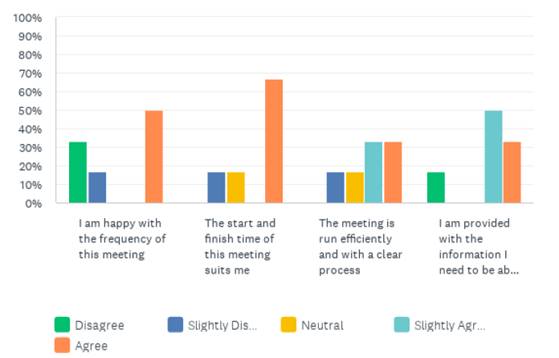
5.23. Various suggestions for improvement to the workshop format were put forward. These included:
5.23.1. The need for workshops to be more interactive
5.23.2. Allowing more time to discuss significant matters or matters soon to come before the Council
5.23.3. Workshop topics change too frequently
5.23.4. Elected Members would like more input into workshop topics
5.23.5. Reports need to better reflect the feedback provided during the workshop
5.23.6. Less frequent but longer sessions – i.e. 3pm – 7pm.
Opportunities for Improvement
5.24. There is an opportunity to make some minor changes to the workshop schedule to help support Elected Members in their preparation for upcoming council meetings by making one of the workshop sessions a ‘Council Agenda Briefing’ session.
5.25. The purpose of this session would allow Elected Members to receive a high-level briefing on significant items coming up on the Council agenda.
5.25.1. Given these briefings would be for significant matters, Elected Members would have already had an opportunity to provide input as part of the workshop process.
5.26. In terms of timing, the briefing session would take place the Monday before the Council agenda is published as part of the already scheduled Council workshop.
5.27. It is now standard practice for the organisation to provide a list of upcoming Council agenda items in the Elected Member Bulletin 10 days before the meeting, providing advanced notice of what is coming up.
5.28. It is not intended for the briefing session to go into detailed wordsmithing of officer reports, but for Elected Members to be given a high-level overview of reports deemed to be of significant importance to warrant a briefing.
5.29. In response to feedback received from Elected Members, engagement with those Elected Members attending via Zoom would be improved if it was a requirement for cameras to be turned on during workshops and briefings.
5.30. Consideration will also be given to address the feedback noted at 5.24 when planning future workshops.
Quarterly Portfolio Committee meetings
5.31. The Council resolved to establish Portfolio Committees to provide support and advice to the City on a range of strategies and policies that contribute to making Hobart a great place to live, work and play.
5.32. These 11 Committees support the delivery of the City’s strategic objectives as described in the Capital City Strategic Plan.
5.33. At the time of writing, all Portfolio Committees have met at least once with City Mobility, City Water, Climate Futures, Creative City and Healthy Hobart having met twice.
5.33.1. Work plans for Portfolio Committees will be presented to the Council over the coming months; this will help guide the activities of the individual committees.
5.34. Attendance has been incredibly high for the Portfolio Committees with many members speaking positively about the opportunity to play an important part in informing Council decision making.
5.35. In addition to the Portfolio Chairperson, other Elected Members have also shown interest by attending various meetings in an observing capacity but have indicated they would like to attend in a participatory capacity.
5.36. As part of the portfolio system, the elected Chairperson is also meeting on a monthly basis with the relevant Director/Sponsor and appointed portfolio manager. These meetings provide an additional opportunity for information sharing and discussing the strategic objectives of the City.
5.37. Feedback from Elected Members about these meetings has been positive with acknowledgement the portfolio system is in its early formative stages.
Opportunities for Improvement
5.38. Given that Portfolio Committees are in their early stages, minimal opportunities for improvement have been identified so far.
5.39. There are some administrative improvements to be made such as clarification around the process for appointing expert committee members and new appointments resulting from a resignation.
5.39.1. This will be considered as part of a review of the Portfolio Terms of Reference and will be returned with the full review of the governance model.
5.40. It is not anticipated that a good understanding of the benefits realised by the portfolio model will be known until at least the two-year mark.
5.41. It is therefore recommended that a more detailed review into the operations of Portfolio Committees not be undertaking until at least August 2024 when the first cycle of Council endorsed Committee work plans would have been completed and preparation for the second year plans are under consideration.
Governance Model Overall
5.42. Overall feedback about the new model is positive with 66.67% of Elected Members who responded, indicating they are very supportive of the new model with 16.67% (n=1) unsupportive and 16.67% (n=1) somewhat supportive.
5.43. It is understood that other Tasmanian councils are considering similar models following the lead of the City of Hobart.
6. Hobart: A Community Vision For Our Island Capital
6.1. The changes made the City’s Governance model are consistent with all statements in Pillar 8 of the Community Vision, including:
8.1 We are strong in our ethics
8.2 We build and maintain strong partnerships
8.3 We have access to decision makers
8.4 Our leadership reflects our communities
8.5 We communicate and engage
8.6 We are involved in civic life
7. Capital City Strategic Plan
7.1. The changes made the City’s Governance model are consistent with outcome statements in Pillar 8 of the Capital City Strategic Plan 2019-2029, including:
8.1 Hobart is a city of best practice, ethical governance and transparent decision-making.
8.2 Strong partnerships and regional collaboration make Hobart a thriving capital City of Hobart.
8.3 City leadership is accessible and reflects Hobart communities.
8.4 People are involved in civic life, and the City’s communication and engagement with Hobart communities are proactive and inclusive.
7.2. Financial Viability
7.2.1. Not applicable
7.3. Funding Source and Impact on Current Year Operating Result
7.3.1. Not applicable
7.4. Impact on Future Years’ Financial Result
7.4.1. Not applicable
7.5. Asset Related Implications
7.5.1. Not applicable
8. Communications Strategy
8.1. The City has been active in highlighting the activities of the Portfolio Committee meetings through its various media channels, including Facebook and LinkedIn.
9. Innovation and Continuous Improvement
9.1. A full review of the Governance Model will be undertaken in December 2023, including a review of Portfolio Committee Terms of Reference but with a more detailed review into Portfolio Committee operations held after August 2024 after the first Council-endorsed work plans have been completed and second year plans are in preparation.
10. Collaboration
10.1. In preparing this report, Elected Members were asked to provide feedback via a survey which were considered together with other comments received since the introduction of the new model.
As signatory to this report, I certify that, pursuant to Section 55(1) of the Local Government Act 1993, I hold no interest, as referred to in Section 49 of the Local Government Act 1993, in matters contained in this report.
|
Kat Panjari Acting Chief Executive Officer |
|
Date: 22 August 2023
File Reference: F23/78718
|
Item No. 19 |
Agenda (Open Portion) Council Meeting |
Page 1 |
|
|
28/8/2023 |
|
File Ref: F23/64549
Report of the Acting Chief Executive Officer of 14 August 2023.
Delegation: Council
|
Item No. 19 |
Agenda (Open Portion) Council Meeting |
Page 1 |
|
|
28/8/2023 |
|
REPORT TITLE: Save UTAS Correspondence
REPORT PROVIDED BY: Acting Chief Executive Officer
1. Report Summary
1.1. The purpose of this report is to request the Council’s consideration of a request by Save UTAS to facilitate ongoing stakeholder meetings.
2. Key Issues
2.1. In response to a decision of Council made at its 12 December 2022 meeting, the City of Hobart initiated a meeting with key stakeholders.
2.2. The meeting was held on 7 June 2023 and in attendance were representatives from the University of Tasmania, Tasmanian University Students Association, the National Tertiary Education Union, and Save UTAS Campus.
2.3. The City of Hobart was represented by the Lord Mayor, Deputy Lord Mayor and CEO. City of Hobart Elected Members were invited to attend as observers; Alderman Bloomfield and Councillors Elliot, Harvey, Sherlock and Lohberger attended as observers.
2.4. Following the meeting, Save UTAS wrote to the Lord Mayor requesting further meetings.
2.5. It is proposed that existing mechanisms be used for future engagement with Save UTAS.
|
That: 1. The Lord Mayor write to Save UTAS and advise that: (i) The Council declines its suggestion that the City facilitate ongoing stakeholder meetings. (ii) Subject to availability, the Lord Mayor’s Court Room be offered as a venue for further meetings should the other stakeholders wish to meet. 2. Save UTAS be encouraged to use existing mechanisms to continue to engage with the City. |
4. Background
4.1. At its 12 December 2022 meeting, the Council resolved inter alia as follows:
That the HCC immediately initiate a meeting with the State Government, Save UTAS, the University of Tasmania, the National Tertiary Education Union, Tasmanian University Students Association, and the HCC for the purpose of dealing with the elector poll and a mechanism to move forward expediently.
4.2. In response to the Council resolution a meeting took place on 7 June 2023.
4.3. Invitees to the meeting included the State Government, Save UTAS, the University of Tasmania, the National Tertiary Education Union, Tasmanian University Students Association, and the City of Hobart.
4.4. The City of Hobart was represented by the Lord Mayor, Deputy Lord Mayor and CEO. City of Hobart Elected Members were invited to attend as observers; Alderman Bloomfield and Councillors Elliot, Harvey, Sherlock and Lohberger attended as observers.
4.5. The agenda for the meeting provided attendees with an opportunity to receive an update about the City’s Sandy Bay / Mt Nelson Neighbourhood Plan and Central Hobart Plan. A response to the elector poll result was also included on the agenda.
4.6. Following the meeting, Save UTAS wrote to the Lord Mayor requesting further meetings.
4.6.1. At the time of the meeting, the Lord Mayor advised that she was unable to commit the City to further meetings, however, she did offer the use of the Lord Mayor’s Court Room as a meeting venue if the other meeting participants wished to meet in the future.
4.7. It should be noted that in separate correspondence to Save UTAS in relation to the Central Hobart Plan, Save UTAS has been an active participant in the current community engagement process involving the development of the Sandy Bay / Mt Nelson Neighbourhood Plan and that we welcomed their ongoing involvement in that process and important project.
4.8. In the same correspondence, the City extended an invitation to meet with Save UTAS representatives as part of the next stage implementation process around the Central Hobart Plan following the Council’s consideration of the Central Hobart Plan in the coming months.
4.9. It is proposed that existing mechanisms be used for future engagement with Save UTAS.
5. Legal, Risk and Legislative Considerations
5.1. None arise from this report.
6. Financial Viability
6.1. Funding Source and Impact on Current Year Operating Result
6.1.1. Not applicable
6.2. Impact on Future Years’ Financial Result
6.2.1. Not applicable
6.3. Asset Related Implications
6.3.1. Not applicable
As signatory to this report, I certify that, pursuant to Section 55(1) of the Local Government Act 1993, I hold no interest, as referred to in Section 49 of the Local Government Act 1993, in matters contained in this report.
|
Kat Panjari Acting Chief Executive Officer |
|
Date: 14 August 2023
File Reference: F23/64549
|
Item No. 20 |
Agenda (Open Portion) Council Meeting |
Page 1 |
|
|
28/8/2023 |
|
20. Tasmanian AFL Package - High Performance Centre
File Ref: F23/89516
Report of the Acting Chief Executive Officer of 23 August 2023.
Delegation: Council
|
Item No. 20 |
Agenda (Open Portion) Council Meeting |
Page 1 |
|
|
28/8/2023 |
|
REPORT TITLE: Tasmanian AFL Package - High Performance Centre
REPORT PROVIDED BY: Acting Chief Executive Officer
1. Report Summary
1.1. The purpose of this report is to determine whether the Council wishes to work with the Tasmanian Government and the Greater Hobart councils to explore a site that has a high potential of being suitable for an AFL TAS training and administration facility (TA Facility).
2. Key Issues
2.1. On 3 May 2023, the Tasmanian Government signed a Club Funding and Development Agreement (AFL TAS Agreement) with the Australian Football League (AFL) for the establishment of a Tasmanian-based AFL and AFLW Club.
2.2. The AFL TAS Agreement requires a training and administration facility (TA Facility) to be built by or on behalf of the Tasmanian Government.
2.3. The selection and development of the site will seek to maximise the potential optimum use of the facility by the Tasmanian AFL, AFLW, VFL, VFLW, Tasmania’s elite and community sportsperson and other community use.
2.4. It is anticipated that the process to be used for site assessment and selection of the preferred site will be confirmed in September 2023.
2.5. Tasmanian Government representatives have advised that if the City determines that it is prepared to explore a site that the project considers has a high potential of being suitable, and the site may be acceptable to the community if associated impacts are carefully considered and managed, then the project would be willing and available to work with the City.
2.6. Site selection needs to be considered in cooperation with the Greater Hobart councils according to the objectives of the Greater Hobart Act 2019, for the best result to be found.
|
That:
1. The Council endorse working with the Tasmanian Government and the Greater Hobart councils to explore sites that have a high potential of being suitable for a training and administration facility (TA Facility), in accordance with the objectives of the Greater Hobart Act 2019. |
4. Background
4.1. On 3 May 2023, the Tasmanian Government signed a Club Funding and Development Agreement (AFL TAS Agreement) with the Australian Football League (AFL) for the establishment of a Tasmanian-based AFL and AFLW Club.
4.2. The AFL TAS Agreement requires a training and administration facility (TA Facility) to be built by or on behalf of the Tasmanian Government.
4.2.1. The facility is anticipated to be accessed for community use purposes and for use by Tasmanian elite athletes.
4.2.2. The ability to further develop community partnerships and programs is an important element of the vision for the facility.
4.3. The selection and development of the site will seek to maximise the potential optimum use of the facility by the Tasmanian AFL, AFLW, VFL, VFLW, Tasmania’s elite and community sportsperson and other community use.
4.3.1. Site selection will also consider the broader social and community benefits and impacts of the use of the site.
4.4. It is anticipated that the process to be used for site assessment and selection of the preferred site will be confirmed in September 2023.
4.5. As advised in the Elected Member Bulletin on 11 August 2023, the Executive Leadership Team (ELT) received a high level briefing from Tasmanian Government representatives on their process to determine a preferred site within Greater Hobart for the TA Facility.
4.5.1. The acting CEO advised the representatives that any proposal would need to be presented to the Council for consideration.
4.5.2. At the high level briefing, the City’s ELT did not identify any preferred sites identified within the municipal area due to:
4.5.2.1. The high utilisation of the City’s existing sport and recreation fields and infrastructure from users across the greater Hobart area;
4.5.2.2. The consequential impact and displacement of existing users, codes and clubs; and
4.5.2.3. The untested social licence for this facility to be located within the City of Hobart.
4.6. Following the briefing, Elected Members were provided with a copy of the commercial-in-confidence presentation (on 15 August 2023).
4.7. Since the briefing, I have received further information from Tasmanian Government representatives who have advised that if the City determines that it is prepared to explore a site that the project considers has a high potential of being suitable, and the site may be acceptable to the community if associated impacts are carefully considered and managed, then the project would be willing and available to work with the City in this regard.
4.8. In addition, Tasmanian Government representatives have advised that if the City requires the assistance of an external consultant to develop a concept plan for the site and/or concept plan for mitigation of an impact (ie relocation of an existing use), then the project may be prepared to fund associated consultancy costs, reasonably incurred by the City.
4.9. The project may be prepared to procure a suitable consultant to perform the services with direction from both the project and officers from the City of Hobart.
4.9.1. In both cases, the scope and cost of such services would need to be discussed and agreed in advance of the services being procured and delivered.
4.10. It should be noted that the Greater Hobart Strategic Partnership (the Mayors of Clarence, Glenorchy, Kingborough and Hobart) has written to the Minister for Stadia and Events, the Hon. Nic Street MP, requesting that the Tasmanian Government liaise with the Greater Hobart Strategic Partnership on the matter of the TA Facility as, in their view, the site selection needs to be considered from a Greater Hobart perspective for the best result to be found. A link to this letter was included in the Elected Member bulletin on 18 August 2023 and is available on the HUB.
4.11. It is also noted that the Lord Mayor has written to the Minister for Stadia and Events, the Hon. Nic Street MP, requesting he outline the proposed process in writing as a matter of priority.
5. Capital City Strategic Plan
5.1. This proposal is consistent with Pillar 1: Sense of Place and Pillar 2: Community Inclusion, Participation and Belonging.
6. Regional, State and National Plans and Policies
6.1. The Greater Hobart Act 2019 was introduced to assist the Greater Hobart area Councils (Clarence, Glenorchy, Kingborough and Hobart) and the State Government to better co-ordinate, across the Greater Hobart area –
(a) the efficient use of infrastructure; and
(b) ease of access to infrastructure, in all locations, for persons of all abilities and needs; and
(c) strategic planning, and other actions, in relation to future land use and development in the Greater Hobart area –
so as to improve the health and wellbeing of persons, and enable the Greater Hobart Objectives to be achieved, in the Greater Hobart area.
6.2. As previously advised, the Greater Hobart Strategic Partnership has written to the Minister seeking a briefing on the TA Facility given its potential impact on greater Hobart.
7. Financial Viability
7.1. Funding Source and Impact on Current Year Operating Result
7.1.1. The project has advised that if the Council requires the assistance of an external consultant to develop a concept plan for the site and/or concept plan for mitigation of an impact (ie relocation of an existing use), then the project may be prepared to fund associated consultancy costs, reasonably incurred by the Council.
7.1.2. It is noted that the City does not have the resources to undertake a concept plan and therefore it will need to be developed by an external consultant.
As signatory to this report, I certify that, pursuant to Section 55(1) of the Local Government Act 1993, I hold no interest, as referred to in Section 49 of the Local Government Act 1993, in matters contained in this report.
|
Kat Panjari Acting Chief Executive Officer |
|
Date: 23 August 2023
File Reference: F23/89516
|
Item No. 21 |
Agenda (Open Portion) Council Meeting |
Page 1 |
|
|
28/8/2023 |
|
21. Code of Conduct
Determination Report
Ms Anna Sharman v Councillor Ben Lohberger
File Ref: F23/90005
Report of the Acting Chief Executive Officer of 23 August 2023 and attachments.
Delegation: Council
|
Item No. 21 |
Agenda (Open Portion) Council Meeting |
Page 1 |
|
|
28/8/2023 |
|

Memorandum: Council
Code of Conduct Determination Report
Ms Anna Sharman v Councillor Ben Lohberger
Pursuant to section 28ZK(2) of the Local Government Act 1993 I have been provided with a copy of a determination report from the Code of Conduct Panel in respect to a complaint lodged by Ms Anna Sharman against Councillor Ben Lohberger.
The Act requires that I table this at the first meeting of the Council which is practicable to do so and which is open to the public. As such, a copy of the determination report is included as Attachment A to this report.
|
That the Council receive and note the Code of Conduct Determination Report in respect to a complaint lodged by Ms Anna Sharman against Councillor Ben Lohberger, shown as Attachment A to this report.
|
As signatory to this report, I certify that, pursuant to Section 55(1) of the Local Government Act 1993, I hold no interest, as referred to in Section 49 of the Local Government Act 1993, in matters contained in this report.
|
Kat Panjari Acting Chief Executive Officer |
|
Date: 23 August 2023
File Reference: F23/90005
Attachment a: Determination Report_Code of Conduct complaint - Ms Sharman v Cr Lohberger
|
Item No. 21 |
Agenda (Open Portion) Council Meeting - 28/8/2023 |
Page 1 ATTACHMENT a |
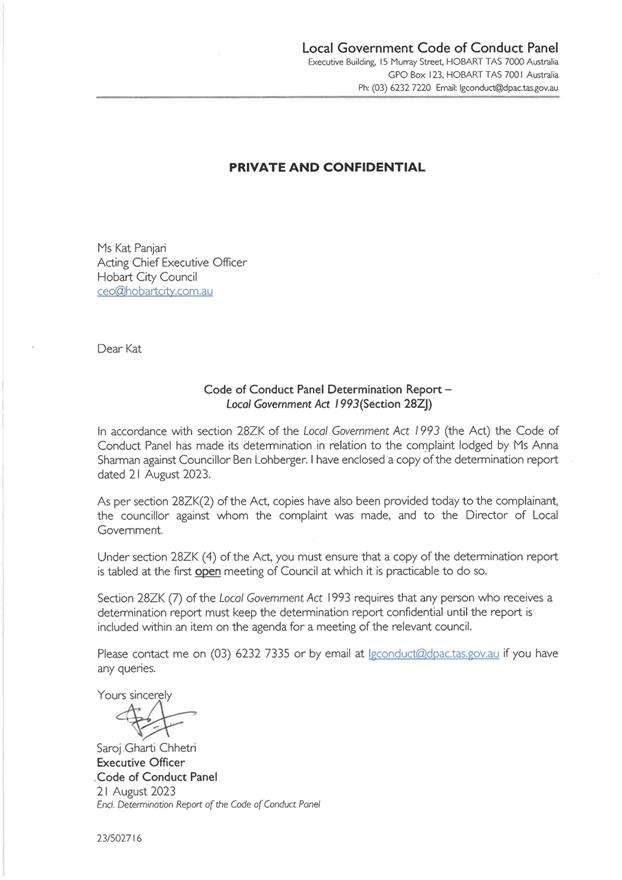
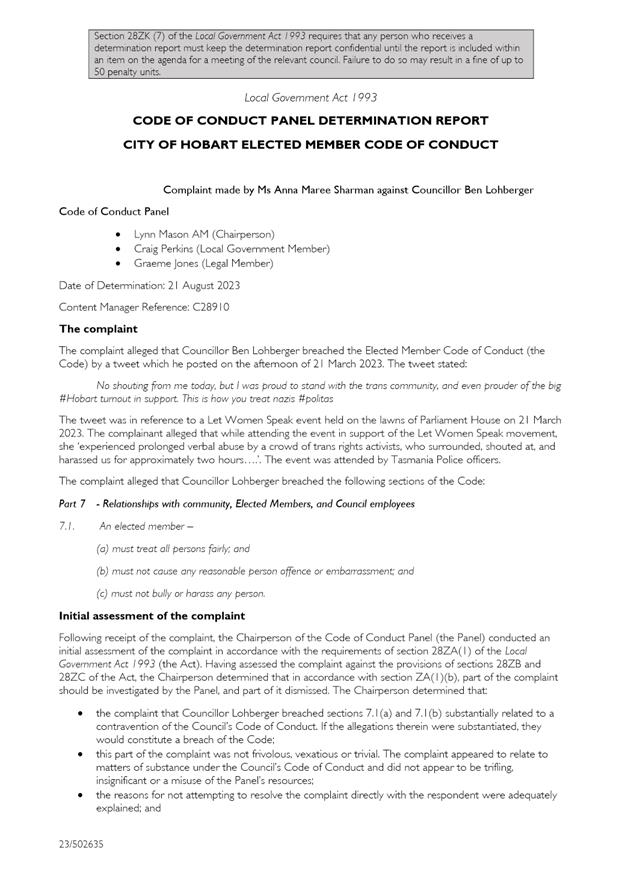
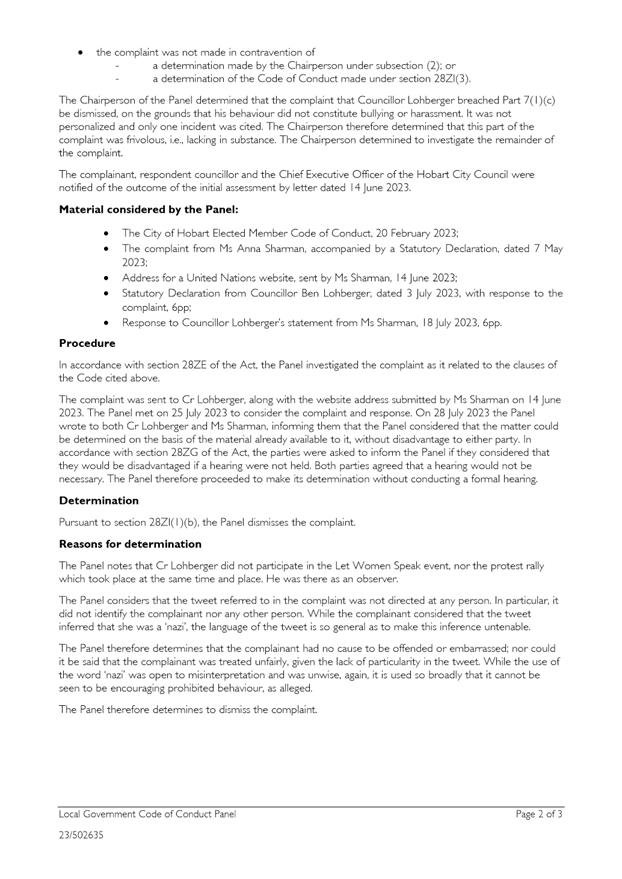
|
Item No. 22 |
Agenda (Open Portion) Council Meeting |
Page 1 |
|
|
28/8/2023 |
|
IN ACCORDANCE WITH REGULATION 16(5) OF THE LOCAL GOVERNMENT (MEETING PROCEDURES) REGULATIONS 2015
22. Climate Change Leadership: Transport Emissions
File Ref: F23/90014
Councillor Lohberger
|
“That:
1. Council notes and welcomes the work being done by staff to update the Council’s Climate Change strategy, and looks forward to increasing the pace of decarbonisation across the organisation.
2. Council acknowledges that given recent alarming news about accelerating climate impacts, it is even more important for community leaders to demonstrate leadership on reducing emissions.
3. Council agrees that: a. The fuel allowance provided for elected members be reduced from 1500 litres per year to 500 litres per year. b. Elected member parking permits be limited to Town Hall parking deck only with all other free parking being discontinued and replaced with a reimbursement process when using the EasyPark app as the tool to pay for parking costs incurred while conducting Council business, with an expenditure limit of $500 per year. c. The Hobart City Council limits interstate and overseas air travel for elected members and staff to events where there is a compelling need to fly instead of engaging online or through other methods. This decision is to be determined by the Chief Executive Officer or their delegate.
4. The Lord Mayor writes to all Hobart’s Sister and Friendship Cities: a. Explaining the Council decision to declare a climate emergency in 2019, and the growing need to show leadership on reducing carbon emissions as climate change accelerates. b. Informing them that international delegations from the City of Hobart will now be limited by the need to reduce transport emissions, and if these delegations do occur in future the number of delegates involved will be minimal. c. Seeking input from Sister Cities on alternative measures to improve cultural ties between our cities without the need for air travel.”
Rationale:
“Climate change is accelerating significantly faster than predictions and it’s been confirmed that Australia and Tasmania are also facing several years of the El Nino event, turbo-charged by accelerating climate change.
The need to take climate action is pressing, and it is incumbent on community leaders to set an example for the community by taking steps to voluntarily reduce and limit their own carbon emissions.
Hobart City Council declared a Climate Emergency in 2019, but the organisation continues to offer a range of benefits to elected members and staff that can encourage and/or reward fossil fuel use. While the Local Government Act mandates an allowance to assist with travel costs, the current arrangements appear excessive, and are inappropriate in the face of runaway climate change. This motion seeks to update Council policy to remove, reduce, or limit those benefits.
In addition, the Council has a challenging budgetary situation, and these are tough economic times for many in the community. Those are also reasons for elected members to show leadership by reducing some of our benefits in accordance with this motion.
Current situation The fuel allowance for elected members is 1500 litres of fuel per year. Not all elected members claim the allowance but it is available.
A permanent undercover parking space is provided at Town Hall in the CBD for elected members conducting Council business, as well as a parking permit for one personal vehicle allowing free parking whilst on Council business. Payment is also available to cover interstate air travel for approved Council-related purposes, and for overseas air travel for Sister and Friendship City delegations.
Fuel Allowance for elected members The current fuel allowance of 1500 litres/year is clearly excessive: 1. According to a 2020 report from the Australian Bureau of Statistics, the average kilometres travelled by a Tasmanian vehicle were 10,900km/year, and the average fuel efficiency was 11.1 km/litre. The current HCC fuel allowance of 1500 litres/year equates to driving 16,650km/year (at 11.1 km/litre), which is around 50% above the average for all Tasmanians. https://www.abs.gov.au/statistics/industry/tourism-and-transport/survey-motor-vehicle-use-australia/latest-release
2. The role of elected members is part-time, most have other jobs and responsibilities outside of their Council duties. It is inequitable that elected members can claim fuel usage at a rate that is 50% higher than the average Tasmanian’s fuel usage, while working in a part-time role. 3. The municipal area covered by the City of Hobart is small compared to most other Tasmanian Council areas. Again, it is inequitable that the current fuel allowance is well above the average fuel usage of all Tasmanians while the size of the municipality is small. The Local Government Act mandates the payment of a travel allowance, so some sort of allowance is required. This motion seeks to reduce the fuel allowance offered to elected members from 1500 litres/pa to 500 litres/pa, but it will not reduce their ability to claim for other local travel costs if necessary, including taxi and bus fares. Parking permits Elected members are provided with a parking permit that provides free parking in Council controlled areas whilst undertaking Council business.
Display of the permit provides free parking in the form of an undercover car parking space in the CBD at the Town Hall. The parking permit also provides for free parking within Council controlled carparks and on-street metered parking within the maximum parking time allowed. This motion calls for the parking permit to be limited to the Town Hall parking deck only with all other free parking being removed. Elected members can instead use the EasyPark app to pay for parking and to seek reimbursement for parking costs up to a limit of $500 per year.
It is hoped that removing free parking and introducing an expenditure cap will encourage elected members to use other forms of transport such as active or micro mobility travel over a private vehicle, leading by example in the City’s efforts to reduce emissions. While not related to climate change, there is also an equity issue involved in making a policy change that requires elected members to use Hobart’s parking meters and EasyPark app. There have been regular complaints about the parking meters in Hobart for many years and it is only fair that elected members start using these meters and the EasyPark app, just like all other ratepayers and visitors to the City.
Air Travel Climate change is accelerating fast. We must start reducing unnecessary carbon emissions as soon as possible and community leaders should be first cab off the rank on this important issue. Flying interstate or overseas is a huge source of emissions, but there are often other options available that involve minimal emissions compared to flying, such as using local training providers or engaging online. While those options are generally never preferred, because we all enjoy travelling, there is a pressing need to prioritise low-emissions options wherever possible. This motion seeks to limit air travel to situations where there is a compelling reason only for flying instead of using alternative options, and to task the CEO with making the ultimate decision on what is or is not compelling.
Sister and Friendship Cities Sister and Friendship City relationships should be maintained, but overseas delegations need to be limited if not abandoned altogether. It is not necessary to send large delegations overseas in order to boost cultural links. There are a range of other options available, especially through online engagement between schools, sporting clubs, and other cultural organisations. These options should be preferred over flights for dignitaries.
The motion seeks to limit overseas delegations, and to send a letter to our Sister Cities explaining the changed circumstances, and seeking suggestions about improving cultural ties between our cities in ways that do not involve the large carbon emissions caused by air travel.
Council’s Climate Change Strategy Council staff are currently working on an updated Climate Change Strategy for the City of Hobart, which will continue the work of reducing the organisation’s carbon emissions. This new strategy will come before elected members later this year, and will be critical to continuing the work started many years ago on decarbonising Council operations.”
|
||||||||||||||||||||
23. Talent Acquisition Policy Update
File Ref: F23/89909
Councillor Louise Elliot
|
“That”
1. The Council notes the Ensuring Recruitment in Tasmanian Councils is Merit-Based Report published by the Integrity Commission and its relevance to the governance of the Hobart City Council.
2. The Council require the Talent Acquisition Policy and Procedure to be updated and returned to Council at its September 2023 meeting for approval, with updates to include:
a. strengthening the parameters around when direct appointments are permitted and associated requirements b. review of conflict of interest identification and management strategies to ensure they are fit for purpose c. any other updates as required, particularly in light of the
Integrity Commission’s report. 3. The Council require that the updated Talent Acquisition Policy and Procedure and all other human resources and work health and safety related policies be published in the Council’s public website as soon as practicable after approval, unless there is a reasonable reason for a specific policy to be publicly available.
Rationale:
“This motion looks to strengthen the Council’s policy and procedures related to recruitment, with a particular focus on direct appointments.
The Council has recently been made aware of a unprecedently large number of direct appointments having been made in the organisation over the past two years, as shown below.
The former CEO stated that these appointments were part of a “talent acquisition strategy” and advised Councillor Elliot in writing that the “City of Hobart, as and if required, will make direct appointments to secure the best talent available in a highly competitive labour market, in accordance with the Talent Acquisition Policy and Procedure.”
The former CEO also stated that “unlike the State Service, there is no mandate for merit-based recruitment in local government.” Given the requirement for merit-based recruitment is not captured in the Local Government Act and the Act is silent on direct appointments, it is even more important that Council’s policies and procedures support that open and competitive recruitment is always the default and preferred method of recruitment for the City of Hobart.
The Council’s current policy on direct appointments essentially provides no limit as to when direct appointments can be made given as it be easily argued that the labour market is always highly competitive. Without stronger parameters in place, it could be consistently argued that a direct appointment was required because the market was competitive and ‘we had to secure them’.
Securing the best talent and promoting merit, transparency and fairness is best achieved through open, competitive, and merit-based processes. Conversely, the overuse and/or improper use of direct appointments and ineffectively managed conflicts of interest, nepotism and favouritism all have a highly determinantal impact on workplace culture and morale.
The Integrity Commission recognises the importance of open and merit-based recruitment and highlights recruitment related misconduct risks, including those related to long-term appointments being made through direct appointment processes to evade competitive merit-based recruitment. The Integrity Commission also notes the risks associated with ineffectively managed conflicts of interest, nepotism, and favouritism.
The Integrity
Commission report is available at https://www.integrity.tas.gov.au/__data/assets/pdf_file/0018/700236/report-1-2023.pdf The Council has a duty to the community and its workforce to ensure that the organisation is appointing the best people to roles and that processes are fair. The City of Hobart is a public organisation and it is appropriate that the organisation provides the community with fair and reasonable opportunity to gain employment with the organisation that serves.”
|
|||||||||||||||||||||||||
24. Public Interests Register Policy Update
File Ref: F23/89926
Councillor Louise Elliot
|
“That the Council require the Public Interests Register Policy to be updated and returned to Council for approval, with the updates to include:
1. a requirement that only suburb details for property are published, not full street addresses
2. detail
around what purposes the information Elected Members provide can be used by
the Council for 3. where
and how the information Elected Members provide is held, how the security of
the information managed, and which roles have access to this information 4. who
has delegation to approve what information is published on the
Council’s website 5. detail
around what ‘other forms’ the information can be provided to the
public in and how this differs to what is available online and who approves
these requests 6. what
the process for elected members having their information altered or removed 7. what happens to information when a person who provided their information is no longer an elected member.
Rationale: “The Council recently commenced implementation of its Public Interests Register Policy. As part of the launch of this policy, the full street addresses that Elected Members had provided were published on the Council’s website. A link to this webpage was also broadcast widely in The Mercury and across X (Twitter), which were likely viewed by many thousands of people. Multiple Elected Members were at the understanding that it would only be suburb details that were made available to the public and expressed concerns around safety and privacy, especially given elected members can be subject to vandalism of their property. When concerns around the publication of the full street addresses was first raised with the organisation, Elected Members were advised that the policy is consistent with what was passed by the Council, and therefore that the publication of the full street addresses was viewed as being the correct course of action and consistent with the policy. Several hours later, the street detail information was edited, and an apology made to Elected Members.
This situation highlights the importance of comprehensive and accurate policies and, in this case, the specific need for the Public Interests Register Policy to be updated.”
|
||||||||||||||||||||
|
Item No. 25 |
Agenda (Open Portion) Council Meeting - 28/8/2023 |
Page 1 ATTACHMENT a |
25. RESPONSES TO QUESTIONS WITHOUT NOTICE
File Ref: F23/87271
Regulation 29 of the Local Government (Meeting Procedures) Regulations 2015.
File Ref: 13-1-10
The Council is reminded that in accordance with Regulation 29(3) of the Local Government (Meeting Procedures) Regulations 2015, the Chairperson is not to allow discussion or debate on either the question or the response.
25.1 Governance Model Review
Memorandum of the Chief Executive Officer 17 July 2023.
25.2 Agenda Distribution Timeframes
Memorandum of the Chief Executive Officer 19 July 2023.
25.3 Parking Infringement Cancellations
Memorandum of the Chief Executive Officer 17 July 2023.
25.4 Transparency of Consultants’ Actions
Memorandum of the Chief Executive Officer 17 July 2023.
25.5 Affordable Housing
Memorandum of the Chief Executive Officer 19 June 2023.
That the information be received and noted
|
Item No. 26 |
Agenda (Open Portion) Council Meeting |
Page 1 |
|
|
28/8/2023 |
|
File Ref: F23/82787
Regulation 29 of the Local Government (Meeting Procedures) Regulations 2015.
File Ref: 13-1-10
1. A councillor at a meeting may ask a question without notice –
(a) of the chairperson; or
(b) through the chairperson, of –
(i) another councillor; or
(ii) the chief executive officer.
2. In putting a question without notice at a meeting, a councillor must not –
(a) offer an argument or opinion; or
(b) draw any inferences or make any imputations – except so far as maybe necessary to explain the question.
3. The chairperson of a meeting must not permit any debate of a question without notice or its answer.
4. The chairperson, councillor or chief executive officer who is asked a question without notice at a meeting may decline to answer the question.
5. The chairperson of a meeting may refuse to accept a question without notice if it does not relate to the activities of the council.
6. Questions without notice, and any answers to those questions, are not required to be recorded in the minutes of the meeting.
7. The chairperson of a meeting may require a councillor to put a question without notice in writing.
|
Agenda (Open Portion) Council Meeting |
Page 1 |
|
|
|
28/8/2023 |
|
|
That the Council resolve by absolute majority that the meeting be closed to the public pursuant to regulation 15(1) of the Local Government (Meeting Procedures) Regulations 2015 because the items included on the closed agenda contain the following matters:
· Minutes of a closed Council meeting · Information of a personal and confidential nature · Personal hardship · Information relating to commercial arrangements · Proposals for the Council in interest of land
The following items are listed for discussion:-
Item No. 1 Minutes of the last meeting of the Closed Portion of the Council Meeting Item No. 2 Communication from the Chairman Item No. 3 Leave of Absence Item No. 4 Consideration of supplementary Items to the agenda Item No. 5 Indications of pecuniary and conflicts of interest Item No. 6 Outstanding Rates and Rates Remissions Granted as at 30 June 2023 LG(MP)R 15(2)(g) and (j) Item No. 7 2023-24 Rates - Variation Objections and Rate Remission Requests LG(MP)R 15(2)(g) and (j) Item No. 8 Response to Notice of Motion - Social Housing on Council Land LG(MP)R 15(2)(g) Item No. 9 Salamanca Market - Revenue Opportunities LG(MP)R 15(2)(b) Item No. 10 Risk and Audit Panel Minutes - 8 March 2023 and 10 May 2023 LG(MP)R 15(2)(g) Item No. 11 Responses to Questions without notice LG(MP)R 15(2)(d) Item No. 12 Questions without notice LG(MP)R 15(2)(b)
|